Empathy is most often defined by
the metaphors of 'standing in someone else's shoes' or 'seeing through
someone else's eyes'. After combining and synthesizing the different
ways the word is used, here are the four basic aspects of empathy that I
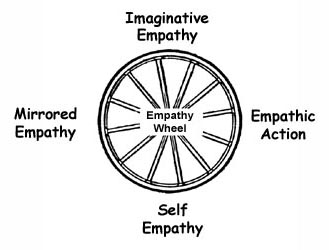
have come up with. One way to think of it is as the 'Wheel of Empathy'
and the "Feel of Empathy". There are 4 major spokes to the wheel
but we can keep adding more and more to become more and more 'granular'
in describing the process. The wheel is more the model of empathy and
how it works, while the feel of empathy is looking at if from the
personal felt experience of it.
1. Self-Empathy
Sensory awareness of our own internal feelings and
internal state.
Turning
your attention inwards into your inner visceral feelings.
Getting connected with yourself.
Becoming
self aware of what is happening inside ourselves without judgments.
Listening to your inner feelings and experiences.
Facilitating inner dialog between different feelings.
Labeling
your inner experiences, feelings and needs.
Translating inner judgments into feelings and needs.
When we are heard by someone else, it actually helps us feel into our
own self more deeply. This is the essence of much of therapy. Having
good friends listen to us has the same effect
Anything
that reduces stress and raises the level of Oxytocin in our bodies
helps.
Meditation, mindfulness practices,
focusing,
yoga,
aikido and the arts, for example, are
a few of the many ways to
foster self-empathy.
2. Mirrored Empathy
Emotional
empathy of others via mirror neurons - reflecting others in ourselves
and ourselves being reflected by others.
With mirror neuron, the same neurons in our brain fire when we do an
action and see the same action happening in someone else.
This is also called emotional or affective empathy.
Emotional contagion is when we catch the emotions of others. The
“process in which a person or group influences the behavior of another
person or group through the conscious or unconscious induction of
emotional states and behavioral attitudes” (Schoenewolf 49-61).
Empathic
(active) listening and physical mirroring exercises can help foster
this.
3.
Imaginative Empathy
Perspective and role taking of others.
This is based on the sense of self-awareness, when we recognize
ourselves as separate beings.
We can imagine
being someone else or imagine being another person, animal, object,
etc. and take on the role of that.
I'm starting to like the term Empathic Creativity and Empathic Arising
for this.
Once connection is created, taking creative action together.
There's a quality to the action which is very connected and has a deep
resonance.
It's responding in an appropriate way to the other by holding their
needs, values, feelings, (common humanity) etc. in mind in the action
process.
Empathy is when the blocks to action are removed, that do not exclude.
Until an adequate level of self, mirrored and imaginative empathy are
in place, empathic action may be blocked.
Also looking for creative ways to resolve conflict.
Our minds are like a puzzle solving machine, through Self-Empathy,
Mirrored Empathy and Imaginative Empathy we see ourselves reflected in
others and they in us. Our minds automatically try to solve the puzzle
of organizing our shared experience, which is Empathic Creativity.
5. The Feel of Empathy
The wheel of empathy represents a model of empathy. Another way of
defining it is what does it feel like to you as a sensed body feeling? Warm, relaxed,
open?
Metaphors of Empathy:
Also what is empathy like as a metaphor? Metaphors can carry an
emotional or sensory quality of the experience. For me, empathy
is like a cornucopia (horn
of plenty), I can feel a wide variety of rich feelings,
sensations, nourishment and experiences that come from other people
through empathy. My life feels enriched. My life would be like a
barren desert (lonely, monotone, sterile, monotonous, etc.) without
empathy.
How does compassion relate to empathy?
Just like with empathy, there are many definitions of compassion and it
can get confusing. There
seems to be 2 major ways it's defined.
One, it is a sub category of the empathic experience. It is
empathy applied to suffering. A feeling into the suffering of someone, often
with a sense of deep presence and consoling. Also with a desire to alleviate
the suffering. This is the definition I use.
Two, it is seen as form of sympathy. First we
empathize with someone, feel their suffering, but then a secondary feelings
comes up where we feel sorry for them. This is more of a patronizing
looking down on the person approach.
We can
empathize with all the different motions, sensations and feelings that someone may have; joy,
sadness, caring, fear, loneliness, creativity, connection, grief,
excitement, boredom, pain, suffering, etc. etc. Compassion is the
name applied to what happens when we empathize with pain and suffering. This
can also be called empathic concern by some.
It follows the same process as empathy. So compassion is a subset of the
empathic process and there is the wheel and feel of compassion.
1. Self-Compassion Feeling compassion for your own pain and suffering. (self
consoling)
2. Mirrored Compassion Via mirror neurons, feeling someone's suffering. When we see
someone in pain our own pain neurons fire.
3. Imaginative or Cognitive Compassion This is based on the sense of self-awareness, when we recognize
ourselves as separate beings. We can imagine the suffering
someone is going through from their perspective.
4. Compassionate Action
The desire and action to alleviate the
suffering, often with consoling. Some call it empathic concern.
5. Feel of Compassion. Feeling: What does compassion feel like as a sensation in your
body. Warm, comforting, safe, etc? Metaphor: What is your metaphor of compassion? I have
heard it described as being like putting out a fire. The fire in your
house or wanting to put out the fire in someone else's house. (See Thubten
Chodron)
EARLY DEFINITIONS: The state of empathy, or being empathic, is to perceive
the internal frame of reference of another with accuracy and with the emotional
components and meanings which pertain thereto as if one were the person, but
without ever losing the "as if" condition. Thus it means to sense the hurt or
the pleasure of another as he senses it and to perceive the causes thereof as he
perceives them, but without ever losing the recognition that it is as if I were
hurt or pleased and so forth. If this "as if" quality is lost, then the state is
one of identification. (pp. 210—211. See also Rogers, 1957.)
A CURRENT DEFINITION: With this conceptual background, let me attempt a
description of empathy that would seem satisfactory to me today. I would no
longer be terming it a "state of empathy," because I believe it to be a process,
rather than a state. Perhaps I can capture that quality.
An empathic way of being with another person has several facets. It means
entering the private perceptual world of the other and becoming thoroughly at
home in it. It involves being sensitive, moment by moment, to the changing felt
meanings which flow in this other person, to the fear or rage or tenderness or
confusion or whatever that he or she is experiencing. It means temporarily
living in the other's life, moving about in it delicately without making
judgements; it means sensing meanings of which he or she is scarcely aware, but
not trying to uncover totally unconscious feelings, since this would he too
threatening. It includes communicating your sensings of the person's world as
you look with fresh and unfrightened eyes at elements of which he or she is
fearful. It means frequently checking with the person as to the accuracy of your
sensings, and being guided by the responses you receive. You are a confident
companion to the person in his or her inner world. By pointing to the possible
meanings in the flow of another person's experiencing, you help the other to
focus on this useful type of referent, to experience the meanings more fully,
and to move forward in the experiencing.
To be with another in this way means that for the time being, you lay aside your
own views and values in order to enter another's world without prejudice. In
some sense it means that you lay aside your self; this can only be done by
persons who are secure enough in themselves that they know they will not get
lost in what may turn out to be the strange or bizarre world of the other, and
that they can comfortably return to their own world when they wish.
Perhaps this description makes clear that being empathic is a complex,
demanding, and strong - yet also a subtle and gentle - way of being.
Carl
Rogers
To perceive the internal frame of reference of another with accuracy
and with the emotional components and meanings which pertain thereto as if one
were the person, but without ever losing the "as if" condition. Thus, it means
to sense the hurt or the pleasure of another as he senses it and to perceive
the causes thereof as he perceives them, but without ever losing the
recognition that it is as if I were hurt or pleased and so forth.
The first quality is empathy. Many people believe that this is the single
quality which is most important in all forms of therapeutic listening. It means
getting inside the world of the person who comes for therapy (usually called the
client, though some people not in this group prefer other words such as patient
or consulter) so that that person feels accepted and understood. Two things are
important about this:
(1) that the empathy be accurate, and
(2) that the empathy be made known to the client.
Both of these are learnable skills, and they do make a huge difference to the
relationship between client and counselor or therapist.
The second quality is genuineness. If empathy is about listening to the
client, genuineness is about listening to myself - really tuning in to myself
and being aware of all that is going on inside myself. It means being open to my
own experience, not shutting off any of it. And again it means letting this out
in such a way that the client can get the benefit of it. Genuineness is harder
than empathy because it implies a lot of self-knowledge, which can really only
be obtained by going through one's own therapy in quite a full and deep way. It
is only a fully-functioning person (Rogers' word for the person who has
completed at least the major part of their therapy) who can be totally genuine.
The third quality is non-possessive warmth. It means that the client can
feel received in a human way, which is not threatening. In such an atmosphere
trust can develop, and the person can feel able to open up to their own
experiences and their own feelings.
1. Knowing another persons internal state,
Including thoughts and feelings
2. Adopting the posture or matching the neural
responses of an observed other
3. Coming to feel as another person feels
4. Intuiting or projecting oneself into
another's situation
5. Imagining how another is thinking and
feeling
6. Imagining how one would think and
feel in the other's place
7. Feeling distress at witnessing
another person's suffering
8. Feeling for another person who is
suffering (empathic concern) An other-oriented emotional response
elicited by and congruent with the perceived welfare of someone in need.
Includes feeling sympathy, compassion, tenderness and the like (i.e.
feeling for the other, and not feeling as the other)"
Dan
Batson is Professor Emeritus at the University of Kansas. His main research
interests are in prosocial emotion, motivation, and behavior. He has
conducted a number of experiments on empathy, on perspective taking, and on
various forms of prosocial motivation.
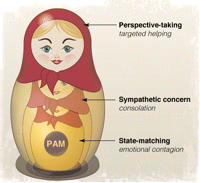
This
definition by Frans De Waal uses the metaphor of the Russian Doll.
Empathy is a layered process that parallels the evolutionary
layers of the brain. The
most basic functions of the brain are found in many animals, then there
are ever more higher layers that integrate with each other. The top
layers are animals that have self-awareness like humans, dolphins,
elephants, chimpanzees, etc.
a) be affected
by and share the emotional state of another,
b) assess the reasons for the
other's state, and
c) identify with the other, adopting his or her perspective.
This definition extends beyond what exists in many animals, but I employ the
term "empathy" even if only the first criterion is met as I believe all of these
elements are evolutionarily connected...."more.
"The Russian doll
model of multilayered empathy. The doll's inner core consists of
the perception-action mechanism (PAM) that underlies
state-matching and emotional contagion.
Built around this hard-wired socioaffective
basis, the doll's outer layers include sympathetic concern and
targeted helping. The complexity of empathy grows with increasing
perspective-taking capacities, which depend on prefrontal neural
functioning, yet remain fundamentally connected to the PAM.
A few large-brained species show all of
the doll's layers, but most show only the inner ones."
The empathy literature is characterized by debate regarding the nature of the
phenomenon. We propose a unified theory of empathy, divided into ultimate and
proximate levels, grounded in the emotional link between individuals. On an
ultimate level, emotional linkage supports group alarm, vicariousness of
emotions, mother-infant responsiveness, and the modeling of competitors and
predators; these exist across species and greatly effect reproductive success.
Proximately, emotional linkage arises from a direct mapping of another's
behavioral state onto a subject's behavioral representations, which activate
responses in the subject. This ultimate and proximate account parsimoniously
explains different phylogenetic and ontogenetic levels of empathy."
Term
Definition
Self-other distinction?
State matching?
Implications for helping?
Synonyms
Emotional contagion
Similar emotion is aroused in the subject as a direct
result of perceiving the emotion of the object.
Lacking
Yes
None
Personal distress,
Vicarious emotion, emotional transfer
Sympathy
Subject feels "sorry for" the object as a result of
perceiving the distress of the object.
Intact
No
Depends on the costs and benefits of the situation.
Empathy
Subject has a similar emotional state to an object as a
result of the accurate perception of the object's situation or
predicament.
Intact
Yes
Increasing with familiarity/similarity of object and
salience of display.
Cognitive empathy
Subject has represented the state of the object as a
result of the accurate perception of the object's situation or
predicament, without necessary state matching beyond the level of
representation.
Intact
Partial, because it can be arrived at in a "top-down"
fashion, involving emotional circuits to a lesser extent.
Likely, because it is more likely to be invoked for
familiar/similar objects.
True empathy,
Perspective-taking
Prosocial behaviors
Actions taken to reduce the distress of an object.
Depends
Not necessarily
Inherent
Helping, succorance
TABLE 1:Usage of
terminology by most current researchers divided into main variables of
classification.
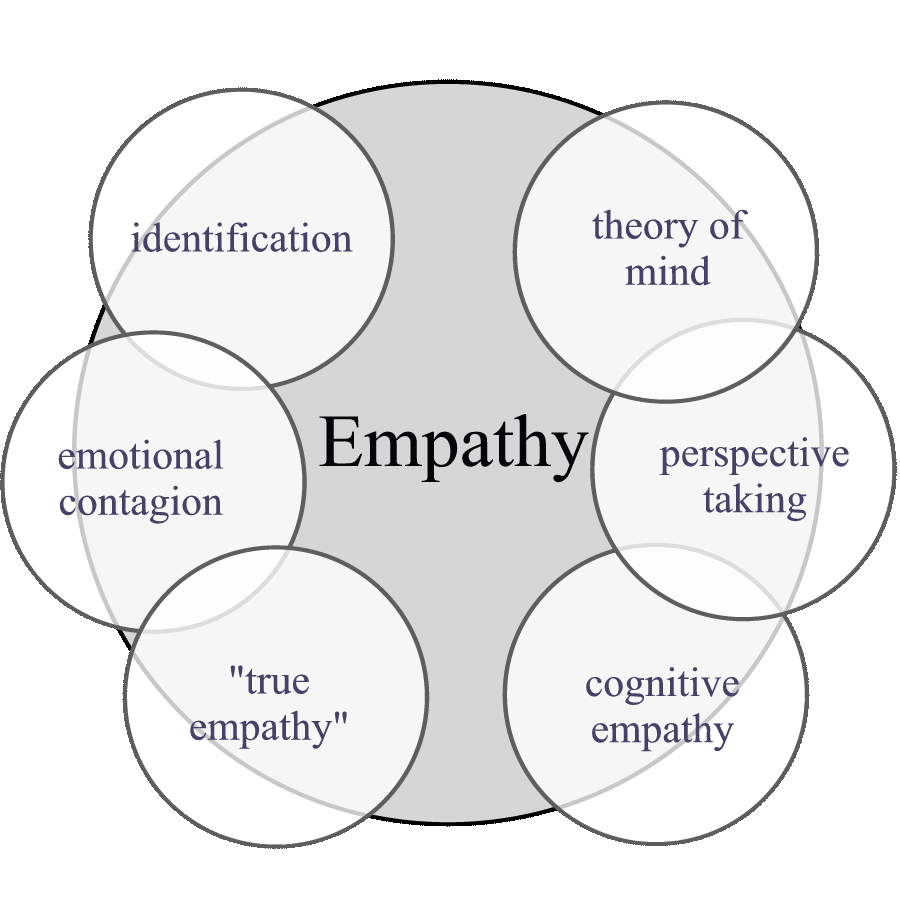
Figure 1:In
order to unify the various perspectives, empathy needs to be construed broadly
to include all processes that rely on the emotional linkage between
individuals.
Compassion & Empathy
at
Greater Good Science Center Wiki "Strict dictionary definitions have a hard time separating the
feelings of empathy, sympathy, compassion, and pity. Often these words are used
to define each other. However research on the concepts has begun to pull them
apart.
Empathy is considered a mirroring or vicarious
experience of another's emotions, whether they be sorrow or joy.
Sympathy on the other hand, is a feeling of sorrow
associated specifically with the suffering or need of another. These
are examples of fellow-feeling, and they require a certain degree of
equality in situation or circumstances. (more
on sympathy)
Pity which regards
its object not only as suffering, but weak, and hence as inferior.
Compassion is much like sympathy in that it
stems from the suffering of another, but it also includes the need or
desire to alleviate suffering" (Eisenberg,
2002).
Paul Ekman
Daniel Golman credits Paul Ekman for his model of empathy which is three parts;
cognitive empathy, emotional empathy and empathic concern. You can see my
interview with Paul where we discussed his
definitions.
"Since I got to know the Dali Lama 11 years
ago I became interested in compassion
it differs from emotions
this got me interested in empathy
which is a bit of a minefield
I don't consider myself an expert on empathy
I never studied empathy per se.
I have to think about it to write about
compassion
There are two kinds of empathy
Cognitive
I appreciate how others are feeling,
but I don't feel it.
Affective
can and do feel in my body what others are
feeling
empathy is broader than compassion -
compassion is with suffering
if I feel your joy, you're not suffering but
that's an empathetic response
if I feel your anger, and I join you in your
anger, is it empathetic
Compassion is a subset of both the Cognitive
and Affective parts of empathy
focused on trying to deal with the suffering
of another person
Compassion is a much more narrower slice
from the world of empathy
"
1. cognitive empathy. “This is about being able to
understand how the other person thinks. Leaders who are good at this
are able to express things in a way that impacts people, that reaches
people effectively.
2. emotional empathy
3. empathic concern
June 12, 2007 - Three Kinds of Empathy: Cognitive, Emotional,
Compassionate
"Being
cool in crisis seems essential for our being able to think clearly.
But what if keeping cool makes you too cold to care? In other words,
must we sacrifice empathy to stay calm? That’s the dilemma facing
those who are preparing top teams to handle the next Katrina-like
catastrophe we might face. Which gets me toPaul
Ekman,
a world expert on emotions and our ability to read and respond to them
in others. Paul and I had along
conversation recently,
in which he described three very different ways to sense another
person’s feelings."
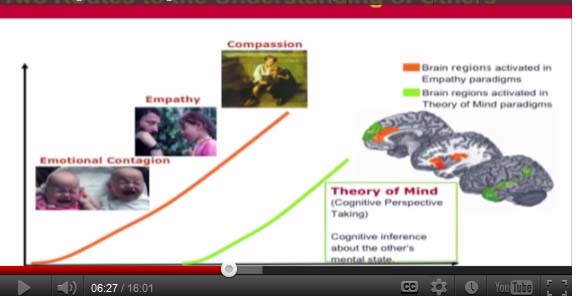
Tania Singer
From Emotional Contagion through Empathy to
Compassion
From
Marshall Rosenberg's book "Non-Violent Communication"
"Empathy
is a respectful understanding of what others are experiencing. Instead of
offering empathy, we often have a strong urge to give advice or reassurance and
to explain our own position or feeling. Empathy, however, calls upon us to
empty our mind and listen to others with our whole being.
In nonviolent communication, no matter what words
others may use to express themselves, we simply listen for their observations,
feelings, needs, and requests. Then we may wish to reflect back, paraphrasing
what we have understood. We stay with empathy, allowing others the opportunity
to fully express themselves before we turn our attention to solutions or
requests for relief.
We need empathy to give empathy. When we
sense ourselves being defensive or unable to empathize, we need to (A) stop,
breathe, give ourselves empathy, (B) screamed nonviolently, or (C) take time
out."
Marshall
Rosenberg: "Empathy, I would say is presence. Pure presence to what is alive in
a person at this moment, bringing nothing in from the past. The more you know a
person, the harder empathy is. The more you have studied psychology, the harder
empathy really is. Because you can bring no thinking in from the past. If you
surf, you'd be better at empathy because you will have built into your body what
it is about. Being present and getting in with the energy that is coming through
you in the present. It is not a mental understanding."
Question: "Is it speaking from the heart?"
Rosenberg: "What? Empathy? In empathy, you don't speak at all. You speak with
the eyes. You speak with the body. If you say any words at all, it's because you
are not sure you are with the person. So you may say some words. But the words
are not empathy. Empathy is when the other person feels the connection to with
what's alive in you."
Various Definitions
Empathy on the Edge (IDEO)
"The definition of empathy is the ability to be aware of, understanding of,
and sensitive to another person’s feelings and thoughts without having had the
same experience. As human-centered designers, we consciously work to understand
the experience of our clients and their customers. "
"Empathy is a social feeling that consists in feelingly grasping or retracing
the present, future, or past emotional state of the other; thus, empathy is also
called a vicarious emotion"
Greater Good Science Center - The Terms of Empathy What does "empathy" mean exactly, and how
is it different from sympathy or other emotional experiences? Some
scientists differ in how they use the term. Below is a list of
definitions of empathy and related terms
Emotional contagion:
Empathy:
Sympathy
Cognitive empathy
OneLook.com We found 42 dictionaries with English definitions that include the
word empathy
Empathy is the capacity to
recognize or understand another's state of mind or
emotion. It
is often characterized as the ability to "put oneself into another's shoes", or
to in some way experience the outlook or emotions of another being within
oneself. Empathy does not necessarily imply compassion, or
empathic concern because this capacity can be present in context of
compassionate or cruel behavior... (extensive article)
Vocabulary.com
"an understanding of and identification with the emotions of another person
Both empathy and the related word sympathy come from the Greek word pathos,
"emotion." To say you empathize with someone is to say you feel their pain or
emotions. If you are empathetic, you "put yourself in someone's place" and try
to understand exactly how they feel. As Atticus Finch said in To Kill a Mocking
Bird, "You don't truly know a man unless you have walked a mile in his shoes."
That is empathy.
- Because she was once destitute herself, she has great empathy for the
homeless. (compassion, sympathy)
- As a nurse, she does more than offer medical care; she provides empathy and
comfort as well. (understanding, compassion)
- Experiencing the death of a close friend has allowed me to be more empathetic
with other grieving people. (understanding) adjective
- He seems like a cold and heartless man; he has no empathy for others.
(compassion, sympathy)"
Encarta.msn.com "1. understanding of another's feelings: the
ability to identify with and understand somebody else's feelings or difficulties 2. attribution of feelings to an object: the
transfer of somebody's own feelings and emotions to an object such as a painting"
Merriam-webster.com
"Greek empatheia, literally, passion, from empathēs emotional,
from em- + pathos feelings, emotion - more at
pathos
Date:1850
1: the imaginative projection of a subjective state into an object so that the
object appears to be infused with it
2: the action of understanding, being aware of, being sensitive to, and
vicariously experiencing the feelings, thoughts, and experience of another of
either the past or present without having the feelings, thoughts, and experience
fully communicated in an objectively explicit manner ; also : the capacity for
this"
Wiktionary.org
'Etymology: A twentieth-century borrowing of Ancient Greek ἐμπάθεια (empatheia),
literally passion (formed from εν- en-, in, at + πάθος pathos feeling),
coined by Rudolf Lotze to translate German Einfühlung. The modern Greek word
εμπάθεια has an opposite meaning denoting strong negative feelings and prejudice
against someone.
Empathy
1. the intellectual identification of the thoughts, feelings, or state of
another person
2. capacity to understand another person's point of view or the result of such
understanding'
Britannica.com 'the ability to imagine oneself in another's place and understand the other's
feelings, desires, ideas, and actions. It is a term coined in the early 20th
century, equivalent to the German Einfühlung and modeled on "sympathy." The term
is used with special (but not exclusive) reference to aesthetic experience. The
most obvious example, perhaps, is that of the actor or singer who genuinely
feels the part he is performing. With other works of art, a spectator may, by a
kind of introjection, feel himself involved in what he observes or contemplates.
The use of empathy is an important part of the counseling technique developed by
the American psychologist Carl Rogers.'
Infoplease.com
'1. the intellectual identification with or vicarious experiencing of the
feelings, thoughts, or attitudes of another.
2. the imaginative ascribing to an object, as a natural object or work of art,
feelings or attitudes present in oneself: By means of empathy, a great painting
becomes a mirror of the self. Origin: 1900-05; < Gk
empátheia affection, equiv. to
em-
em-2+ path-
(base of páschein to suffer) +
-eia
-ia; present meaning translates German -
Einfühlung'
Encarta.msn.com
1. understanding of another's feelings: the ability to identify with and
understand somebody else's feelings or difficulties
2. attribution of feelings to an object: the transfer of somebody's own feelings
and emotions to an object such as a painting
Bartleby.com
Identifying oneself completely with an object or person, sometimes even to the
point of responding physically, as when, watching a baseball player swing at a
pitch, one feels one's own muscles flex.
Allwords.com
1. the intellectual identification of the thoughts, feelings, or state of
another person
2. capacity to understand another person's point of view or the result of such
understanding
Etymology: A twentieth-century borrowing of Ancient Greek á (empatheia),
literally "passion" (formed from - en-, "in, at" + pathos "feeling"), coined by
w:Rudolf Lotze, Rudolf Lotze to translate German Einfíhlung. The modern Greek
word has an opposite meaning denoting strong negative feelings and prejudice
against someone.
concord, accord, harmony, symphony, agreement, sympathy, union, unison, unity,
unanimity, league, friendship, alliance, understanding, conciliation; antonym: Discord
Etymonline.com
1903, translation of Ger. Einfühlung (from
ein "in" + Fühlung
"feeling"), coined 1858 by Ger. philosopher Rudolf Lotze (1817-81) from Gk.
empatheia "passion," from en-
"in" + pathos "feeling" (see
pathos). A term from a theory of art appreciation.
Empathize (v.) was coined 1924; empathic
(adj.) is from 1909.
EMPATHIEA-"Empathy literally means the power of understanding things outside
ourselves after the Greek empatheia, but has come to imply a reliance on inner
feeling"
feeling into another individuals emotional state (einfuhlung)" Lipps 1903
-
"empathy involves resonating with other peoples unconscious affect" - feeling
vibrations?
On Empathy: By: Dr. Sam
Vaknin -
The Encyclopaedia Britannica (1999 edition) defines empathy as:
"The ability to imagine oneself in an other's place and understand the other's
feelings, desires, ideas, and actions. It is a term coined in the early 20th
century, equivalent to the German Einfühlung and modeled on "sympathy." The
term is used with special (but not exclusive) reference to aesthetic experience.
The most obvious example, perhaps, is that of the actor or singer who genuinely
feels the part he is performing. With other works of art, a spectator may, by a
kind of introjection, feel himself involved in what he observes or contemplates.
The use of empathy is an important part of the counseling technique developed
by the American psychologist Carl Rogers."
The capacity to know emotionally what another is experiencing from
within the frame of reference of that other person, the capacity to sample the
feelings of another or to put oneself in another's shoes. D. M. Berger
A sense of similarity in feelings experienced by the self and the
other, without confusion between the two individuals.Jean
Decety
An affective response that stems from the apprehension or
comprehension of another's emotional state or condition, and that is similar
to what the other person is feeling or would be expected to feel. Nancy Eisenberg
To empathize means to share, to experience the feelings of
another person. R. R. Greenson
The ability to put oneself into the mental shoes of another
person to understand her emotions and feelings. Alvin Goldman
An affective response more appropriate to another's situation than
one's own.
Martin Hoffman
A complex form of psychological inference in which observation, memory,
knowledge, and reasoning are combined to yield insights into the thoughts and
feelings of others. William Ickes
Empathy is the capacity to think and feel oneself into the inner life
of another person.
Heinz
Kohut
Empathy involves the inner experience of sharing in and comprehending
the momentary psychological state of another person.
Roy
Schafer
"We recognize others as empathic when we feel that they have accurately
acted on or somehow acknowledged in stated or unstated fashion our values or
motivations, our knowledge, and our skills or competence, but especially as
they appear to recognize the significance of our actions in a manner that we
can tolerate their being recognized."
Wynn Schwartz
Empathy is the experience of foreign consciousness in general.
Edith
Stein
In popular usage the idea refers to the emotional resonance
between two people, when, like strings tuned to the same frequency, each
responds in perfect sympathy to the other and each reinforces the responses of the
other. A good example of this occurs in the statement: "Aleatoric concert
music, like jazz, demands a strong empathy between performer and listener"
(Houkom,
p. 10).
Empathy is about spontaneously and naturally tuning into the
other person's thoughts and feelings, whatever these might be [...]There are
two major elements to empathy. The first is the cognitive component:
Understanding the others feelings and the ability to take their perspective
[...] the second element to empathy is the affective component. This is an
observers appropriate emotional response to another person's emotional state.
Simon
Baron-Cohen (2003):
"[Empathy] is what happens to us when we leave our own
bodies...and find ourselves either momentarily or for a longer period of time
in the mind of the other. We observe reality through her eyes, feel her
emotions, share in her pain.."
Khen
Lampert (2005):
Outline:
Charles Darwin. "We are.. impelled to relieve the sufferings of another, in
order that our own painful feelings may be at the same time relieved. The
mere sight of suffering, independently of love, would suffice to call up in
us vivid recollections and associations. "
Dali Lama, "In the human mind, seeing someone bleeding and
dying makes you uncomfortable. This is the seed of compassion... We are thus
impelled to relieve sufferings of another, in order that our own painful
feelings may be at the same time relieved..."
Four types of Compassion (typology in terms of the Target)
1.
Familial Compassion - Root or Seed
Is it an emotion? Doesn't think so.
2.
Familiars Compassion - friends, neighbors, work associate.
Darwin: " many a civilized man, or even boy, who never before risked his
life for another, but full of courage and sympathy, has disregarded the
instinct of self preservation and plunged at once into a torrent to save
a drowning man, though as stranger"
3.
Stranger Compassion
some or all strangers (global compassion)
based on similarities in appearance, culture
"..a savage will risk his own life to same that of a member of the same
community, but will be wholly indifferent about a stranger: a young and
timid mother urged by the maternal instinct will, without a movement's
hesitation, run the greatest danger for her own infant, but not of the
mere fellow creature."
Why stranger compassion is not an emotion?
What produces stranger compassion without training?
chance
upbringing
genetic
previous incarnation
4.
Sentient Compassion
Darwin. "Sympathy beyond the confines of man, that is humanity to the
lower animals, seems to be one of the latest moral acquisitions….This
virtue [concern for lower animals], one of the noblest with which man is
endowed, seems to arise incidentally from our sympathies becoming more
tender and more widely diffused, until they extend to all sentient
beings." (Darwin’s
views on human compassion)
Different typologies possibilities
Darwin: " (Compassion is of).. high importance to all those animals which
aid and defend one another, it will have been increased through natural
selection; for those communities, which included the greatest number of
the most sympathetic members, would flourish best, and rear the greatest
number of offspring."
(karuna) traditional buddhism: compassion is a mental state -
endowed with a sense of concern - that focuses on another being and
wishes for that being to be relieved of suffering.
Affective or emotional component
- a feeling of concern
Cognitive component
- perception of other's suffering
Motivational component
- wishing to see that suffering relieved
Modern researchers on compassion speak of three elements of
compassion
1. noticing other’s suffering
2 empathically feeling the person’s pain
3. acting to ease the suffering - (this is less in the Buddhist
tradition)
multifaceted process and not a basic emotion
higher order level
10:24 a sense of caring - we instinctively posses
11:45 What compassion is not?
look at multiple models
we don’t have all the constructs
look at all the models of compassion
compassion not pity (near enemy)
compassion not attachment (self regard)
compassion is not the same as empathic feeling of other’s pain
13:45 There is a lot of muddlement between empathy, compassion,
altruism. need greater clarity. at least for theoretical constructs
compassion is not conditional
compassion is not self-regarding
15:30 Buddhist compassion cultivation practice
cultivating deeper sensitivity to nature of suffering, casual
dynamics,
cultivating equanimity - common humanity
cultivating others as dear - need to be able to make a connection
cultivating interconnectedness
cultivating gratitude
“in the field of equanimity, with loving kindness as moisture, the
seed of compassion grows into a tree of true altruism.”
22:00 capacity to feel for others is inborn
sentient creatures feel pain
with training can widen compassion
heart of compassion is to relieve others suffering
highest form of compassion -
24:30 Don’t get too attached to definitions and constructs
seems 3 kinds of altruism definition
psychologists, buddhist, philosophers
motivation is important feature
neuroscientists, biologist, Zoologists
defined independently of motivation
26:50 List of questions
does empathy always arises through the empathy route ?
What is Empathy?
- by Seung Chan Lim
Empathy is an explanatory principle for our potential to
experience an event where we feel as if we are embodying or
understanding the experience of an other and its related meanings from
the context and vantage point of that other.
Others to Sort
Qualitatively it is an active process of desiring to know the
full, present and
changing awareness of another person, of reaching out to receive his words and
signs into experienced meaning that matches at least those aspects of his
awareness that are most important to him at the moment. It is an experiencing of
the consciousness behind another's outward communication, but with continuous
awareness and this consciousness is originating and proceeding in the other.
(Barrett-Lennard,1962:143-144 )









 '
'