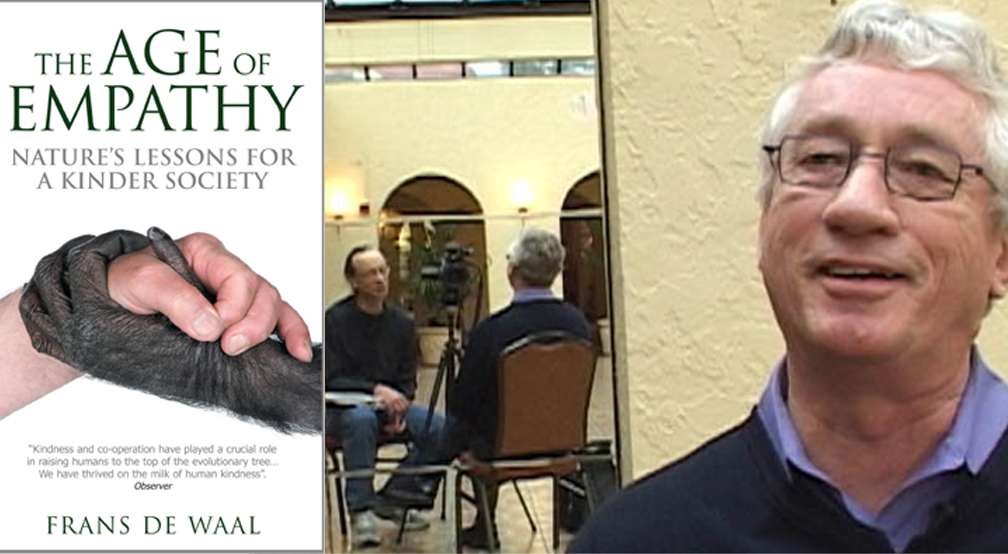
One of the most influential people in the study of empathy is
the Professor of Primate Behavior, Frans de
Waal. See links to videos and articles about him and his work below.
Frans
de Waal is a psychology professor at Emory University with a Ph.D.
in biology. He is the author of many books, including Chimpanzee
Politics, Our Inner Ape and The Age of Empathy: Nature's
Lessons for a Kinder Society. The director of the Living Links
Center at the Yerkes National Primate Research Center in Atlanta, de
Waal was ranked among the World’s 100 Most Influential People of
2007 by Time.
We're
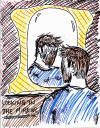
in front of a mirror here, how is empathy related to mirroring?
mirror
neurons
were
discovered in monkeys
can not
do these tests on humans, can't do single cell recording
self
awareness - recognizing the self in a mirror
more
cognitive forms of empathy need to differentiate self and the other
empathy
fuses the minds or body so to speak
more
advanced forms of empathy we need differentiate between my emotions and the
others
need to
be able to make the distinction between self and other
that
distinction correlates, we think, with self awareness
human
children when they are 2, they start to recognize themselves in the mirror
and
develop more complex forms of empathy
can
position themselves in the situation of somebody else
some
species - elephants, dolphins, great apes who recognize themselves in the mirror
which
allows them to have more complex forms of empathy than others
dog and
cat does not recognize itself in the mirror but do respond to emotion,
which is the basis of empathy
2:50
You have done mirror tests with elephants
Gordon
Gallup, 30 years ago discovered self recognition in apes
self
awareness in the apes corresponds to empathy
started
testing other animals
we did
mirror test with elephants.
we put a mark on their head.
elephants
passed the self awareness test
5:30
How do you define empathy?
empathy
has many layers
emotional
contagion
babies
cry when they hear another baby cry
visible
in all mammals
on top of
that we build more complex layers
where you
not only understand others emotions but try to do something
that's
more complex and is a cognitive layer on top of it
dogs
are very empathic animals, but not particularly good at taking the perspective
of someone
6:50 -
How can we build a culture of empathy?
first
step is to give empathy a positive sound
which it
has gotten in the mean time
I spoke
with scientists who started studying empathy 30 years ago and they said people
laughed at them
it was a
funny topic and in the same category as telepathy and astrology
it was
not a serous topic
The first
thing is to make it a serious topic with a positive sound
I've been
doing that by looking at empathy in animals
so that
people don't see it as some new cognitive ability but something that is deeply
engrained in human nature
deeply
engrained in our mammalian heritage which is 200 million years old
make
empathy a positive that is good for society
(In USA) we've
come out of a period where we though greed and selfishness was good for society,
I don't think it particularly is
with the
collapse of the economy a could of years ago people have started to reflect if
greed is so good.
I'm not
saying we will ever have a society that's without selfishness
it's a
balancing act
empathy
used to be a soft word that no one took seriously and I think that has to change
9:00
There seems to be a lot of other scientist working on this now?
yes, the
neuro scientists, the economists and anthropologist, people in animal behavior
it's
becoming a bigger and more respected topic
in the
next 25 years there will be an enormous amount of discoveries
10:00
Paul Ekman told me we need a Empathy Manhattan project! what
else can we do?
The other
things, that I'm not an expert on is education and culture of course. A cultural
and educational change that emphasizes empathy more. I would
also warn that empathy is not invariably positive. People
think that empathy is automatically a positive characteristic Empathy can be
used for bad purposes also.
the used
car salesman uses empathy to sell you a crappy car.
the
torturer needs to know know what will effect you
empathy
by itself is a neutral characteristic that we can use for good of for bad
but first
we need to learn how it works before we get into how we're going to enhance it.
11:20
There's a level of empathy that is so deep that you feel like your selves merge.
It's hard to do harm then?
males and
females are different in this regard
I think
the origin of empathy in mammals in female maternal care
the
female needs to respond to the needs of the offspring
so woman
have a more profound kind of empathy
the
mechanism is more developed, so to speak
it is
more automated than in men
I think
men can switch back and forth
I can
like you one moment, be empathic, but then you slight me then you become an
enemy
and all
my empathy is gone and I'll get you, one way or another
men are
like that, they can turn the switch on it, more than woman
there's
experimental studies on this
when you
talk about merging with the other that prevents you from exploiting the other,
I'm not sure that applies completely to men. I think men always have the ability
to step out of it.
12:45:
What do you think about the enlightened self interest argument?
it is
true that Americans do love that Self Interest story. If we do things for
yourselves and there's a positive byproduct for others that's ok,
it's the
Ayn Rand type of thinking
I don't
know why Americans like that sort of thinking so much, because it's not
particularly popular outside of the US.
that is
sort of the mythology, even though t people are very friendly and generous here
and not less empathic than anywhere else in my opinion
the
self-interest story
Empathy
is self interest, it evolved for survival like all characteristics that we have,
they serve some purpose
but once
it is there, it can be applied outside of that purpose
one you
have empathic capacity you can apply it to a stranded whale
certainly
empathy did not evolve for us to take care of a stranded whale
humans
can apply it outside of the context for which it was originally intended
we do
that all the time with all kinds of characteristics that we have
to call
that then self-interested, I'm not sure that's the right word for me
I'd say
it's the expanded use of the capacity of empathy
you can
empathize with
other
species,
individuals that you don't know
you see a
child fall and you flinch even thought you don't know the child
it's an
automated reaction that we have
it has
nothing to do with self interest in that particular instance
but the
capacity evolved in the end because it was beneficial for us
15:30
Once we have the capacity, we're not doing it out of self interest but embodying
our capacity?
not every
instance where you embody empathy is there a self interest going on
15:50
What do you think of the vision of building a culture of empathy?
I think it is important in society, especially at the moment. Now that
we have come out of this period where greed was so good. I think it is important to
emphasize that there are alternative ways of looking at society. A society where
solidarity is important and caring about others is important.
the whole
health care debate. it is not health business
the
European model is more about caring
it comes
out of care and responsibility
rather
than making money off it
17:30
How did empathy become important to you?
I studied
consolation in chimpanzees
20 years
ago, went to a conference and they talked about empathic concern in children
that's
the connection, consolation to empathic concern
I wasn't
calling it empathy but then started calling it empathy
there was
resistance from others
now it is
more and more accepted that animals have empathy
19:15
Have your studies made you more personally empathic?
I am
a very empathic person
studying
animals it helps to be empathic
many
field workers love the animals and empathize with them
they are
more interested in them
my
empathy doesn't stand in the way of object date gathering, I can do both
"Do animals show empathy? Are there any signs of morality in animal
societies? Can a monkey distinguish right from wrong? And what are the
standards of what is right and what is not? Does morality evolve in time
both for human societies and animal societies?
It is hard to imagine that empathy—a characteristic so basic to the
human species that it emerges early in life, and is accompanied by
strong physiological reactions—came into existence only when our lineage
split off from that of the apes. It must be far older than that.
Examples of empathy in other animals would suggest a long evolutionary
history to this capacity in humans. Over the last several decades, we’ve
seen increasing evidence of empathy in other species. Emotions suffuse
much of the language employed by students of animal behavior -- from
"social bonding" to "alarm calls" -- yet are often avoided as explicit
topic in scientific discourse. Given the increasing interest of human
psychology in the emotions, and the neuroscience on animal emotions."
"Empathy has long been considered a uniquely human trait, but it's an
ability that has also been observed in apes and other animals.
Primatologist Frans de Waal says that examples of empathy in non-human
primates and other mammals suggest that empathy has a long
evolutionary history in humans.
Frans de Waal is the C.H. Candler Professor of Psychology at Emory
University where he directs the Living Links Center for the Advanced
Study of Ape and Human Evolution. He’s the author of several books
including The Age of Empathy, and most recently, Are We Smart Enough to
Know How Smart Animals Are? Credits: Nancy Rosenbaum produced our
story. Our editor is Audrey Quinn."
Obviously empathy is not universally good. It is not even
defined as a positive capacity, since its definition has to do with
adopting the emotional state of others, understanding their situation,
which are capacities that may be used for negative or exploitative
purposes. I am on board with Bloom that pure empathy is not going to save
the world, and that it may even be dangerous given the bias that's built
into empathy, a bias for the own group and for people similar to us. But I
am surprised by his suggestion that we need to separate empathy and
rationality, as if this is even possible. This is built upon the
traditional dichotomy in Western thought between emotion & reason. Most
psychological science has now debunked this dichotomy.
First, emotions are quite intelligent, since they rest
on appraisal mechanisms that require a cognitive evaluation of the
situation we are in.
Second, rationality could not even exist without
emotions, as there would be no reason to think about anything if we were
not emotionally interested. Pure reason is pure fiction. Read Damasio,
read Hume. Bloom follows a very Cartesian line of thought.
If we think about what kind of society we'd like to live
in, automatically we will bring emotions and empty into the picture. We
may rationally decide that slavery is not acceptable, that it undermines
society, that it denies human rights, yet Lincoln mentioned explicitly in
his correspondence that he was seriously bothered by the sight of slaves
when he visited the south and that this was part of his motivation to
fight slavery. Emotions seep into every rational decision we make, and for
Bloom to suggest that it could be otherwise is naive. Yet, if his point is
that some emotions and some forms of empathy can be counterproductive, I
agree and the difference of opinion is perhaps not as great as it may
seem.
Empathy is a capacity that has evolved over the last 200 million years in
the mammals, it can't be as bad as Bloom make it seem.
"Professor
de Waal was brought to campus as part of the Jardezky Lecture Series on
Science, Culture and Ethics...
Much of the talk focused on empathy. de Waal divides empathy into two distinct
types: bodily empathy, which involves basic mimicry and coordination between
individuals, and cognitive empathy, which allows individuals to distinguish
themselves from others and take the place of others in their minds.
Cognitive empathy is more complex, and depends on an organism’s ability to
form an image of themselves as a distinct individual. This is often
investigated by a mirror test, where an animal is marked with paint, then
presented with a mirror and tested to see if they notice the change. Humans
are able to pass this test starting when they are about two years old, which
corresponds with an increase in ability to know other people’s emotions. Other
animals, such as apes and dolphins, have shown they can pass this test as well
2013-06-09
- Frans de Waal on chimps & bonobos
- NPR - To the Best of
our KNOWLEDGE "Are humans unique - or really not that different from other apes?
Primatologist Frans de Waal says chimps & bonobos share many of our
traits, including empathy and a sense of fairness. He describes some of
his research that challenges assumptions about human exceptionalism."
"Paulson: You’re talking about empathy here - the
capacity to recognize another chimpanzee’s pain or difficulties, and
then to help that animal.
de Waal: Yeah. Empathy is one of those traits that humans
over-estimate the complexity of. And that’s why if you tell the average
psychologist, you say that there is empathy in animals, they will say
that’s not possible. Because they think empathy means that you
consciously put yourself in the shoes of somebody else. Now we know from
human research that is not the case. In human research we know that
there’s a lot of empathy, automatic empathy responses.
Like if I’m frowning and looking sad, you’re going to be frowning
and looking sad. Because you’re going to be affected by my facial
emotions, right? If I’m happy and laughing and smiling, you’re going to
be laughing and smiling. And so there’s a lot of bodily connection in
human empathy. And that bodily connection, which is usually called
emotional contagion, is easily demonstrable in lots of animals. And so
we can test out these bodily connections that exist, and that’s how
empathy basically starts."
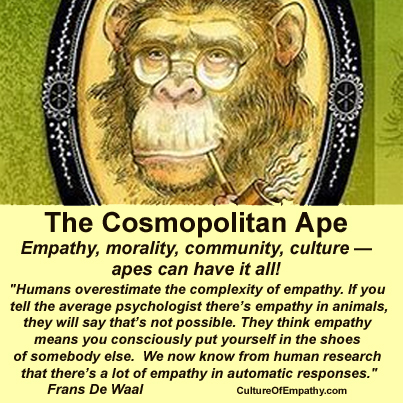
"Humans overestimate the complexity
of empathy. If you tell the average psychologist there’s empathy
in animals, they will say that’s not possible. They think empathy
means you consciously put yourself in the shoes of somebody else.
We now know from human research that there’s a lot of empathy in
automatic responses. If I’m frowning and looking sad, you’re going
to frown and look sad because you will be affected by my facial
emotions. If I’m laughing and smiling, you are going to laugh and
smile.
That bodily connection, usually called emotional contagion, is
easily demonstrable in lots of animals. We do research on yawning
contagion in chimpanzees. If I’m yawning, you are going to yawn at
some point. We know from human studies that it’s correlated to
empathy. People who are very empathetic are also very sensitive to
the yawns of others..."
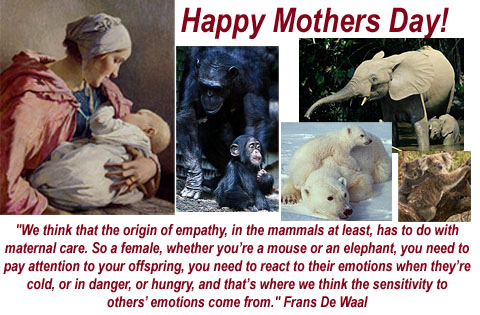
De Waal: We think that the origin of empathy, in the mammals at least,
has to do with maternal care. So a female, whether you’re a mouse or an
elephant, you need to pay attention to your offspring, you need to react
to their emotions when they’re cold, or in danger, or hungry, and that’s
where we think the sensitivity to others’ emotions come from.
That also explains why empathy is more developed in females than males,
which is true in many animals, and it’s true for humans, and it explains
the role of oxytocin. Oxytocin is a maternal hormone. If you spray
oxytocin into the nostrils of men and women, you get more empathic
(empathetic) reactions from them, and so the general thinking about
empathy is that it started in the mammals with maternal care, and then
from there it spread to other relationships. So men can definitely have
empathy, but they on average have a little bit less of it than women.
CNN: By empathy, you mean that they feel each others’ pain?..."
a) be affected
by and share the emotional state of another,
b) assess the reasons for the
other's state, and
c) identify with the other, adopting his or her perspective.
This definition extends beyond what exists in many animals, but I employ the
term "empathy" even if only the first criterion is met as I believe all of these
elements are evolutionarily connected...."more.
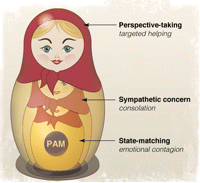
"The Russian doll
model of multilayered empathy. The doll's inner core consists of
the perception-action mechanism (PAM) that underlies
state-matching and emotional contagion.
Built around this hard-wired socioaffective
basis, the doll's outer layers include sympathetic concern and
targeted helping. The complexity of empathy grows with increasing
perspective-taking capacities, which depend on prefrontal neural
functioning, yet remain fundamentally connected to the PAM.
A few large-brained species show all of
the doll's layers,
but most show only the inner ones."
Empathy, cooperation, fairness and reciprocity -- caring about the
well-being of others seems like a very human trait. But Frans de Waal
shares some surprising videos of behavioral tests, on primates and other
mammals, that show how many of these moral traits all of us share.
Hieronymus Bosch - and morality and religion
garden of earthly delights.
Chimpanzees and power, aggression,
view was the humanity is competitive, aggressive,
dominance, nasty
but there is reconciliation
relationship damaged - do something about it
Humanity is more empathic cooperative than it's give
credit for
3:12 - Pillars of Morality -
reciprocity -> Fairness
empathy -> compassion
more this, but the basics
video of chimps cooperating.
video of elephants cooperating.
Empathy: the ability to understand and share the
feelings of another.
Human
morality is older than our current religions, and may go back to
tendencies observable in other mammals. In a bottom-up view of morality,
this talk is one man's road to discovering an array of positive
tendencies in animals at a time when competition and aggression were the
only themes.
2011-05-11 -
Were You Born Selfish?: An Interview with Frans de Waal
Richard Dawkins has declared that humans are “nicer than is good for our
selfish genes.” Emory University primatologist Frans de Waal argues
against this popular picture of evolution as a Hobbesian wilderness of
selfishly competing individuals, where life is “nasty, brutish, and
short.” De Waal focuses his research on the social behavior of primates,
studying questions of culture, altruism, morality, and empathy.
EXCLUSIVE INTERVIEW WITH PROF. FRANS DE WAAL
We can learn about the origins of our sociality, both in
terms of hierarchies, competition and power games and in terms of
empathy and morality. We share both with our animal relatives, both the
good and the bad, and should stop blaming everything we don't like about
ourselves on our biology ("we're acting like animals!") while claiming
all good we do for our noble human nature. All of our tendencies evolved
for a reason among the social primates, and once we understand this, we
will better understand the dynamics of our own societies.
2009 -
Bodies in Sync: Contagious laughter, yawns, and moods offer
insight into empathy’s origins.
Empathy engages brain areas, such as the limbic system, that are more
than 100 million years old. The capacity arose long ago with motor
mimicry and emotional contagion, after which evolution added layer after
layer, until our ancestors not only felt what others felt, but
understood what others might want or need. That ultimately led to
sympathy: while empathy is a way we gather information about someone
else, sympathy reflects our concern about the other and a desire to
improve the other’s situation. Sympathy is anything but automatic.
Nevertheless, it is common not only in humans but also in other animals,
such as apes, dogs, elephants, and birds.
Frans de Waal, author of The Age of Empathy
(Society becoming more empathic, Supreme Court example,
from maternal care,
Oxytocin, cross species empathy, conservatives see Social Darwinism,
competition v. empathy, degrees of empathy in many animals).
"We think that the origin of empathy, in the mammals at
least, has to do with maternal care. So a female, whether you’re a mouse
or an elephant, you need to pay attention to your offspring, you need to
react to their emotions when they’re cold, or in danger, or hungry, and
that’s where we think the sensitivity to others’ emotions come from.
That also explains why empathy is more developed in
females than males, which is true in many animals, and it’s true for
humans, and it explains the role of oxytocin. Oxytocin is a maternal
hormone. If you spray oxytocin into the nostrils of men and women, you
get more empathic (empathetic) reactions from them, and so the general
thinking about empathy is that it started in the mammals with maternal
care, and then from there it spread to other relationships. So men can
definitely have empathy, but they on average have a little bit less of
it than women."
2010-10-17 - Morals Without God?- Frans de Waal - NY Times
Such observations fit the emerging field of animal empathy, which deals
not only with primates, but also with canines, elephants, even
rodents. A typical example is how chimpanzees console distressed
parties, hugging and kissing them, which behavior is so predictable that
scientists have analyzed thousands of cases. Mammals are sensitive to
each other’s emotions, and react to others in need. The whole reason
people fill their homes with furry carnivores and not with, say, iguanas
and turtles, is because mammals offer something no reptile ever will.
They give affection, they want affection, and respond to our emotions
the way we do to theirs.
After many of such tests it
has now been concluded that, yes, primates other than humans love to
help each other. They do care about the welfare of others as much as
humans do, which is to say, some of the time.
This has implications for
modern human society, because all too often politicians start from
the assumption that society needs to be structured around competition,
given that this is how nature works. Their dismal, inaccurate view of
the natural world thus informs their view of human society. Too bad if
some people have no health insurance, so the argument goes, so long as
those who can afford it do. Senator Jon Kyl of Arizona went one step
further by voting against coverage of maternity care, because, as he
explained, he had never had any need for it himself.
I feel that we should hold
Senator Kyl and others of his species aloft in the glaring daylight and
see what their shadow tells us. If they don't see the sun soon, there
will be a never-ending winter.
2010-01-00 - Frans
de Waal.-
The Evolution of Empathy
http://greatergood.berkeley.edu/greatergood/2010/january/De_Waal.php Empathy's not a uniquely human trait, explains
primatologist
Frans de Waal. Apes and other animals feel it as well,
suggesting that empathy is truly an essential part of who we are.
Once upon a time, the
United States had a president known for a
peculiar facial display. In an act of controlled emotion, he would bite his
lower lip and tell his audience, "I feel your pain." Whether the display was
sincere is not the issue here; how we are affected by another's predicament is.
Empathy is second nature to us, so much so that anyone devoid of it strikes us
as dangerous or mentally ill.
At the movies, we can't help but get
inside the skin of the characters on the screen. We despair when their gigantic
ship sinks; we exult when they finally stare into the eyes of a long-lost lover.
2009-09-xx - Article -
By Frans de Waal - Bodies
in Sync
http://www.naturalhistorymag.com/features/251555/sept
Contagious laughter, yawns, and moods offer insight into empathy’s origins. That is where empathy and sympathy start—with the synchronization of
bodies—not in the higher regions of imagination, or in the ability to
consciously reconstruct how we would feel if we were in someone else’s “shoes.”
And yet empathy is often presented as a voluntary process, requiring role
taking, higher cognition, and even language. Accordingly, most scholarly
literature on empathy is completely human centered, never mentioning other
animals. As if a capacity so visceral and pervasive could be anything other than
biological! To counter such widespread views, I decided to investigate how
chimpanzees relate to and learn from one another.
The behavior of our ape relatives, known as peaceful vegetarians, once bolstered
the view that our actions could not be traced to an impulse to dominate. But in
the late 1970s, when chimpanzees were discovered to hunt monkeys and kill each
other, they became the poster boys for our violent origins and aggressive
instinct. ....
The empathy literature on animals is growing fast, and is no longer restricted
to such anecdotes. There are now systematic studies, and even experiments that
show that we are not the only caring species. At the same time, we are getting
used to findings of remarkable human empathy, such as those by neuroscientists
that reward centers in the brain light up when we give to charity (hence the
saying that "doing good feels good") or that seeing another in pain activates
the same brain areas as when we are in pain ourselves. Obviously, we are
hard-wired to be in tune with the emotions of others, a capacity that evolution
should never have favored if exploitation of others were all that mattered.
2009-10-15 -
Learning
Empathy From Apes
I'm Maureen Cavanaugh, and you're listening to These Days on KPBS.
Although Charles Darwin never said it, the phrase ‘survival of the fittest’ has
become part of what people understand about the theory of evolution. The
implication has always been that the ‘fittest’ referred to individual members of
species who were stronger, healthier and sometimes more clever than their
counterparts. But what if fittest also referred to behaviors that contribute to
the survival of groups of animals, behaviors that display awareness of the needs
of others? That’s the question posed in a new book by renowned primatologist and
psychologist Frans de Waal.
2009-10-10 - Article -
By Frans de Waal - Morals without God
http:/www.huffingtonpost.com/frans-de-waal/morals-without-god_b_316473.html
Without God, we will live like animals!
After listening to the
debate between Bill O'Reilly and Richard Dawkins, it struck me again that
the resistance to evolutionary theory largely stems from the illusion that
without God there can be no morality. Some believers feel threatened by
evolutionary theory not because the theory is right or wrong -- the evidence
doesn't seem to matter much to them -- but because accepting it would mean
accepting that we have been created by natural processes including our
morality. The final part is what bothers them the most.
2009 - How Bad Biology Killed the
Economy
http://www.thersa.org/fellowship/journal/features/features/how-bad-biology-killed-the-economy
An unnatural culture of greed and fear has brought the global economy to
its knees. We need to start playing to our pro-social strengths, says
Frans de Waal. The CEO of Enron - now in prison - happily applied
‘selfish gene’ logic to his human capital, thus creating a
self-fulfilling prophecy. Assuming that the human species is driven
purely by greed and fear, Jeffrey Skilling produced employees driven by
the same motives. Enron imploded under the mean-spirited weight of his
policies, offering a preview of what was in store for the world economy
as a whole.
In the meantime, primatologists were debating altruism, too, and found the same
or similar
empathy
and altruism outside of our own species. Monkeys and apes sometimes take
great risks to help each other, for example against predators (chimps in the
forest defend each other against leopards) or enemies (females defend each other
against violent males). Chimpanzees spontaneously share food with each other,
and in recent experiments it was found that primates will secure rewards for
others even if this does not benefit themselves in any way. Since they didn't
need incentives to do so, it is possible they were doing it for some internal
reward. Perhaps other primates, too, derive pleasure from giving.
"The Age of Empathy" excerpt 1
A short excerpt from the audiobook "The Age of Empathy: Nature's Lessons
For a Kinder Society" by Frans de Waal (read by Alan Sklar; 2009; disc
3, tracks 3-6) on the topic of social synchronicity and imitation among
primates as well as humans.
The
Age of Empathy" excerpt 2
Another excerpt from Frans de Waal's audiobook titled "The Age of
Empathy: Nature's Lessons For a Kinder Society" (2009; read by Alan
Sklar; disc 4, tracks 1-4) on the topics of empathy and sympathy in
chimps and humans.
Morality: It's not just for humans
"You might think of "morality" as special for humans, but there are
elements of it that are found in the animal kingdom, says de Waal --
namely, fairness and reciprocity.His
latest study,
published this week in the journal Proceedings of the National Academy
of Sciences, suggests that chimpanzees may show some of the same
sensibility about fairness that humans do.. "
We think that empathy evolved to take care of others that you need to
take care of, especially, of course, between mother and offspring, which
is universal in all the mammals," de Waal said."