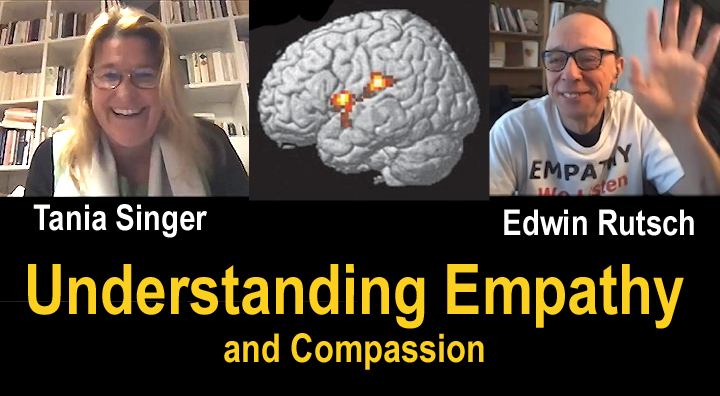
Tania Singer is a social neuroscientist and psychologist at the Max Planck
Institute in Berlin, Germany. Her research aims to increase our
understanding of the foundations of human social behavior. Adopting an
interdisciplinary approach, she and her team investigate the neuronal,
hormonal, and developmental foundations of human social cognition, social
and moral emotions such as empathy and compassion. In this dialogue we
discussed the nature of empathy and her studies on different empathy
and compassion training types and their benefits.
Study Conclusion:
"Contemplative dyads elicited engagement similar to classical contemplative
practices and increased perceived social connectedness. Contemplative dyads
represent a new type of intervention targeting social connectedness and
intersubjective capacities deficient in participants who experience
loneliness and in many psychopathologies."
In other words, there are a lot of benefits in
people empathically listening to each other. One of the benefits is
that it reduces social anxiety about being judged and they feel more
connected. This feeling of lower stress and greater connection lasts over
time as well.
Mindfulness in the west has been reduced to mind training to help us
to be more efficient but mindfulness was designed to reduce suffering
in the world.
Altruism and social stress only shift if you do relation based
practices.
Fear of not being good enough is ingrained in our culture
now so if we can increase care motivation and judge ourselves and
others less we could potentially cure social diseases like depression
and loneliness"
Jan 24 2015: How to build a caring economy
By Tania Singer "Research in the fields of psychology and neuroscience shows
beyond doubt that the assumptions about human nature that underpin mainstream
economic models are simply wrong... The difference between empathy and compassion.
It is important, however, to distinguish between basic empathic and caring
responses, and a more universal capacity for compassion. It is possible that
universal compassion is solely a human function. Empathy alone does not
necessarily prompt prosocial behaviour. If you empathize with the suffering of
another, for example, you may not necessarily help this person. Empathy can
also result in empathic distress that may even lead to withdrawal or
aggressive behaviour."
"Breakthroughs in cognitive neuroscience: Highlighting influential
research from the past 20 years
CNS talked with Singer, who is now at the Max Planck Institute for Human
Cognitive and Brain Sciences in Leipzig, Germany, about the influence of the
2004 paper, her work exploring training people for compassion, and new avenues
for social neuroscience, including the merging of neuroscience, economics, and
psychology.
CNS: Why do you think your empathy for pain 2004 paper was and is still so
important? Singer: At the time of its appearance, it was one of the first cognitive
neuroscience papers that reported about two people within the scanner
environment instead of just focusing on a single brain. We had asked couples
to come to our laboratory and scanned the female while she was empathizing
with the suffering of her partner who was sitting next to her by the scanner.
At that time, such an experimental set-up was extremely unusual as it was
trying to capture a real-life social phenomena.
psychopaths understand the intentions, beliefs, - good
at manipulating the other because they know what the person needs and
thinks. no empathy and compassion, they don't care.
9:50 - training different capacities - exercising
metaphor.
affective and perspective taking have different brain
networks so can be trained differently
effects of trainings
Does time of practice matter?
have a test on stress
Old Model for economics
neo classic -self interest
context
we can be motivated by different forces (needs,
feelings)
Raising Compassion
"Raising Compassion brings together a diverse group of neuroscientists,
mental health professionals, and Buddhist monks in a remarkable exchange
between science, art, and contemplative practice. In a series of
informal conversations about compassion, initiated by neuroscientist
Tania Singer and artist Olafur Eliasson, the protagonists discuss the
public perception of compassion, talk about compassion-training programs
at various research centres, relate their experiences about working with
prisoners and in hospitals, and promote the practical uses of
compassion-training in dealing with social and political issues."
July 2011,
You have pain and
I share your pain - Self other distinction
Difference between
empathy and compassion
Empathy is a
precursor and is good but if you have to much of it you can go into
distress.
go into closing
down
What we want to
have is compassion
What are driving
motivational factors to be prosocial. not egoistic
The roots of
coming to understand the other (routes of social cognition
affective root -
resonance
cognitive
metalizing - theory of mind
psychopathy
44:40 Empathy for
Pain Tests - pain matrix
47:50 Modulatory
factors (what blocks empathy)
Alexthymia
don't know what
you feel?
don't have
access to your feeling
understanding
your own feeling and empathy is very close [self-empathy]
introspective
training
Perceived fairness
of others
[isn't fairness
like the person is not empathizing with you?]
empathizing or
not with the cheater
Perceived group
membership
ingroup and out
group
more empathy for
outgroup
Schdenfreude and
prosocial behavior
53:45 Summary
we are wired for
empathy
connects to and
use our own neurons
empathy training
should start with learning to read your own feelings
you can inhibit
empathy
56:00
Empathy is fragile
What
can we do about it. Through training
Looked
for experts and did tests
Dali
Lama monks
activate warm feelings from caring system
59:00
Addressing compassion fatigue
has big
grant in training
address
burnout, stress, egocentricity >> leads to depression
1:00:00
End
Q
and A?
Priming
How should we change our behavior
Q 1:05
- Why should we be empathic and why should we learn it.
start
with empathy go to compassion
Q - Do
you do something to increase your empathy and compassion?
exercise the steps we teach
meditation
many
techniques
Attention and perspective taking training
Q Do
you measure differences between cultures?
we are
not there.
the
systems are universal even in animals.
Q. do
you work with the police?
will
publish a book with findings and trainings.
The Neuroeconomics of Mind Reading and
Empathy pdf The phenomenon of
empathy entails the ability to share the affective experiences of
others. In recent years social neuroscience made considerable progress
in revealing the mechanisms that enable a person to feel what another is
feeling. The present review provides an in-depth and critical discussion
of these findings./..
Tania Singer–Neuroscience,
Empathy versus Compassion from Biological perspective
(times are off?)
Singer - empathy and compassion from a biological perspective
How first and
third person perspective can meet
and can lead to
something new
Our framework:
Affective Sisters
From contagion
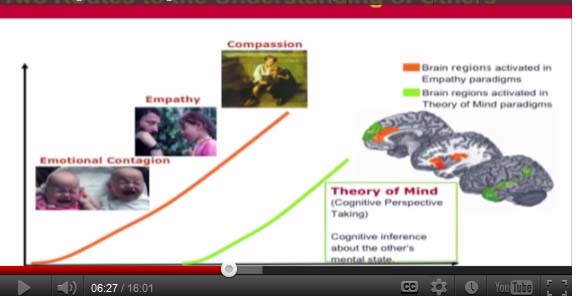
via empathy to compassion
Emotional
contagion (not empathy)
babies crying
yawning
laughing
stress
watching stress
3:04 Empathy
needs a distinction between self and other
develops after
18 months
empathy is not
compassion
it's a
vicarious feeling
empathy is
only to get into resonance together
I share your
pain
(why is
everyone so hung up on pain? just over and over again)
can lead to
burnout and poor health in the helping professions
Compassion has
motivation to help
4:50 Theory of Mind -
is a cognitive route
Metalizing
Cognitive
perspective taking
to others
beliefs and thoughts
Compassion
is a warm
feeling rooted in love not a distressing feeling
wanting to
alleviate the pain
compassion is
much broader
Want to lead to Prosocial behavior
6:15
Experimental Set-up: Empathy 'In Vivo'
suffering pain
empathy for pain circuitry
8:00
Can we train empathy and compassion?
how
are training effects associate with changes in the brains, behavior and
health
8:13
Plasticity of the Social Brain
study
experts compassion meditation
comparing empathy and compassion
rising warmth and concern
tested just resonating with the suffering
11:18
Contrasting Pain and Empathy V Compassion and Metta
different networks activated
12:15
Effects of Compassion vs Empathy Training
Compassion vs. Empathy Distress
if
you are just having empathy, your picking up the distress of others,. If you
get empathy training you pick up the distress better. This means you will
have more stress and lead to burnout. Compassion training helps you relieve
the stress.
Empathy
Compassion
Empathic Concern Sympathy
other related emotion positive feelings - love good health prosocial motivation
14:42 changes in
brain responses after compassion training
16:30 one week of
empathy training?
just resonate with
the suffering of the others
people were
feeling distressed
17:15 then trained
in compassion for a week
compassion
training brought people back to normal
2011-03-08 Interview with Tania Singer @Stanford University CCARE
*Can we train people to become more empathic, and which processing level
(bottom-up or top-down) should be targeted in order for such a training
to be most effective and persistent? For example, is it more effective
to increase sensory awareness and low level affective sharing, or should
we develop emotion regulation strategies or positive compassionate
feelings to reduce personal distress and withdrawal behavior? How does
this interact with individual differences in trait empathy and related
concepts, and at what age(s) should training take place? Apparently, the
investigation of the latter questions requires large-scale longitudinal
studies which could have enormous implications for education and society
as a whole.
What do you think Compassion is?
is not an agreement on definition
a mixture of
a feeling of love for another person
wish to see person happy
if person is suffering a desire to do something
about it
a motivation to help
Describe compassion personally?
closest to love that is not conditioned to getting
something back
a way of unconditional love
not wanting something back
if you feel it, your out of the way, but it's good
for you
it's closes to real freedom
Is compassion innate or can it be cultivated?
basic compassion/love is innate
in humans have different capacities - systems
love/compassion
fear
have to learn to deal with fear
if fear is up - compassion down, and visa versa
learn about your fears.
to cultivate compassion learn to work with your fears
Empathy - everyone has more or less
emotion contagion
that's a precursor of compassion
Difference of empathy and compassion?
sisters of empathy
family of empathic responses
emotion contagion - animals have that
yawning - you yawn
babies crying
Shared feelings
if you have identity of self
you are sad - and I'm sad for you
distinction between you and I
Empathy doesn't mean I'm nice to you
empathy can have everything
Empathy concern or compassion
Empathy is a necessary precondition for
compassion to arise
psychopaths can't do compassion because no
empathy
too much empathy might be detrimental
care giving might lead to burnout
need to teach how to deal with these feelings
transform pain into action
Courage and compassion?
are they the same thing, no
need courage to deal with pain
compassion moves to pain
Courage, empathy and compassion training?
studying plasticity of brain - for empathy and
compassion
how can we train that
Personal role of Compassion in your life?
many have done compassion for me
is subtitle - we connect with people and get into
relationship with people
"What defines humans: self-interest, self-focus, empathy or compassion?
While "exogenous" sciences like economy and sociology failed to give by
themselves an exhaustive definition of human nature, producing partial
concepts like the "homo economicus", the answer might come from an
"inside-out" approach."
Breaking the wall between people
The fall of the wall in Berlin
Walls between between people were breaking -
minds and mental states
less in and out group - empathy joy
2:00 Talk about these experiences from social
neuroscience
how do we understand other minds?
others thoughts, believe, intensions
2:50 From Emotional Contagion through Empathy to
Compassion
Emotional Contagion
babies crying contagion
baby laughing contagion - [video]
eye pupil measurements - are also contagious
see someone that is sad, you mirror it.
unconsciously
[dogs?]
this is not yet empathy
Empathy
self other distinction
differentiating my pain and your pain.
people think empathy is a good thing,
if you have too much empathy, like in
caregiver profession, this can be a problem
you can burnout
you can turn it into compassion
Compassion
you can turn it into sympathy, compassion, concern
for the other
a real motivation for the welfare for the other
a concern for the other
a warm feeling
Theory of Mind (TOM) - there are different
routes into the brain/mind of another person
Theory of Mind - a cognitive perspective taking
not an affective root into the other but a
cognitive route.
Psychopaths for example have (TOM)
good at manipulating others, know the others
needs and beliefs are
but they lack empathy
6:20 have identified the different roots into the mind.
6:50 shared pain tests in scanner
empathy for pain
shared pain circuitry
brain response of husband and wife
check networks used in the brain
9:30 What factors block this automatic empathy
Schadenfreude - how does this come about? joy
in the pain of others.
Unfairness or cheating by someone
Economic games tests
principle of fairness
woman - empathy for both fair person and unfair
player
men - empathy for both fair person and non empathy
for unfair player
In group and out group helping
13:40 Can you train compassion?
checking monks
regulation of emotion and compassion
doing studies and tests
The Neuroscience of Compassion
| Tania Singer
World Economic Forum
"Can training our brains help make the world a better place? Tania Singer
from the Max Planck Institute for Human Cognitive and Brain Sciences
thinks it can. She’s a social neuroscientist and psychologist who says
the brain’s plasticity means it can be trained to make us less selfish
and more compassionate. In this video for the World Economic Forum,
Singer shows how our decision making is driven by a set of psychological
motivations - from power to fear - that can be altered to help us make
better decisions for society and for our health. Her research has also
influenced the development of a new model of “caring economics” that
hopes to work towards sustainability and global cooperation.'
"A world expert on empathy, Tania Singer explores how improved cognitive
and mental skills foster stability of mind, open hearts and encourage
cooperation. After a short talk on the neurobiological basis of
compassion, she'll leads a special DLD workshop based on her freely
downloadable multi-media eBook "Compassion. Bridging Science and
Practice." Developed through a cooperative effort of neuroscientists,
therapists, contemplative scholars and monks, the book describes a
variety of secular mental training programs, their use in education,
clinical settings and for everyday life, as well as scientific findings
on the resulting changes of brain, health and general well-being."
"Empathy expert Tania Singer will resign as director of the
Max Planck Institute for Human Cognitive and Brain Sciences in Leipzig,
Germany, after a commission confirmed allegations of bullying made by several
members of the institute.
“[S]ignificant failures in leadership had occurred” at the institute, the Max
Planck Society said in a statement released yesterday. “In order to avoid a
further escalation of the situation and to enable all parties involved to
return to focused scientific work, the Max Planck Society and Ms. Singer have
agreed that she will step down from her position as Director on her own
initiative.” The neuroscientist “will continue her work as a scientific
researcher, on a smaller scale, without a management function outside the
Leipzig Institute,” the statement noted."
"On Wednesday, the
journal Science broke the story that neuroscientist and lab director Tania
Singer allegedly bullied and intimidated her colleagues, particularly
pregnant women. Singer is one of the world’s most respected empathy
researchers, best known for her groundbreaking work on feeling others’ pain
and the impact of meditation.
Singer isn’t the only academic whose alleged personal behavior is in
conflict with her professional focus. In March, the Boston Globe reported
that psychiatrist Bessel van der Kolk was fired from his post as medical
director of the Brookline Center, where he had worked for 35 years, for
allegedly bullying and denigrating employees.
His 2014 book, “The Body Keeps the Score:
Brain, Mind, and Body in the Healing of Trauma,” has been celebrated by
experts and laypeople alike; the New York Times ran a 7,000-word profile
of Van der Kolk in advance of its release.
"Having a baby was you letting down the team’: Professor
described as a world expert on empathy is dubbed a BULLY by eight colleagues
who have complained about her behaviour
Tania Singer, the leading expert on empathy, is facing bullying claims from
scientist
Eight employees at the Institute for Human Cognitive and Brain Sciences in
Germany have made the claims
It's claimed she reduced staff to tears and discriminated against pregnant
women
Her lawyers denied allegations of bullying and said she had never
discriminated against pregnant women
"World's top empathy researcher accused of bullying colleagues: 75%
of her researchers have QUIT over claims she screams and intimidates
Dr Tania Singer
directs the Max Planck Institute's department of social neuroscience
She is world famous for her sprawling study of the biology of empathy and
meditation
But eight colleagues
claim that Dr Singer threatened their job security and brow-beat them for
everything from disagreeing with her to getting pregnant
Dr Singer has been
on a year-long sabbatical since mediation proceedings concluded last year
She is slated to return with a 'new start' in January 2019"