|
Panel 01-A:
How Can We Build a Culture of Empathy and Compassion? |
|
 |
Ilene
Fortune
Sherry McCreedy
Mutima Imani
Edwin Rutsch |
Our first panel with
some members of the empathy curriculum development team. We tested
out the panel process and talked about how we can build a culture
of empathy.
Sub Conferences:
Education |
| |
|
|
|
Panel 01-B:
How to Nurture, Foster & Teach Empathy in the Education System?
|
|
|
Ilene
Fortune
Sherry McCreedy
Mutima Imani
Edwin Rutsch |
Our second panel with some members of the empathy curriculum
development team. We discussed How to Nurture, Foster & Teach
Empathy in the Education System?
Sub Conferences:
Education
|
| |
|
Panel 02: How does The No-Fault Zone Game teach and support
creating a culture of empathy in schools? |
|
 |
Jared
Finkelstein
Tom Gostinger
Victoria Hodson
Sophie B Langri
Sura Hart
Edwin Rutsch |
The
No-Fault Zone Game helps create a culture of empathy in schools by
providing hands-on materials that students and teachers use
throughout the school day to: understand themselves, empathize
with others, solve problems, resolve conflicts collaboratively.
The Game is also used to enrich academics, helping students
understand characters in literature and history, and strengthen
their own story-telling and writing.
Sub Conferences:
Education |
| |
|
|
|
Panel 03: How Can We Build a Culture of Empathy? |
|
 |
Marco Iacoboni
Karen Gerdes
Rhonda Morton
Edwin Rutsch |
Edwin
Rutsch and Marco Iacoboni (Neuro Scientist), Karen Gerdes
(Professor in School Of Social Work) and Rhonda Morton (Artist)
explore the nature of empathy from different fields of study. We
looked for ways to promote empathy in society. |
| |
|
|
|
Panel 04: Fostering Empathy With the
Arts |
|
 |
Lynn
Johnson
Seung Chan Lim
Joan Kuenz
Tal-Chen Rabinowitch
Eva
Vigran
Edwin Rutsch
|
This panel of guest artists
from the fields of dance, music, theater, and design, shared their
personal insights of how empathy plays a vital part in their
various art forms. The artists also outlined how they would make
empathy front and center in our culture through their art form.
Sub
Conferences: Arts |
| |
|
|
|
Panel 05: How Can We
Build a Culture of Empathy? |
|
 |
Joe
Brummer
Rhonda Morton
Edwin Rutsch
|
Edwin
and Joe (mediator - empathy trainer), and Rhonda (artist) explore
the nature of empathy from different fields of study. We looked
for ways to promote empathy in society. |
| |
|
|
|
Panel 06: How does
Empathy Show up in Your Restorative Justice Work? |
 |
Deb Witzel
Rea Blash
Laura Snider
Beverly Title
Edwin Rutsch |
1. How do you all think restorative justice helps
build empathy? Do you have a story of when you saw it or felt it?
2. When you are sitting in a restorative justice process how do
you know when empathy is happening?
3. What ways do you work to build empathy when doing restorative
justice?
4. What else would you like to say about restorative justice and
empathy?
Sub Conference:
Justice |
| |
|
|
|
Panel 07: How to Create a
Culture of Empathy with Men? |
|
 |
Owen Marcus
David
Mabelle
Michael Welp
Edwin Rutsch
|
Owen
Marcus moderates this panel discussion about how men can deepen
their empathy and live more fulfilling lives. Owen, David and
Michael facilitate men's groups.
|
| |
|
|
|
Panel 08: How Can We Build a Culture
of Empathy & Compassion with the Occupy Movement? |
|
 |
Darci Shaver
Jon
Ramer
David Hazen
Edwin Rutsch
|
Discuss how we can foster empathy and compassion as
foundational values of the Occupy movement. |
| |
|
|
|
Panel 09:
How to Build a Culture of Empathy in the Justice System |
|
 |
Joe
Brummer
Victoria Pynchon
Edwin Rutsch |
We follow-up talking about
Victoria's
Forbes article and explore How to Build
a Culture of Empathy in the Legal and Justice System.
Sub Conference:
Justice |
| |
|
|
|
Panel 10: Learning about
Empathy and Compassion with Teenagers |
|
 |
Muna
Awad
Vinciane Rycroft
Edwin Rutsch |
Learning about Empathy and Compassion with
Teenagers - The Experience of the Charter for Compassion in the
Jordan. |
| |
|
Panel 011: Nurturing Empathy in
the Home: Attachment and Reflective Capacity |
 |
Elle
McSharry
Kim
Beuhlman
Sarah
Schumacher
Edwin Rutsch |
Nurturing Empathy in the home: Attachment and
reflective capacity.
Kim, Sarah and Elle discuss promoting empathy,
reflection, safety, and compassion in relationships between adults
and the infants and toddlers in their care. |
| |
|
|
|
Panel 12: Building a Culture of Empathy with
Empathic Action |
|
 |
Daniel Bassill
Bert Ola-Bergstrand
Bill Huddleston
Edwin Rutsch |
How does empathy motivate actions of donors, volunteers and
investors? This panel discussion brings together Bill Huddleston,
a leading thinker in workplace fund raising in the USA, Bert
Ola-Bergstrand, a social entrepreneur from Sweden, and Daniel F.
Bassill, D.H.L., founder of the Tutor/Mentor Institute, LLC and
Edwin Rutsch, director of the Center for Building a Culture of
Empathy. |
| |
|
|
|
Panel 13: 1440 Challenge Participants
Building Empathy Together |
|
 |
David A. Levine
Sura Hart
Molly
Rowan
Edwin Rutsch |
In this panel, four
participants in the
1440 Challenge came together to dialog about their respective
projects and how they nurture and foster empathy in our society.
Each participant shared their work and then other panelists
responded. Responses included: empathic listening, reflection
about the project, rephrasing or restating what we heard, support,
curiosity and questions about the project. We then made
connections and collaborative plans for how we can work together
to raise the level of empathy in society. |
| |
|
|
|
Panel 14: 1440 Challenge Semi-Finalists Building
Empathy Together #2 |
 |
Laura McMullin
Ingrid Stabb
James Hadlock
Mary Ann Brussal
Edwin Rutsch |
In this panel, five Semi-Finalists in the
1440 Challenge came together to dialog about their respective
projects and how they nurture and foster empathy in our society.
Each participant shared their work and then other panelists
responded. Responses included: empathic listening, reflection
about the project, rephrasing or restating what we heard, support,
curiosity and questions about the project. We then made
connections and collaborative plans for how we can work together
to raise the level of empathy in society. |
| |
|
|
|
Panel 15: How to build a
culture of empathy and compassion with the interfaith community? |
 |
Geoffrey Mitelman:
Homayra Ziad
Jenny Peace
ORose
Edwin Rutsch |
Not all participants
could make it so we postponed this panel. |
| |
|
|
|
Panel 16: Ashoka Activating Empathy
Competition Winners Hangout |
 |
Dina Buchbinder
Mark Rodriguez
Nicholas Carlisle
Laura
Zax
Lauren Parnell Marino
Lennon Flowers
Ari Cowan |
This is not a direct
part of our conference but we include it as a resource. "The
winners of the Ashoka Changemakers Activating Empathy competition
discuss empathy in our education systems and how we can all work
together to ensure all students learn this important skill"
Several participants have done interviews for the conference.
|
| |
|
|
| |
|
|
|
Panel 17: How to Build a
Culture of Empathy with Aikido? |
 |
Jerry Green
Nick Walker
Quentin Cooke
David Weinstock
Edwin Rutsch |
Representatives of Aiki-Extensions, Inc from California,
Washington State, England and the Center for Building a Culture if
Empathy discuss and demonstrate how principles of Aikido entrain
compassion and embody empathy around the world.
Bringing somatic attunement (embodied presence) to conflicted
situations. Finding ground and center under pressure. Learning to
listen to the different languages of the head, the heart and the
wisdom of the belly.
Sub Conference: Aikido & Empathy |
| |
|
|
|
Panel 18: The Intersection of
Conflict Resolution and Empathy |
 |
Cinnie Noble
Kenneth
Cloke
Eileen
Barker
Lorraine Segal
Edwin Rutsch
|
How do conflict resolution professionals describe empathy? What
are the connections between empathy and healing conflict? How do
coaches and mediators build empathy for their clients and
themselves? How do forgiveness and empathy connect? These
eloquent, distinguished experts in the field have a free ranging
discussion of these and other related questions.
Sub Conference:
Justice |
| |
|
|
|
Panel 19:
Challenge of Balancing Analysis and Empathy |
 |
Anthony Jack
Helen
Riess
Richard Boyatzis
Edwin Rutsch |
Recent evidence shows
that adopting an analytic frame of mind suppresses brain areas
involved in empathy, and emotionally engaging with others
suppresses brain areas involved in analytic thought. This presents
a challenge for contexts that require both forms of thought.
Managers, teachers and doctors all have professional roles in
which optimal performance depends both on a capacity for clear
analytic thought, and on their ability to emotionally resonate
with others. This panel brings together three experts in the
neuroscience of empathy and how to train it. They discuss the
challenges involved in fostering a balance between empathy and
analysis in professional life, and suggest solutions. |
|
Panel 20: Empathy in
Critical Care - Empathy and Healthcare Conference |
 |
Keonnis R. Taylor
Jodi Halpern
Barbara Beach
Marilyn Ababio
Edwin Rutsch |
This panel with experts in the field of healthcare
explored the role of empathy and compassion in providing medical
care. The panel included; Jodi Halpern, M.D., Ph.D, Associate
Professor of Bioethics and Medical Humanities at the University of
California, Berkeley. Barbara Beach,
M.D., Co-founder and Medical Director of George
Mark Children's House. Keonnis Taylor, Executive Director,
and Marilyn Ababio, Director of the Board, at
Comfort Homesak.
Edwin Rutsch, Director, Center for Building a Culture of
Empathy. |
A few of
the questions addressed were;
- How do those providing objective medical care,
especially around the grim subject of one's own death, provide
compassionate care without absorbing the emotions surrounding imminent
death?
- Please describe your work and why the principle of
empathy is relevant to it?
- The theory of Counter-Transference in Psychology
postulates that the practitioner's feelings are entangled with the
patient's. Does this also happen in the medical field? etc.
|
| |
|
|
|
Panel 21: Philosophy and Empathy |
 |
Anthony I. Jack
Joshua Knobe
Philip Robbins
Edwin Rutsch |
This panel brings
together three leading researchers in the emerging field of
experimental philosophy: a field which uses the experimental
methods of the cognitive and social sciences to shed light on
philosophical problems. This is a free ranging discussion of
recent research and work in progress. We discuss how our
conception of the minds of others relates to empathy of various
types, with a particular focus on empathy in the sense of
compassion. The discussion touches on dehumanization,
objectification, and how empathy relates to our tendency to see
minds as embodied, as able to feel different kinds of emotion, and
as possessing autonomy or free will. |
| |
|
|
|
Panel 22: Empathy and Yoga: Yoga is a tool kit
for Empathy
|
 |
Nixa
De Bellis
Michael Hewett
Elena Brower
Edwin Rutsch |
Yoga is a tool kit for
Empathy. In its methods we cultivate a feeling sense of ourselves
and the world. We both take measure of our own person and revel in
the multitude of relationships through an awareness practice of
deeper than ordinary looking and listening.
The logic of our differences,
our similarities and our sameness is not evident without practice,
and so we have the yoga technologies for actively engaging
ourselves, our families, our communities and our world. |
| |
|
|
|
Panel 23
- The Role of Empathy in Crime, Policing and Justice |
 |
Chad Posick
Joe
Brummer
Michael Rocque
Edwin Rutsch |
The role of empathy in
policing, both empathy for and by the police, is gaining attention
from criminal justice researchers and practitioners. While
research on the effectiveness and importance of empathy in
policing is limited, the existing research indicates that empathy
increases perceptions of legitimacy and trust in the police. This
panel discusses a range of issues related to the role of empathy
in criminal behavior, punishment, and policing with a specific
emphasis on training police on how to incorporate empathy into
their work.
Sub
Conference: Justice |
| |
|
|
|
Panel 24: Moving Medical Culture from
Detachment to Empathy |
 |
Helen
Riess
Jodi Halpern
Edwin Rutsch |
Edwin Rutsch hosts a
discussion with two of the primary leaders in the movement to
transform medical culture from detachment to a culture of empathy.
Jodi
Halpern M.D., Ph.D, is Associate Professor of Bioethics and
Medical Humanities at the University of California, Berkeley, in
the Joint Medical Program and the School of Pulic Health.
Helen
Riess M.D., Ph.D is Associate Clinical Professor of
Psychiatry, Harvard Medical School and Director of the Empathy and
Relational Science Program at Massachusetts General Hospital. |
| |
|
|
|
Panel 25:
Libertarian: How might we
transform domination cultures & systems into empathic cultures? |
 |
Wesley Bertrand
Katie Testa
Tom Garrett
Edwin Rutsch
|
Through a reflective listening and empathy process, we explored
some of the concerns about systems (organizations and institutions
with laws, rules, policies, procedures, and norms) that can
discourage empathy with self and with others. Domination systems
are based on hierarchies of authority and demanded compliance,
with punishments administered for noncompliance..... We speculate
that if empathy were focused on and practiced in relation to
systems of domination, helpful transformations could take place. |
| |
|
|
|
Panel 26 - What is the Relationship Between
Self-Empathy, Empathy, Self-Compassion & Compassion?
|
 |
Kristin
Neff
Christopher Germer
Edwin Rutsch |
In this panel discussion,
Kristin Neff, Christopher Germer
and Edwin Rutsch discuss the question,
What is the Relationship Between
Self-Empathy, Empathy, Self-Compassion & Compassion? There is a great deal of confusion about the
meanings and definitions of self-empathy, empathy, self-compassion
& compassion. We might be talking about the same experience
but are using different words, or are talking about different
experiences and are using the same words.
|
| |
|
|
|
Panel 27 - How Might We Create More Interfaith
Empathy? |
 |
Sheima Salam Sumer
Abdulmonaim Merkt
Amal Damaj
Adam Ericksen
Edwin Rutsch |
The discussion is about how to build
more empathy among the different religious groups. Our panelists are
Christians and Muslims who are located in Iraq and the USA. |
| |
|
|
|
Panel 28 - Empathy-Based Parenting Educators On the Role of
Empathy in Different Parenting Styles? |
|
 |
Amy Bryant
Robbyn Bennett
Kim Hopkins Betts
Lori
Petro
Edwin Rutsch
|
Our
panel of Empathy-Based Parenting Educators discuss, What is the
Role of Empathy in Different Parenting Styles?
Some of the styles discussed are; Authoritarian, Authoritative,
Indulgent (permissive), Neglectful (uninvolved), Attachment,
Nurturant and Empathic Parenting. |
| |
|
|
|
Panel 29: Philosophers Empathy Circle: For &
Against Empathy |
 |
Lori Gruen
Jesse
Prinz
Edwin Rutsch
|
With David Hume looking over his their shoulders,
Edwin Rutsch facilitates a new way for philosophers to dialog
with each other about their views. Instead of a competitive debate, they
try to empathize with each others feelings,
needs,
points of view and understandings. Edwin
facilitates this
Philosophers Empathy Circle
with
Jesse Prinz who is
'against empathy' and
Lori Gruen who is 'for empathy'.
Check out this fascinating process and discussion. How will it end? |
| |
|
|
|
Panel 30: How might we build a more empathic
society and culture? |
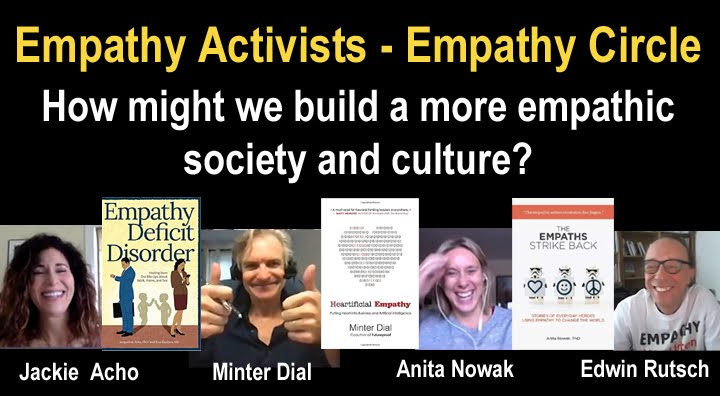 |
Jackie Acho
Minter Dial
Anita
Nowak
Edwin Rutsch
|
This the first of a series of Empathy Circles with
empathy activists. Most participants have written books or head
programs on the topic. This is a way to explore the different
facets of empathy together and for people in the field to get to
know each other and exchange ideas and insights. |
| |
|
|
| |
|
|
|
Panel 33: |
| |
|
|
| |
|
|
|
Panel 32: |
| |
|
|
| |
|
|
|
Panel 33: |
| |
|
|
| |
|
|
|
Panel 34: |
| |
|
|
| |
|
|
|
Panel 35: |
| |
|
|
| |
|
|
| |
|
|