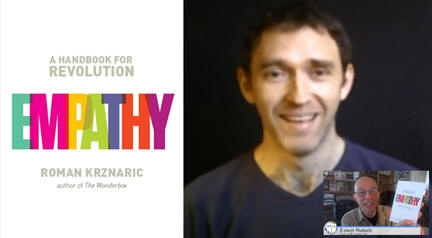
Roman Krznaric is
a cultural thinker and writer on the art of living. He is a founding
faculty member of The School of Life in London, which offers instruction
and inspiration on the important questions of everyday life, and advises
organisations including Oxfam and the United Nations on using empathy and
conversation to create social change. He has been named by The Observer as
one of Britain’s leading lifestyle philosophers.
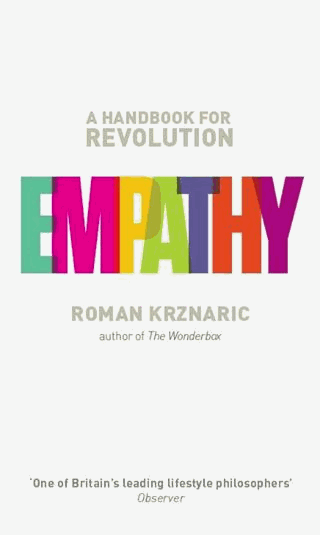
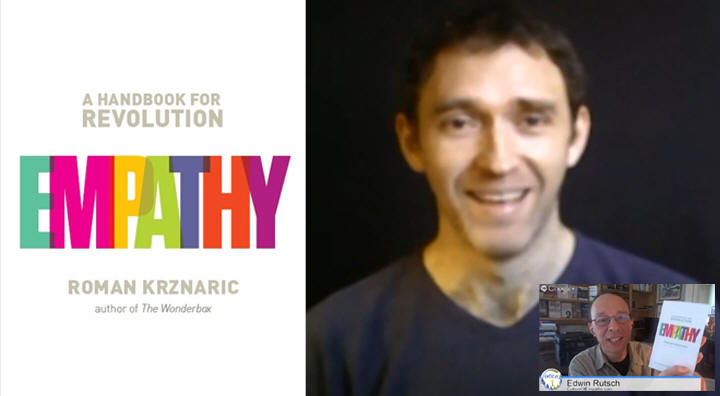
Roman is author of
Empathy: A Handbook for Revolution.
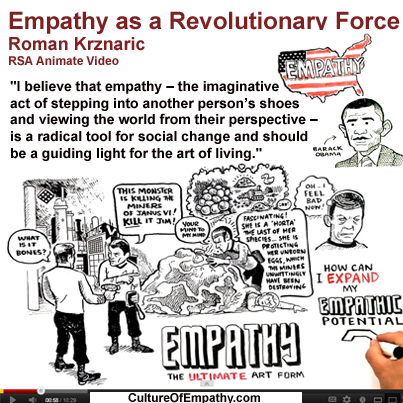
"I believe that empathy – the imaginative act of
stepping into another person’s shoes and
viewing the world from their perspective –
is a radical tool for social change and
should be a guiding light for
the art of living."
From the book
description; "Through encounters with actors, activists, groundbreaking
designers, undercover journalists, nurses, bankers and neuroscientists,
Krznaric defines a new breed of adventurer. He sets out the six
life-enhancing habits of highly empathetic people, whose skills enable
them to connect with others in extraordinary ways. Empathy has the power
to transform relationships, from the personal to the political. Krznaric
contends that, as we move on from an age of introspection, empathy will be
key to fundamental social change - making this book a manifesto for
revolution."
(Video
Transcriptions: If you would like to take empathic action and
create a transcription of this video, check
the volunteers page. The transcriptions will make it easier
for other viewers to quickly see
the content of this video.)
(Video
Transcriptions: If you would like to take empathic action and
create a transcription of this video, check
the volunteers page. The transcriptions will make it easier
for other viewers to quickly see the content of this video.)
Roman Krznaric argues our brains
are wired for social connection: empathy is at the heart of who we
are. It’s an essential, transforming quality we must develop for
the 21st Century.
Through encounters with actors, activists, groundbreaking
designers, undercover journalists, nurses, bankers and
neuroscientists, Krznaric defines a new breed of adventurer. He
sets out the six life-enhancing habits of highly empathic people,
whose skills enable them to connect with others in extraordinary
ways.
Empathy has the power to transform relationships, from the
personal to the political. In this way it will be key to
fundamental social change – making this book a manifesto for
revolution.
Contents
The Radical Power of Empathy
The Revolution of human relationships
The Six Habits of Highly Empathic People
Tackling the empathy deficit
From introspection to outrospection
The Empathic Challenge
Habit 1. Switch on Your Empathic Brain
Science fictions or science fact?
It's human nature, isn't it?
Child psychology and the discovery of homo
empathicus
Get in touch with your inner ape
Dissecting the empathic brain
Can we learn to e more empathic
Re-framing your mind
Habit 2. Make the imaginative Leap
If empathy is so good, why don't we do it more?
Authority
Distance
Humanize the Other
Discover what you share and what you don't
Empathies with the enemy
What is it like to be a bat?
Habit 3. Seek Experiential Adventures
Being Daniel Day-Lewis
Immersion or how to be an undercover empathist
Exploration, or how empathy journeys can change you
Cooperation, or why it may be time to join local
choir
Learning the Language of empathy
Habit 4. Practice the Craft of Conversation
The crisis of conversation
Curiosity about strangers
Radical Listening
Take off your mask
Concern for others
Creative spirit
Sheer courage
Empathy with yourself
Habit 5.Travel in Your Armchair
Can you change the world fro your living room?
Theatre and film: war through enemy eyes
Photography: the political power of empathic images
Literature: can we learn empathy from novels?
Online culture: from digital revolution to empathy
revolution?
In praise of ektasis
Habit 6. Inspire A Revolution
Empathists of the World Unite!
The greatest meeting of strangers in history
The First Wave: the rise of humanitarianism in the
eighteenth century
The Second Wave: the expansion of rights after the
Second World War
The Third Wave: deepening personal relationships in
the age of neuroscience
The prospects fro bioempathy
Riding the revolutionary wave
The Future of Empathy
From early on I have suspected that so
important-sounding task "Know Thyself" is a ruse of cabal priests.
They are trying to seduce man from activity in the outside world, to
distract him with impossible demands; they seek to draw him into
false inner contemplation. Man only knows himself insofar as he
knows the world. Johann Wolfgang Goethe
"Is the introspection of self-help and therapy hurting our ability to
empathise? Over the past century, self-help and therapy culture have
emphasised constantly looking inward as a means of self-discovery and
self-improvement. But are we really any better off for it? The UK-based
author and philosopher Roman Krznaric believes that, for humanity to
have a more empathetic, moral, creative and progressive 21st century, we
must step outside of our own experiences to see how other people live."
Minneapolis Institute of Art: Empathy, Art the Revolution of Human
Relationships: Roman Krznaric Vimeo: PART 1 Vimeo: PART 2
Drawing on his
international bestseller Empathy: Why It Matters, and How to Get It, social
philosopher Roman Krznaric reveals how empathy cannot only enrich personal
life, but also
helps create social change. Empathy, he argues, has the power to transform
personal and
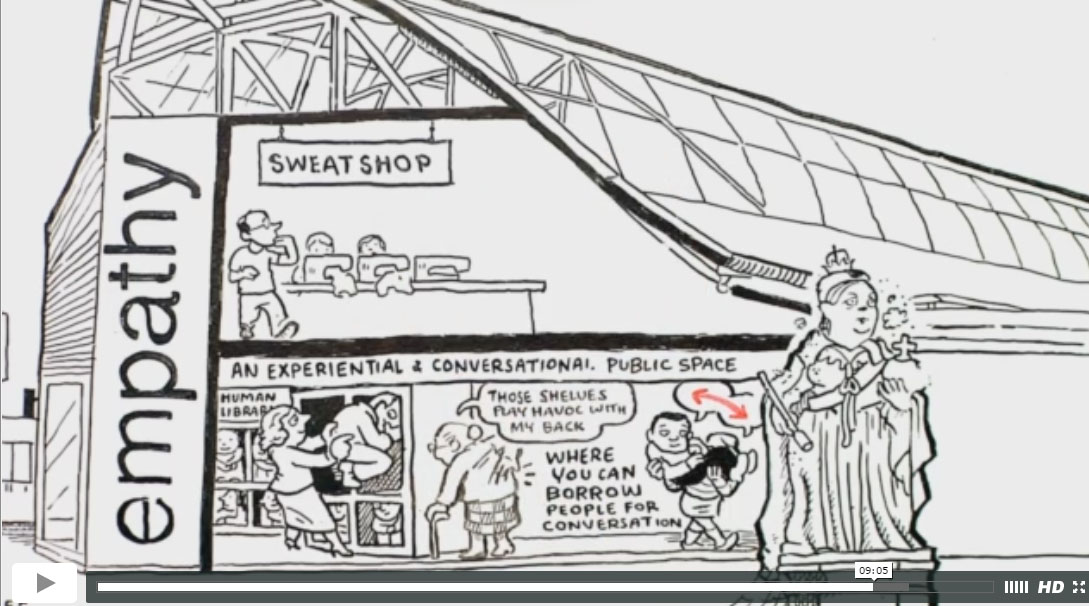
political relationships. Krznaric explores how art and culture helps us expand
our empathic
imaginations, focusing on subjects as varied as ancient Greek theater and
Renaissance
painting to the history of cinema and participatory artworks such as the
Empathy Museum. He
explores empathy through the lens of neuroscience and industrial design and
its role in eroding
conflicts in the Middle East and beyond. Book signing to follow.
"Roman Krznaric’s writings on empathy have been widely influential
amongst political and ecological campaigners, education reformers,
social entrepreneurs, and designers. His books include: Empathy (2014),
How to Find Fulfilling Work (2013) and The Wonderbox (2011). He is
founder of the world’s first Empathy Museum and of the digital Empathy
Library as well as a founding faculty member of The School of Life and
on the faculty of Year Here. "
Empathy in Australia Presented by The School of Life
"The School of Life is holding a special symposium called, Empathy in
Australia. It will cover key issues facing modern-Australian society and
discuss how we might turn our empathic potential into a powerful tool
for positive change."
"Can empathy
really transform out lives? Philosopher Roman Krznaric, founder of the
Empathy Museum is in Perth, and he spoke with Gillian O'Shaughnessy."
It’s comforting
to know popular philosopher and empathy expert Roman Krznaric is not, in
his own words, “some sort of empathy superhero”.“I’m struggling the same
way as anybody else to try to see the world through others’ eyes,” says
Krznaric, the author of Empathy: Why It Matters, and How to Get It and
founder of the world’s first Empathy Museum. On the line from his Oxford
home ahead of his first visit to Perth for the 2016 Perth Writers
Festival, where he’ll give the opening address, the Sydney- born
“cultural thinker and writer on the art of living and social change”
tells of the childhood trauma which for a time left him bereft of
empathy.
"There is a
quiet revolution going on in the criminal justice system. In courtrooms
and in prisons, the latest crime-fighting weapon is empathy.Sydney-born
Roman Krznaric has conducted empathy training for some of Britain's top
judges as well as the violent offenders they sentence. He believes that
developing the ability to put ourselves in another's shoes is the key to
a fairer, more productive and harmonious society."
"Learn how to
use and expand your empathy to transform your life and the lives of
others
When we as a society and as individuals face up to world crises, human
rights abuse and issues happening in our own country, one concept often
comes to mind: empathy. Sometimes we’re baffled at how people in
positions of power seem to suffer from a lack of empathy; occasionally,
we might recognise when we need to show more towards others. Empathy is
what brings us to show compassion, which means that it’s a powerful tool
for positive change."
"What
is your capacity for empathy? Is it just reserved for the down and out?
How about empathizing with those in power? Can empathy travel across
great distances and through time? This informative animation challenges
how we tend to view empathy and advocates for the transformative power
that can bring about change for individuals as well as entire
societies."
"Stepping into other people’s shoes has been a catalytic force for
social change throughout human history. You can always tell when a good
idea has come of age: people start criticising it. That’s certainly the
case when it comes to empathy.
Empathy is a more popular concept today than at any time since the
eighteenth century, when Adam Smith argued that the basis of morality
was our imaginative capacity for “changing places in fancy with the
sufferer.” Neuroscientists, happiness gurus, education policy-makers and
mediation experts have all been singing its praises."
"Empathy is a quality that is integral to most people's lives - and yet
the modern world makes it easy to lose sight of the feelings of others.
But almost everyone can learn to develop this crucial personality trait,
says Roman Krznaric.
Open Harper Lee's classic novel To Kill A Mockingbird and one line will
jump out at you: "You never really understand another person until you
consider things from his point of view - until you climb inside of his
skin and walk around in it."..
Make a habit of "radical listening"...
Look for the human behind everything...
Become curious about strangers...
Renegade Ink: Roman
Krznaric, author of ‘Empathy: Why it matters and how to get it”,
talks to us about empathy in the age of self interest.
empathy is fiery and can create a social revolution
Good to think about happiness
lots of unhappiness in the world
Empathy is the heart of good relationships
good for creativity
good for human bonds
Problem - hyper individualism
US has big drop in empathy
How to expand empathy - 6 ways to increase it
Definitions
Effective - shared mirrored response
compassion - shared suffering
Cognitive - perspective taking
Confused with golden rule
You may be Skeptical about empathy
self-interested model of humanity
empathy model of humanity
6 habits - how to support empathy?
(1) 10:00 - understand you are wired for empathy
mirror neurons
empathy can be taught
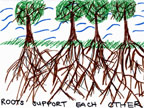
roots of empathy
(2) make imaginative leap
Role playing
Dan Batson - facts vr imagination
Barriers to empathy - judgments
Example of good empathy - Gandhi
Empathize with your enemies - KKK member and black
woman
Discussion with partners
(3) Cultivate Craft of Conversation
empathic listening - NVC - Marshal Rosenberg
reflective listening
Brene Brown - Vulnerability
be curious about others and use conversation
Human library events
(4) 30:30 - seek experiential adventures
Occupy the life of another
George Orwell
Patricia Moore - industrial designers
Dialog in the dark - experience being blind
Live below the line
(5) travel in your armchair
travel in your armchair - reading, films, etc
more dialog about book, film
(6) 40:30 - inspire a revolution
mass empathy contractions - holocaust, etc
mass empathy expansions
empathy -> reason and rights -> social justice
how to expand empathy at this level?
Israel - Palestinian
empathy museum
introspection - outrospection
Q and A
How do we measure empathy?
self rating
reading eyes
Empathy careers?
social work
social entrepreneurs
57:00 - Difference between empathy and compassion?
compassion has many definition?
empathy is cornerstone of compassionate action
59:45 - Is it possible to be too empathic?
yes, empathic over arousal - overload
it can be too much or paralyzed
human overload, nurses
society has empathy deficit
1:02 - Empathy relationship to resources - changes over
life.?
childhood changes in empathy
1:05 - Can empathy inspire violence?
ingroup empathy - step out of your ingroup
[we need a universal transformative empathy]
1:09 - Counselor - how to maintain empathy in daily
life?
barrier to empathy
empathy breaks through barrios
1:13 - Autism and empathy. can we teach people
with these problems empathy?
1:15 - Live your values.
1:19 - Your personal development in empathy?
still trying to do it.
Is Empathy Possible in the Digital Age? Philosopher Roman Krznaric interviewed
about his new book Empathy: A Handbook for Revolution on Chanel 4's
SundayBrunch
9 May 2014: Why The Empathy Critics Are Wrong: Empathy
Doesn’t Break Democracy, It Makes It
"You can always tell when a new idea is becoming popular – people start
critiquing it. That’s certainly the case when it comes to empathy, a
concept that is getting more public attention today than at any point in
its history (the frequency of Google searches for the word ‘empathy’ has
more than doubled in the past decade)."
"In this talk from The School of Life's acclaimed Sunday Sermon series,
philosopher Roman Krznaric draws on his new book, Empathy: A Handbook
for Revolution, to show how empathy - the art of stepping into the shoes
of another person and seeing the world from their perspective - can
enrich our own lives and create radical social change."
Empathy: A Handbook for Revolution
February 19, 2014 · by randomhouseindia ·
"I don’t think it’s ever a good idea to write a book about the art of
living if you think you’ve got all the answers. It’s almost certain to
be too preachy and too self-confident. My new book, Empathy: A Handbook
for Revolution (published by Rider Books), is about how empathy – the
ability to step imaginatively into the shoes of other people and look at
the world from their perspective – can transform our everyday lives and
the society we live. And I can safely say that it is still something I
struggle with in my daily life"
Are you empathetic? Do you have the imaginative ability to step into the
shoes of another to try and understand what they are feeling or
perceiving? It’s an ability that is quite different from feeling
sympathetic or sorry for another person. Philosopher and author Roman
Krznaric argues that empathy is in decline but, he says, we need it in
abundance if societies are to flourish.
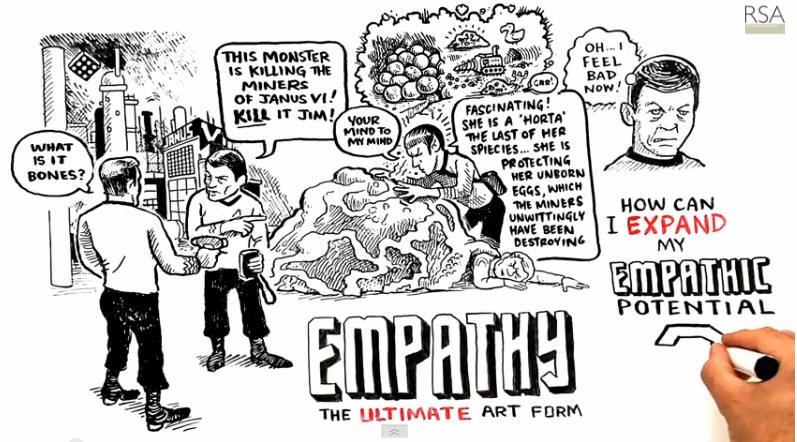
The Power of
Outrospection - Empathy
Here is a fun RSA animation of a talk given by Roman
Krznaric at the Royal Society for the encouragement of Arts in the UK.
Roman talks about empathy as a revolutionary force.
How to
start an Empathy Revolution: Roman Krznaric at TEDxAthens 2013
TEDxAthens is a world-class conference about Innovation, Creativity and Ideas
based in Athens, Greece. TEDxAthens is one of the first TEDx events worldwide
and the first ever TEDx event in Greece - started in May 2009. Its main goal
is to develop and leverage the TED experience at a regional level, uniting
innovators, thinkers, inspirational speakers, shakers, makers and breakers.
TEDxAthens is curated by Dimitris Kalavros-Gousiou and organized by a team of
40 volunteers.
Age of hyper individualisms
Need antidote - Empathy
Understanding them - thoughts, feelings
empathy can create radical social change
revolution of social change
empathy for social glue to hold us together
Problem of the World
use empathy for social transformation - 8 ideas for
empathy revolution
Train the next generation - Roots of Empathy
program
"Childhood trauma left Roman Krznaric emotionally withdrawn. Since then,
he has tried to repair the damage and his own children have taught him
how to step into someone else's shoes
Growing up, I knew this was the reason why I rarely felt other people's
joys and found it equally hard to connect with their sorrows. But it was
only a few years ago that I realised it was also the spur to my
obsessive research into empathy: I was driven by an unconscious desire
to recover the empathic self I had lost as a child. This realisation
launched me on a personal quest to explore – and tackle – my empathy
deficit through my family life."
Mahatma Gandhi was one of the great empathetic adventurers of the
twentieth century, a master in the
art of looking at the world from another’s perspective. His
philosophy was embodied in what is known as “Gandhi’s talisman”, a
moral code which calls on us to consider the
viewpoint of those living on the social margins..
"For four centuries, we have embraced a narrow view of human nature.
Roman Krznaric has set out to widen our perspective. He talked with
Martin Eiermann about human empathy, self-absorbed psychologists, and
the importance of a little bit of madness."
...Empathy isn’t a nice and fluffy concept, it’s fiery and dangerous and
radical. It’s ultimately a revolutionary force – not in the sense of
overthrowing institutions, but by revolutionizing human relationships."
Jules Evans investigates the elusive notion of empathy through a series
of interviews with Roman Krznaric and Aeon contributors
Maria Konnikova
and Tobias Jones.
" Here’s a new podcast from
the rather wonderful Aeon
Magazine, in which philosopher Jules
Evans explores the theme of empathy. I kick off by talking about the
history of empathy, tracing the concept from Adam Smith’s ideas in the 18th
century and through developments in child psychology over the past hundred
years.
Then comes Maria
Konnikova, who makes the case that Sherlock Holmes was a master of the art
of empathy, based on her new bookMastermind:
How to Think Like Sherlock Holmes. Finally there is novelist Tobias
Jones, who discusses his attempts to create an empathic community at his
home in Somerset."
If you think you’re hearing the word “empathy”
everywhere, you’re right. It’s now on the lips of scientists and
business leaders, education experts and political activists. But there
is a vital question that few people ask: How can I expand my own
empathic potential? Empathy is not just as a way to extend the
boundaries of your moral universe. According to new research, it’s a
habit we can cultivate to improve the quality of our own lives."
But if shame is such a burden, what are we supposed to
do about it? The answer is developing ‘shame resilience’, and it is
empathy that is the ‘real antidote to shame’. What does she mean? ‘If we
can share our story with someone who responds with empathy and
understanding, shame can’t survive.’ So we can’t really get over shame
without other people. We can’t keep shutting it out by keeping ourselves
busy (or distracted). We can’t wish it away by denying our feelings.
What we really need to do is seek connection with someone who is going
to lend us an empathic ear, someone who is able to listen to us and
endeavour to understand our fears, anxieties and uncertainties."
The Six Habits of Highly Empathic People - RSA
Feb 16, 2012
'At lunchtime I chaired aneventwithRoman
Krznaric that
will soon be available to download from our website. In light of the
event’s intriguing title, and my current oppressive workload, I wanted
just to list the six habits...
"Drawing on his new book, The Wonderbox: Curious Histories of How to
Live, cultural thinker Roman Krznaric reveals how empathy - the art of
stepping into the shoes of another person and seeing the world from
their perspective - can not only enrich your own life but also help
create social change by helping us challenge prejudices and overcome
social divides. Drawing on everything from the empathy experiments of
George Orwell to developments in neuroscience and industrial design,
from the struggle against slavery in the eighteenth century to the
Middle East crisis today, Roman explores six different ways we can
expand our empathic potential."
00:00 - 20th century, era of introspection
self help - look into yourself
self interest
didn't work out so well
21st century - need to shift to outrospection
step out side yourself
ultimate art form for this is empathy
empathy doesn't just expand your moral universe -
it's good for you
helps creativity
bonds between people
its about social change
empathy can create a revolution of human
relationships
Culture told us we are self interested beings
New Science - homo empathicus
Frans De Waal
Mirror neurons
Child development
Set habits of empathy
1. curiosity of others
George Orwell - did it - go tramping
2. challenge prejudice
CP Ellis - from KKK to caring
3. Experiential empathy
Patricia Moore - dressed as old person -
universal design
4. Art of conversation
two way dialogs
Parents Circle - Palestinians and Israeli
5. Rise and fall of empathy during history
Anti - Slavery story
experience being a slave
6. Develop imagination
empathize with those in power
empathize across space and time
16:00 - Q and A
In London - blocking out others it's overwhelming?
empathic over arousal - only a few have this
we're not doing empathy enough
17:4 - not really empathizing but projecting
assumptions?
I
am in the midst of a long-term project to document instances when
empathy has flowered on a mass scale and shifted the course of human
history. While empathy has periodically collapsed on a collective scale
– just think of colonialism in Latin America or the Holocaust – there
have also been moments when it has emerged as a force for positive and
radical social change.
"Tell us
more about the crucial role of empathy, which I know is a great interest
of yours. What should we all keep in mind about empathy?
I think we’ve been too obsessed with self-interest over the last
century, and that’s limited the way that we pursue the good life. I
think that empathy – the ability to try to imagine yourself into someone
else’s life, to look through their eyes – can expand our lives
enormously. Of course, if you see somebody begging under a bridge you
might feel sorry for them or toss them a coin, but that’s not empathy,
it’s sympathy or pity. Empathy is when you have a conversation with
them, try to understand how they feel about life, what it’s like
sleeping outside on a cold winter’s night – try to make a real human
connection and see their individuality."
"What exactly is empathy? The concept was invented over a century ago by
German psychologists and now has two main meanings. The traditional
approach is to think about empathy as an emotional connection between
individuals. A different approach, and the one I consider essential for
the art of living, is empathy as an imaginative leap in which you
endeavour to understand the world from the perspective of another
person.
If you open a psychology textbook you will usually encounter the first
approach, in which empathy is defined as the capacity to share or
partake in the emotional life of others. That is, being able to feel
what another person feels, such as when you feel anguish upon seeing the
tearful anguish on the face of a child. Every time you wince when you
see someone in pain, you are displaying empathy. someone who is feeling
bereft after the death of a family member. "