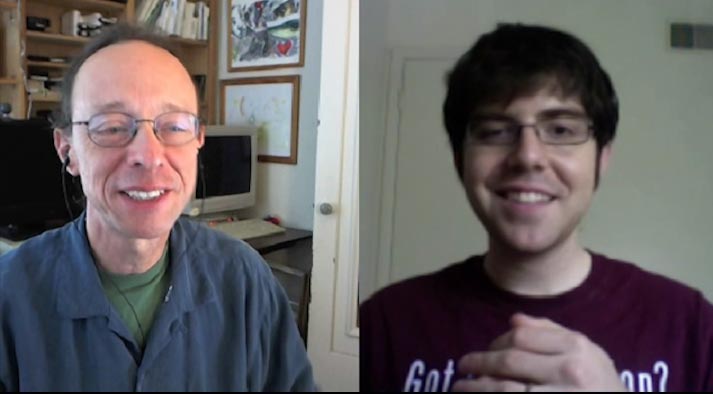
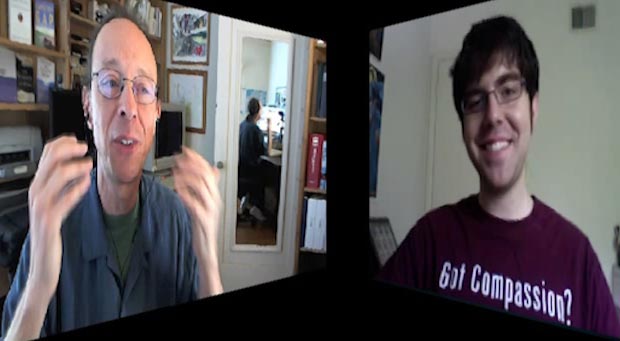
Daryl Cameron is a social psychology doctoral candidate at
UNC Chapel Hill. "I work at the crossroads of social psychology and
philosophy. My research examines the relationship between implicit social
cognition and moral decisions: how do automatic affective reactions and
deliberative reasoning interact to shape our moral lives?" Daryl's research focuses on the causes and consequences of compassion regulation;
and how implicit emotional processes contribute to moral decision-making.
"Psychological studies show that people feel more compassion for a
single victim than for multiple victims, a finding that has been
called "the collapse of compassion." The collapse of compassion should
strike you as shocking. Most people predict that they would --
and should -- feel more compassion if more people are suffering. Yet
people's emotional responses to actual victims tell otherwise. "
Daryl says, one way to increase empathy and compassion is
to make helping easy and not overwhelming. Create small easy steps that
people can do. Also develop trainings that build empathy and
compassionate resilience.
"Even when feeling empathy for others isn't financially
costly or emotionally draining, people will still avoid it because they
think empathy requires too much mental effort, according to new research
published by the American Psychological Association"
"Empathy Is Hard Work: People
Choose to Avoid Empathy Because of Its Cognitive Costs," by C.
Daryl Cameron, PhD, Julian A. Scheffer, MA, Eliana Hadjiandreou, BA,
Pennsylvania State University; Cendri A. Hutcherson, PhD, Amanda M.
Ferguson, MA, and Michael Inzlicht, PhD, University of Toronto; Journal
of Experimental Psychology: General, published online April 18.
Abstract
Empathy is considered a virtue, yet fails in many situations, leading to
a basic question: when given a choice, do people avoid empathy? And if
so, why? Whereas past work has focused on material and emotional costs
of empathy, here we examined whether people experience empathy as
cognitively taxing and costly, leading them to avoid it. We developed
the Empathy Selection Task, which uses free choices to assess desire to
empathize. Participants make a series of binary choices, selecting
situations that lead them to engage in empathy or an alternative course
of action. In each of 11 studies (N=1,204) and a meta-analysis, we found
a robust preference to avoid empathy, which was associated with
perceptions of empathy as effortful, aversive, and inefficacious.
Experimentally increasing empathy efficacy eliminated empathy avoidance,
suggesting cognitive costs directly cause empathy choice. When given the
choice to share others’ feelings, people act as if it’s not worth the
effort
"Question: Do U.S. presidents need empathy in order to govern
effectively?
An ethicist responds: As Election Day nears, voters are debating the
qualities that make for an effective leader. One contested quality is
empathy: the ability to understand and resonate with the experiences of
others. Does it matter if a president can relate to you and care about
what you are going through? On the one hand, empathy may enable
democratic governance by increasing awareness of different points of
view. On the other hand, empathy might cause partiality and favoritism
to particular points of view, clouding objectivity and fair judgment.
"
"His research focuses on causes and consequences of empathy
and compassion. In particular, he focuses on motivational factors that
inhibit empathy toward large-scale crises (e.g., natural disasters,
genocides) and stigmatized targets (e.g., drug addicts). His research is
funded by the National Science Foundation."
00:00 Introduction
03:00 Begin
big theme that unites my research is motivation capacity and limits of
empathy
what is empathy and what are it's limits and why does empathy appear
to fail in many cases when it's needed the most.
story situation - thought experiments.
child
drowning - do you have moral obligation to save the child? (powerful
empathy)
helping child via unicef (lacking empathy)
Cecile the lion is shot. lots of empathy and compassion for Cecile but
not for the millions of other animals.
Syrian boy drowned. lot's of empathy for him but not for others
My work: Why do we feel strong empathy for Cecile the lion and syrian
boy and not large scale suffering.
Definition of Terms - has subcomponents
experience sharing - photo of suffering boy you feel his
suffering - what are your reactions
7:30 some say empathy is automatic
we have choice about our empathy
empathy is a choice
9:00 benefits of empathy and compassion
cornerstone of morality
9:45 - people argue empathy has a dark side.
a susceptible to a variety of biases and limitations
10:00 Paul Bloom
inspired by Jesse Prinz
idea is we can run out of empathy -it's a fixed pie.
11:40 Argue that empathy deficits emerge from motivated choice
Self-control studies -
can fixed limits on empathy be expanded
limits based on motivated limits to disengage from others
Empathy avoidance studies
Studies by Jamil - if people think empathy is a skill that can be
incrementally build, they will exert more effort to feel more empathy
14:00
Empathy deficit in autism and psychopathy. give motivation and
they can raise empathy level
studies show empathy limits can fluctuate
15:00 empathy deficits are flexible not fixed
motivations
limits of empathy is not empathy itself but the motivations
18:00 Limit: Innumeracy issue - One death tragedy,
1 million a statistic.
suffering of large groups
one to many
why are we numb to numbers
does various experiments
Summary Innumeracy is not build in
32:00 Limit: Parochialism - Outgroups
dehumanization
happens in US most to homeless and drug addicts
53:00 what about compassion
compassion v compassion
59:00 Are the limits to empathy really flexible and if you motivate
people will they empathize more? (could make it a cultural value
to incentive people)
empathy is as limited as
we want it to be
59:30 Q and A
1:00 - What could cause empathy seeking?
trying to remind the social norms of helping.
having guilt for not being empathic
cost of not feeling empathy
if people felt they were effective at empathy they would do it more.
(don't be afraid of empathy)
A sponsorship for Edwin Rutsch - support me in leader the
imitative .
"The
terrorist attacks on Paris sparked an outpouring of support for people
affected. The attacks in Beirut that day before did not. Why?
Daryl Cameron, assistant professor of social psychology and director at
the Iowa Morality Lab at the University of Iowa, says it’s because we
don’t respond to the people living in those places in the same way....
During this hour of Talk of Iowa, host Charity Nebbe talks with Cameron
and Rebecca Renze, who is a high school counselor at Waterloo East High
School, about why we have empathy for some people and not others. Nebbe
also talks with Cameron and Renze about how to teach empathy."
"An essay in this week’sNew
Yorkerargues
that we don't have enough empathy to go around. But new research says we
can keep renewing and expanding our feeling for others.
Is empathy a limited resource, easily depleted and
restricted to those closest to us? That’s the argument psychologist Paul
Bloom makes in an essay for this week’sNew
Yorker, subtitled“The
case against empathy.” He admits that
empathy can do a lot of good: decades of research show that feeling
empathy can lead us to be more caring, forgiving, and altruistic.
But according to Bloom, empathy also can do a lot of bad. It’s an
untrustworthy moral compass because it is “parochial, narrow-minded, and
innumerate.” Empathy seems tuned to only one frequency, that of a single
identifiable victim, with whom we feel some personal connection.
According to Bloom, these biases make empathy ill-suited to help us
confront crises like natural disasters, genocides, and climate change.
Bloom concludes, “Empathy will have to yield to reason if humanity is to
have a future.”
"Compassion is a
powerful moral emotion—it moves us to care for the suffering of others,
and enables us to live cooperatively with one another.
Yet we live in a society of constant connection, in which the successes
and sorrows of others are brought to us instantly through phones,
computers, TV, radio, and newspapers. With that increased connection
comes the risk of becoming overwhelmed or overburdened by our emotions.
Fearing exhaustion, we turn off our compassion.
But my research suggests we can actually expand our compassion bandwidth
without hurting ourselves. As the science of compassion develops, we can
find empirically supported ways to cultivate and sustain compassion when
it is needed the most."
hen a stranger asks for money, people choose not to give for a variety
of reasons, even if their hearts want to -- perhaps they're not sure
what the money will be used for, or perhaps they'd rather give to an
organization that helps people in need. Or maybe they just don't want to
part with their cash.
Psychological studies show that people feel more compassion for a single
victim than for multiple victims, a finding that has been called"the
collapse of compassion."The
collapse of compassion should strike you as shocking. Most people
predict that they would -- andshould--
feel more compassion if more people are suffering. Yet people's
emotional responses to actual victims tell otherwise. Imagine reading
about either a single victim or eight victims. Experiments find that
compassion doesn't simply level off with more victims -- so it's not
that adding seven victims to the single victim increases compassion only
a little bit. Instead, adding seven victims makes you feellesscompassion
compared to just one. Compassion plummets as the numbers increase.
2:15pm - 3:15pm - The Costs of Compassion and Callousness
Compassion is a powerful moral emotion that often compels us to help
others in need. Yet we often avoid feeling compassion in the pursuit of
self-interested goals. In this talk, I will examine factors that
motivate people to avoid feeling compassion for others, and how
compassion avoidance changes how people think about morality.
Presenters:
Daryl Cameron, social psychology graduate student at the University of
North Carolina at Chapel Hill