



|
|
|
Culture of Empathy Builder: Jamil
Zaki
Jamil received his BA from Boston University, his Ph.D. from Columbia
University, and postdoctoral training at Harvard University. Now that he's
in the Bay Area, his hobbies include compulsive hiking, eating avocados,
and trying to remember how to drive again.
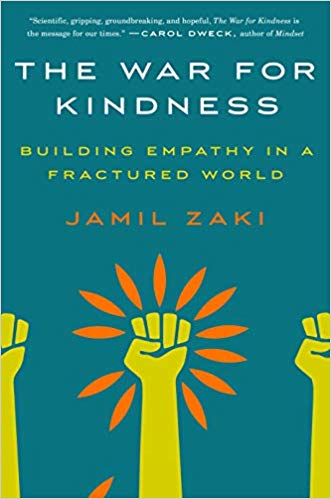
The War for Kindness: Building Empathy in a Fractured
World Hardcover
Empathy is in short supply. Isolation and tribalism are rampant. We
struggle to understand people who aren't like us, but find it easy to
hate them. Studies show that we are less caring than we were even thirty
years ago. In 2006, Barack Obama said that the United States is
suffering from an "empathy deficit." Since then, things only seem to
have gotten worse.
Book Claims
Empathy as a Radical Act | Forum "Are we born with a certain level of empathy? Stanford
psychology professor Jamil Zaki explores that question in his new book,
"The War for Kindness," which looks at the declining level of empathy in
society. He argues that, like a muscle, empathy must be trained or it
can atrophy.
(starts at 6 min)
Family story
Benefits of empathy
patents of doctors
relationships
give empathy - less stress, better adjusted.
Explain empathy - sense the friend is upset
catching feeling = emotional empathy
try to understand what and why they are feeling = cognitive empathy
feel concern for them and desire for their well being. = empathic
concern/compassion
Metaphor of the muscle groups.
Empathy levels scores - university student test.
Why empathy going down?
People living on their own
The internet?
living with a lot of people but it's not deep
22 - people who have experienced deep suffering (trauma) can go open
or closed -
altruism born of suffering
factor is how much support you get
25:34 - empathy double edged sward
Paul Bloom - empathy is parochial
oxytocin - become more ingroup caring
Jamil - we can broaden our empathy
27:30 - The Police and empathy training
(confuses taking sides and empathy)
(individualistic empathy)
empathy for ingroup.. making a judgment.
(confuses identifying with empathy)
30:00 - Oncologist - they suffer giving bad news
has a person cost
empathy can be an occupational hazard for the people who give it
Psychotherapist friend, sensitive to depressed patients
will absorb negative, painful feelings of others
also will lose themselves
caring professions - feel they have to turn off their empathy
People avoid situations where they will avoid situations
similar seeing the homeless
being
34:00 level of the group
we can dehumanize people because we are reluctant to feeling the
pain of empathy for a group
empathy can hurt us,, we can see ourselves in ways we do not like
38:00 Person wants to help
Building Empathy - Gym
41 - VR for identifying with others
feel being homeless
putting ourselves in the story can build empathy
Acting - role taking
actors become more empathic
narrative fiction (most stories are Us v Them,
reinforces us-them)
"they form greater empathy for those groups"
46 - In-groups
soccer fans supporting each other. (why are psychological
researchers so deceptive? does the deception have an effect of the
study)
expand the size of what we consider our group
empathy is the understanding that someone else's world is just as real
as yours.
THE WAR FOR KINDNESS
Stanford Prof. Creates Kindness Class To Help College Students Find
Empathy
"Empathy
in our culture is quickly receding, especially among college students,
the latest findings from Sage Journal show. The report says that the
average American college student in 2009 was less caring than three
quarters of students in 1979. Are people giving up on empathy?"
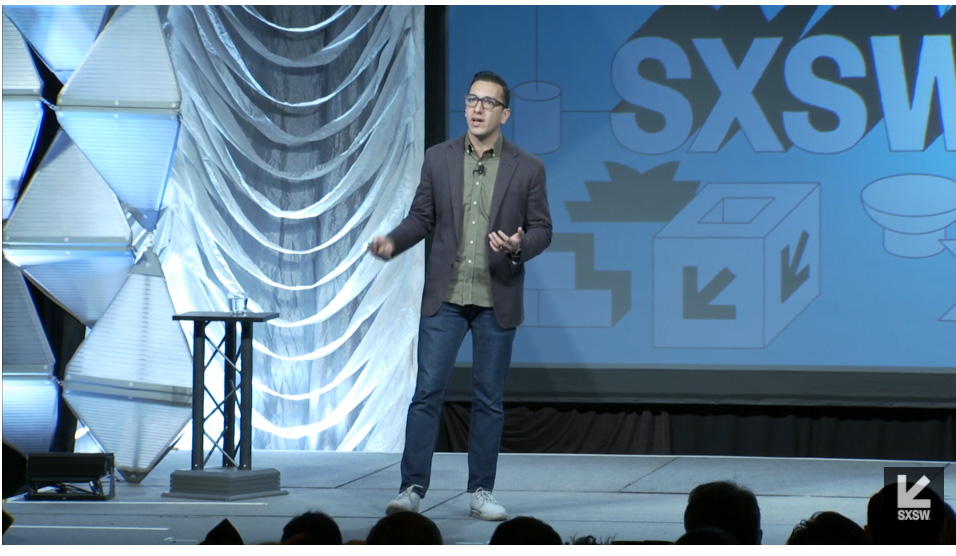
SXSW Live: 9:30am–10:30am | Featured Session: Jamil Zaki
Starts at 5 min mark. - ends at 1hr 5min
Sapiens cared for each other. worked together.
why worked well together. Empathy
psychologically we integrate
feeling of the tightrope
Adam Smith - fellow feeling - now called empathy.
Empathy an umbrella term
Benefits of Empathy
reduced depression - loneliness
Improved adolescent adjustment
professional success
patents more satisfied
employees do better
happier marriages
generosity for community
more open-mindedness
interest in environment
Empathy can be hard
hard in modern life
living in cities - don't know neighbors
alone in a crowd.
relationships are transactional
Compassion collapse
Hard to care about large groups.
Anonymous, Tribalism and Disconnected
Empathy Test - Empathy going down in society
Does it have to be this way? empathy down.
There is the idea that empathy is fixed.
Empathy is learnable - is a skill
Personal family story, divorce and empathy
Strategies to increase empathy
Conformity - can work for good.
create an Empathic norm
intervention - school test
Police Training. Washington
can create empathic culture
empathize with one person
life after hate
Believing you can increase empathy - increases empathy
Q and A
empathy goes up and down - feelings come and go
astronaut empathy
political polarization
being aware of manipulating
be aware and louder about empathy
crippling empathy - developing communication skills
empathy paralysis in large societies
unempathic manager
empathy in the body and chemicals - and VR
empathize with peoples negative qualities
how to empathize with people who are different
contact theory - have connection with the other side
role of touch and empathy
empathize with others and losing sense of self
empathy for non humans
ARTICLES
Compassion can be cultivated, argues a psychologist
Empathy is a skill that improves with practice, Stanford
psychologist-author says
"Much like our eye color or our hair's hue, empathy is sometimes thought
of as a trait that's determined by our genes and fixed for life. If you
believe this to be true, you may think that failing to empathize with
another person means this kind of compassion is missing from your
biological makeup. Fortunately studies of empathy suggest this isn't the
case. As Stanford psychologist Jamil Zaki, PhD, explains in a recent
Stanford news story, empathy isn't doled out to us in a fixed quantity
at birth, it's a skill that improves each time we use it."
Episdoe 78: Jamil Zaki & Michael Nye
"A night spent drinking and writing about his parents' divorce uncovered
an urgent need in Stanford professor Jamil Zaki to author THE WAR FOR
KINDNESS: BUILDING EMPATHY IN A FRACTURED WORLD. He and James talk about
how empathy can literally grow parts of the brain, hating the term
hard-wired, facing the problems of the world today, and (sigh) STAR
TREK: THE NEXT GENERATION. Plus Michael Nye returns to talk about
reviving and relaunching STORY.
EMPATHY IS A SKILL. HERE'S HOW TO CULTIVATE IT
JUNE 10TH, 2019
'A War For Kindness' Favors The Practical Over Polemical
Stanford scholar examines how to build empathy in an unjust world
June 4, 2019
"Even when empathy doesn't feel good, we know it can make us look good.
If Mother Theresa, the Dalai Lama, or Jesus are any indication,
compassion and generosity are the clearest signs of virtue. When people
must establish their moral bona fides, they turn to empathic actions.
Individuals are more generous in public than in private, and also act
kindly to convince themselves of
their own goodness. In several studies, psychologists have put people
under "moral threat," for instance asking them to remember times they
betrayed someone else's trust. To compensate, these participants help
strangers, donate to charity, and advocate for environmentally friendly
behaviors more than people who were not threatened."
Curious Minds:
Jamil Zaki On The Science Of Empathy
"If you're sensing that people are less empathetic today than decades
ago, your instincts would be right. We are. Though human beings are
wired to care about each other, we need the right conditions for those
feelings to grow.
Making Empathy Central to Your Company Culture
Psychology professor from Stanford speaks on how empathy
can mend our broken society
People filled the ballroom of the Hilton Austin Downtown Hotel, waiting
to hear about e"mpathy's short supply yet extreme importance. Jamil
Zaki, a psychology professor from Stanford University, spoke at SXSW on
March 12 at the Hilton. Highlighting his upcoming book "The War for
Kindness: Building Empathy in a Fractured World," Zaki discussed empathy
and how society can use it to mend gaps within cultures.
How
to Use Empathy to Better Your Life - Jamil Zaki
How do we navigate our differences at work, at home, in politics and in
society? In this enlightening, lightly humorous, and research-based
talk, Dr. Jamil Zaki delivers an astonishing overview of empathy: how it
really works, why it truly matters (especially to work places), why it's
on the decline, and how to build it back up through deliberate practice.
Experts in Emotion
-- Jamil Zaki on Empathy
0:00 Chapter
1. Introduction to Dr. Jamil Zaki
About Jamil Zaki
On Empathy and emotion
How did it start?
Grandmother in Peru - a collectivist society
Definition of empathy
complex - multiple definitions
put multiple definitions together - 3 parts
1. emotional response
2. cognitive understanding - TOM
3. motivational piece - understanding you do I have a motivation
to do something?
these are different distinct parts
emotional contagion
psychopaths can understand others but don't feel them or help
them.
may manipulate or harm others
5:00 How different for sympathy and pity?
pity - don't' enter into the emotion of the other
What are most interesting science discoveries?
the pieces - components of empathy are separate
Mirror neurons -
TOM - figuring out what people are feeling
understanding the context - full empathic response
9:30 Understanding the context
is it uniquely human?
degrees of empathy in animals
mice
chimps
How does this fit into society?
Pinker - society is less violent - maybe has to do with expanding
empathy
Is empathy a fixed quality? interventions
it can be changed - with perspective taking interventions
dissolve boundaries between people and groups.
compassion mediation helps
online interventions would be good
16:37 Chapter
4. What do you see in store for the future of emotion?
filed going in 2 directions
1. Fine grain assessment of empathy - math models
2. complex and naturalistic tests - how it unfolds in real life
situation
18:03 Chapter
5. What is your advice to viewers?
what are the next steps - the undiscovered teritory.
How to Avoid Empathy Burnout – Issue 35: Boundaries
Invited Symposium on Prosociality and Empathy
JAMIL ZAKI is an assistant professor of psychology at Stanford
University and the director of the Stanford Social Neuroscience Lab.
BUILDING
EMPATHY: How to hack empathy and get others to care more
Choosing Empathy: A Conversation With Jamil Zaki [10.20.15]
"If you believe that you can harness empathy and make choices about when
to experience it versus when not to, it adds a layer of responsibility
to how you engage with other people. If you feel like you're powerless
to control your empathy, you might be satisfied with whatever biases and
limits you have on it. You might be okay with not caring about someone
just because they're different from you. I want people to not feel safe
empathizing in the way that they always have. I want them to understand
that they're doing something deliberate when they connect with someone,
and I want them to own that responsibility.
Responses from
Empathy is a moral force by Jamil Zaki
FORTHCOMING in Gray, K. & Graham, J. (Eds.), The Atlas of Moral
Psychology
"More recently, however, a growing countercurrent has questioned the
utility of empathy in driving moral action. This argument builds on the
broader idea that emotions provide powerful but noisy inputs to people's
moral calculus (Haidt, 2001). Affective reactions often tempt people to
make judgments that ar
Full
Empathy: A motivated account by Jamil Zaki
"We often think of empathy as an automatic process. However, empathy is
often context-dependent. Our willingness to empathize with others
changes with different situations and with different people .A new paper
by Jamil Zaki resolves this tension by underscoring the role of
motivation in empathy. Motives drive our willingness to empathize. In
his paper, Zaki highlights specific motives that drive people to avoid
and approach empathy, illustrates a motivated model of empathy, and
suggests potential interventions to maximize empathy."
"People tend to stereotype psychological phenomena. It's tempting to
think that stress is always bad, resilience is always good, and so
forth. Like other stereotypes, these beliefs help us neaten the world
and extract signal from noise. Also like other stereotypes, such beliefs
are misleading and often harmful. Call me pessimistic, but whenever the
media breathlessly praises a practice or trait-meditation and grit come
to mind-I always wonder about its downsides. Jogging is great for you,
but not always, and not in every way (ask my knees). The same goes for
happiness. My own favorite human characteristic, empathy, is no
different. "
Empathy as a choice
"About 250 years ago, Adam Smith famously
described the way observers might feel watching a tightrope
walker. Even while standing on solid ground, our palms sweat and
our hearts race as someone wobbles hundreds of feet in the air (you
can test this out here).
In essence, we experience this person's state as our own. Centuries later, this definition does a surprisingly good job at capturing scientific models of empathy. Evidence from across the social and natural sciences suggests that we take on others' facial expressions, postures, moods, and even patterns of brain activity. This type of empathy is largely automatic. For instance, people imitate others' facial expressions after just a fraction of a second, often without realizing they're doing so. Mood contagion likewise operates under the surface. Therapists often report that, despite their best efforts, they take on patients' moods, consistent with e vidence from a number of studies."
5 ways to
be a more empathetic person
The neuroscience of empathy: progress, pitfalls and
promise "The last decade has witnessed enormous growth in the neuroscience of empathy. Here, we survey research in this domain with an eye toward evaluating its strengths and weaknesses. First, we take stock of the notable progress made by early research in characterizing the neural systems supporting two empathic sub-processes: sharing others' internal states and explicitly considering those states. Second, we describe methodological and conceptual pitfalls into which this work has sometimes fallen, which can limit its validity. These include the use of relatively artificial stimuli that differ qualitatively from the social cues people typically encounter and a lack of focus on the relationship between brain activity and social behavior. Finally, we describe current research trends that are overcoming these pitfalls through simple but important adjustments in focus, and the future promise of empathy research if these trends continue and expand."
A Conversation with Jamil Zaki About Empathy and Writing
What, Me Care? Young Are Less Empathetic "HUMANS ARE UNLIKELY to win the animal kingdom's prize for fastest, strongest or largest, but we are world champions at understanding one another. This interpersonal prowess is fueled, at least in part, by empathy: our tendency to care about and share other people's emotional experiences. Empathy is a cornerstone of human behavior and has long been considered innate. A forthcoming study, however, challenges this assumption by demonstrating that empathy levels have been declining over the past 30 years."
Empathy Fatigue and What the Press Can Do About It
Interview
Definition of empathy why not more about Carl Rogers?
Tania Singer Study Study of SJW
How to build Empathy?
Block to Empathy
Current work: Exploring - Cultural Empathy
THE WAR FOR KINDNESS
CHAPTER 1: The Surprising Mobility of Human Nature CHAPTER 2: Choosing Empathy CHAPTER 3: Hatred Versus Contact
CHAPTER 4: The Stories We Tell
CHAPTER 5: Caring Too Much
compassion fatigue. caring too much - self sacrifice few are at greater risk of overdoing on empathy than "caring professionals" p96 if you empathize to much (not empathizing with your own needs) (an individualistic empathy) you can empathize too much. look at it from the relational viewpoint. what is the level of empathy in the system? Teaching Empathy
CHAPTER 6: Kind Systems
CHAPTER 7: The Digital Double Edge EPILOGUE: The Future of Empathy Appendix A: What is Empathy Appendix B: Evaluating the Evidence
|
|||||||
|
||||