|




|
|
Culture of Empathy Builder: George Lakoff
(Thanks to Mike Epstein for doing the transcription.) Hi, it’s Edwin Rutsch, and these are dialogues on how to build a culture of empathy, and today I’m here with George Lakoff. Thank you for joining me, George. GEORGE LAKOFF: A pleasure to be here Edwin. Always a pleasure. EDWIN RUTSCH: Great, and let me just give a little introduction. So you’re a cognitive linguist and professor of linguistics at the University of California, Berkeley, and also Wikipedia says you’re most famous for your ideas on the centrality of metaphor to human thinking, political behavior and society. And you’re an author of quite a few books. They seem to break down in two different categories. One is academic books, and a couple of them are called Philosophy in the Flesh and Metaphors We Live By. And then you’ve got a whole series of books that are political books, and there are books like A Political Mind, Whose Freedom? Moral Politics, and Don’t Think Of An Elephant. I happen to have a couple of them right here. Some pretty thick, and some thinner. And the latest, I’m coming to that. So the latest is a little blue book The Central Guide to Thinking and Talking Democratic. Is there more by way of introduction about your background and academic and political interests? GEORGE: Sure. Let me first hold up a book. There’s the little blue book. Now, what I’m doing now is working on the way that the physical brain does thought and language. How do you get thought and language out of neurons? And I’ve been working with a group at the International Computer Sciences Institute for the last 25 years on neuro computation and cognitive linguistics putting it together with work on neuroscience and on experimental psychology. That has borne incredible fruit. We’ve learned a lot about how the brain does thought and language and especially metaphor. And that is going to be written up this summer. So I’m working on a book with ______ O’Ryan, who heads the AI group over at ICSI. The other part of this has to do with metaphor. Back in 1978 I made a discovery jointly with one other person who did it independently. And what we found was that metaphor is not a matter of language, but of thought. We think metaphor but … And since then we’ve worked at the details of that. There are certain metaphors that arise before you learn language – just by being in the world. And we have a neuro theory of how that works, so that just having a brain that’s connected to the body allows that, and that explains what “embodied cognition”, that is that your ideas are not abstract, that they are tied to your body, to how you move in the world and how you perceive and understand in general how your emotions are. All of those things are structuring the system of concepts that you use to think with. And many of those are metaphorical. And the metaphors are the most complicated kinds because they use other modes of thought. So you break down the types of thought that there are. Metaphors use them all, and that’s not obvious, but that’s what we’ve been showing. So by studying metaphor we are able to study the most complex thought and answer the question “how is it possible for the physical brain – 100 billion neurons and a quadrillion connections – how is that possible, how does that give you thought and language. And we have an initial answer to that. So that’s cool. That’s what I get to do otherwise. And the other applications that relate to politics, one is to literature, obviously, but also to philosophy. It turns out each philosopher has a set of metaphors they take literally. And then they carry their reasoning out perfectly. And that is in the book called Philosophy In The Flesh. And then there is a book called Where Mathematics Comes From where Rafael Nunez and I work out the foundations of mathematical understanding. So to understand mathematics, and any mathematician understands, it turns out that embodied cognition, together with metaphor, allows you to understand higher mathematics, understand forms of infinity, exponentials – things like that. And imaginary numbers, infinite numbers, and so on. It turned out to be metaphorical, only precisely mathematically specify those metaphors. So that’s done in a book called Where Mathematics Comes From. That’s what I do in my day job. EDWIN: That’s really such fascinating work. So you’re really like studying the physical workings of the brain and the neurons and how it relates to all these different fields and to language and to linguistics. So that kind of brings us to your book, The Little Blue Book. What we want to talk a bout here is how can we go about building a culture of empathy, and your book seems to be related to that topic. GEORGE: Oh, it’s essentially related to that topic. When I work on moral politics and was looking for the foundation of conservative and liberal thought, I didn’t understand conservatism at all. And so I said why is it that conservatives have the collection of ideas that they have. Why are they against abortion but for a flat tax or against taxation. What does taxation have to do with abortion. Why are they against environmental regulation. What does that have to do with abortion. Why are they for tort reform or for owning guns. What does owning guns have to do with tort reform. And then I realized that I had the opposite views, and I set out to try to understand this by studying my field, linguistics. You know I study political science and how people think. And what I discovered is that there are two moral systems behind this based on two notions of the family. We have the metaphor of the family. And that metaphor takes strict father families and nurturing parent families and wraps them onto conservative ideology and progressive ideology. And those ideologies apply to different domains. To the market, to religion, to foreign policy, to all sorts of things. And that turns out to explain the differences. And then when we got into the neuroscience of this, it turns out, of coursed, that a great many people, probably most people, have both systems, and are partly conservative and partly progressive. Conservative in some areas and progressive in others. And there’s an explanation for this in the brain. Which is that when you have two neural circuits – one for conservative ethics and one for progressive ethics. And they contradict each other. They way that works is by a mechanism called mutual inhibition, the activation of one inhibits the other. And then the more one is used, the stronger it gets and the weaker the other gets. And conservatives have been taking advantage of that. Now what does empathy have to do with all of this? Everything. Because America was founded on a moral system, and that moral system starts with empathy. It says citizens care about each other – they have empathy for each other, and they act on that. They don’t just sit around being empathetic. They act by forming with themselves and others a government that creates a concept of the public. What the public is – the public provides provisions for everybody. Obviously schools, you know, public health measures, food safety measures, clean air, clean water, sewers. But also things like electrical systems, power grids, for example, rural electrification. Or transportation systems, systems in which you have air traffic controller systems, things of that sort. The Federal Communications Commission sets up communication systems. These are systems that we all need. And it turns out that every private enterprise uses the public and depends on it. And e very private person having a decent private life depends upon the public. So imagine what your life would be like if none of that existed? It would sort of be like living in Somalia or you know, some other place where you don’t have necessarily roads that are maintained and built. And you don’t necessarily have electric grids and all of these things. This is absolutely necessary, and it starts with empathy. EDWIN: Okay, you’re saying that empathy is this kind of foundational value that progressive values are based on. So how are you defining empathy? What is your kind of working definition of what empathy is? GEORGE: Well, empathy arises physically. Empathy is a physical phenomenon. And that’s what’s interesting about neuroscience. This was discovered in Italy, back in the early 1990’s, by Professor Rizzilatti’s group there. And I’ve worked with the group, and I’ve worked with Vitorrio Balezi, who is one of the discoverers. And what we did – Vitorrio came to Berkeley for a couple of months, and we took the primary data that they had on this. What they discovered was this – they were worked with macaw monkeys. They had trained the monkeys to do certain tasks, like pressing buttons or peeling bananas, or crunching peanuts and eating the peanuts, and so on. And they had probes in the monkeys’ brains that went down into what’s called the pre-motor cortex. It’s the part of the brain that choreographs complex actions. And what they were able to do was to show what parts of the brain were active when the monkey did each of these things. That worked fine. And then one day
they were working on this, somebody took a lunch break, went out, came
back, saw a pile of bananas, started peeling a banana, and all of a
sudden, one of these brains started acting – the computer that was tied
to its third brain, and what they found out, was that when the
experimenter peeled the banana, the banana peeling So what that suggested, and what they later confirmed was that the same neurons that were involved in acting were involved in perceiving this same action. This has to do with moving your face and muscles in your body, because your emotional system is tied to your body. There is a physiology of motion that has been studied since the 1950’s. Paul Ekwin did the original work, and now it’s extended. We know what the body does when you're feeling certain emotions. We know where the brain is active when you’re feeling those emotions, and so on. And it turns out that you can tell basically, mostly, what other emotions people are feeling. Are they happy, said, or depressed? Are they feeling pain, etc. You can tell my looking at someone if there is some extreme emotion they have. And that’s a very important thing. You can also tell if they’re in the middle of some motor program, i.e., suppose they go pick up a glass of water as if to take a drink, you expect them to take a drink, because that’s what your motor program would do. So, the idea of empathy is this: that you have a physical ability to connect with other people, to see what they are doing with their body as if it were your body. And then to see what their muscles are doing, and your brain automatically connects those to the emotional regions to give you a sense of what their emotions are, as if they are your emotions. Now there are also parts of the brain that distinguish between yours and theirs. EDWIN: You’re talking about the inhibition, that you can know that your actions – there’s a separation between your action and others. GEORGE: The reason for that is when the motor neurons are firing, they fire somewhat les when you see someone else than when you are doing it, although they are firing when you see someone else. And actually, it’s more complicated than that. Only 30% of them work exactly this way, and the other 70% do much more complicated interesting things that Galazi and I have studied, figured out, and written up. Now, there’s also a set of neuron near there called the c0notical neurons. And they’re called conotical because they work on what are called “conotical actions”. For example, if you peel a banana, that is the normal thing that you do with a banana. You don’t normally stick a banana in your ear or step on it, or put it on your nose, or whatever. So this fire, when you eat or see a banana, or you does a conotical action on a banana. Okay. And it’s not just bananas – it’s anything else. So it is a set of neurons for connecting you to the world in terms of the normal things you do when you experience in the world. And you can see that we evolved to have this. We evolved to interact with the world, with the physical world in normal ways. So we actually have parts of our brain that connect us socially or emotionally to other people and to the physical world. And those parts of the brain can be either enhanced by being raised in the right way, or can be killed off by being raised in the wrong way. And that’s a very important thing, that is the way you are raised and what kind of family you’re in and what your parents do have everything to do with whether you’re going to be an empathetic person and whether you are going to have a respect for objects in the world and for nature itself. And those are very important things to know. And that physical basis is the basis for not just progressive thought but the basis for American democracy. The alternative to that in terms of the idea of democracy is the conservative view. And on the conservative view, democracy is about liberty, the liberty to seek your own well-being and your own self-interest without being responsible for the well-being or self-interest of anybody else. That is, everything is a matter of individual responsibility, not social responsibility. EDWIN: Can we take a step back? In terms of mere neurons, as I’m waving my hands here, you’re seeing my hands waving, and your body, your neurons are firing as if you are waving your hands as well. So that’s what the empathic connection is, is on how sensitive you are on picking up your acknowledgment with your head waving, a shaking. GEORGE: That’s right. I’m acknowledging by moving my head, and you’re getting that. EDWIN: Yeah, and then I know, you’re getting what I’m saying. So we have kind of this connection, a kind of a mirroring. GEORGE: It’s also a metaphorical connection. The major metaphor for communication is the communication is sending ideas to someone else through some conduit, and what you are doing is tracing out that conduit with your hands. This was discovered back in 1980 by researchers doing work on gesture, and they discovered there are metaphorical gestures. And now there is a whole field that studies metaphorical gesture. EDWIN: So then it’s the actions turn into a metaphor, and then the other person can kind of pick up that metaphor, and it creates an experience for them. Kind of a viscerally felt emotional experience. GEORGE: And language can do the same. Language too can create visceral emotional experiences, which is why people read novels or go to movies or watch TV shows, or whatever. Language or images can do that for you. And what’s interesting is that they can create in your brain, since all of that, every idea that you have is physical in a neural circuit. Every metaphor is physical in a neural circuit. Every narrative, everything you understand is there in a neural circuit in your brain. Now what’s interesting is those circuits can be activated independent of what’ external. You can imagine things. So there’s a great discovery that was made, first by Martha Fara at the University of Pennsylvania where it turns out that the same neural structures that are there used for seeing and moving in the world are also used for imagining. And the same neural circuits for feeling are also used for imagining. So that you can imagine things and put them together. So imagine a flying pig, okay? We’re “pigasus”, wear the wings. Well, you know where the wings are. They are attached to the sides of the back, right? And you know where is the snout, it’s facing where the beak of the bird would be, etc. What you are doing is putting together the structure of a bird and the structure of a pig, and you’re creating a flying pig, even though pigs can’t fly. Now, this is not the only way you can get a flying pig. You could also have super swine, which is a cake, and as it thaws out, like that, right? And I think the main thing is that you can imagine this. Now it turns out dreams work the same way. I have a study some years back of the metaphorical structure of dreams. What I showed is the normal metaphor system is there interacting with your everyday concerns to structure your dreams. And then the dreams have to do with the activation of those metaphors and your concerns and your emotional concerns in your everyday life. And that gives rise to the emotional and cognitive structure of dreams and the linguistic structure of dreams, internally. One of my students, Beth Ford Friend, did a dissertation in the divinity school in Berkeley where she looked at religious visions. You know, St. Teresa of Avila, for example, and others. And what she found is that they were metaphorical as well. And that what was involved is they put together existing conceptual metaphors, that is circuits in the brain to give them an experience coming from the inside. And when you have that experience coming from the inside, which you attribute it to being external, as when people hear voices which are generated from the inside. That is the brain can generate knowledge, inferences, ideas and so on, and this supplies to politics as well and to human relationships, to relationships with your loved ones, with your family, with friends, and so on. So it turns out empathy is right at the center of all of these issues. EDWIN: Well that’s why I’m kind of delving into the definition of it, because I’ve looked at this for some time now, and there seems to be a lot of different use of the word empathy. So I’m really trying to get a sense of clarity around what empathy is. So there seems to be two parts to it, what you’re saying. One, it seems to be based on that mirror neuron where we’re mirroring. And the second part is kind of an imaginative, and I think the academics might call it cognitive empathy or perspective taking. Is that the second part of how you’re seeing it? GEORGE: They’re not separate. They have the same mechanism in the brain. That’s what is interesting. They’re not different. From the perspective of how the brain works, they are one phenomenon. That is, it is perspective taking, which means you can activate the same circuits that would be involved in interacting with someone else. And that you can imagine it, and maybe interacting with an imaginary person. Or with your image of what God would be. Or something like that. So the idea is that you have empathy of all sorts, but there is one mechanism for it. And what gives rise to the multiple definitions is our folk theory of how the brain works, or how the mind works, which is our folk theory, which is that our thoughts are abstract – they are separate from the body. And that is false. As soon as you understand how thought actually works physically, then you see that there is really one mechanism. And from a scientific point of view, there is just one empathy. EDWIN: So it’s like a perspective, so-called perspective taking, is really just kind of imagining someone else as using all that mirror neuron circuitry, basically, to activate all those feelings and experiences. GEORGE: But in doing that you’re activating that circuitry. So you’re actuating an imaginative version of mirror neuron circuitry, where you’re imaging perceiving, you’re also imaging acting, moving your body. And you’re also imagining the function that go along with the physiology of emotion. EDWIN: Okay, so if we want to build a culture of empathy, what we are wanting to do is basically to enhance that process. And there are all different kinds of blocks, maybe, to that process of connecting, with each other. GEORGE: Right. And let me tell you some of the blocks. When you look at the strict father model of morality, which is the basis of conservative thought. It is based on the notion of a strict father family. Now, the basic – and that’s a moral system. So the question is where does our morality come from? From the same place, it turns out. Our morality has to do with well-being, our well-being and the well-being of others who we can connect with. So the very notion of morality involving our well-being which has to do with neural circuitry in our brain plus the neurotransmitters, the chemicals emitted in the brain because of the action of that circuitry and that also cause the action of the circuitry. They are intimately connected. That is the basis of all moral systems. That is, when we grow up as a child, we experience well-being in certain contexts and ill-being in others. And those contexts give rise to a metaphor called understanding of morality. For example, you are better off if you eat pure food than if you eat rotten food. So morality is purity, and immorality is rottenness. Some things are rotten in the state of Denmark. Some things are rotten things to do. You have purification rituals around the world. Or every one-year-old knows that it is better to stand up and walk on two legs than to have to crawl on the ground. So morality is uprightness, and immorality is being low-down, underhanded, and, you know, being a snake in the grass, etc. Right? You have the idea that you’re better off if you have the things you need than if you don’t. Right? So, that gives rise to the idea that well-being is wealth, and ill-being is poverty. Poor John, you know. This world for being poor is used also for having ill-being, for not having well-being. And that gives rise to the notion of well-being as wealth and accounting gives rise to a complex metaphor of moral accounting. If I do you a favor, you owe me one, how can I ever repay you, etc. If you hurt me, then I can repay you in kind, or I can hurt you back, or you can make up for it, and, you know, you can recompense me, and so on. So moral accounting is part of that. And a big part of it has to do with the family. That is, you are better off generally if your parents nurture you than if they don’t. So morality is nurturance. You’re better off if you listen to your parents than if you don’t. So morality is obedience to legitimate authority. That notion of morality, obedience to parents and legitimate authority, gives rise to a strict father family. The other metaphor gives rise to a nurturing parent family. Those metaphors arise just by living in the world. They arise because two parts of your brain – one with well-being and one with some other experience – are activated together. When they are activated together, activation spreads to find the shortest pathway between them, and neuro-learning will create a metaphor which is that pathway. So that you will learn metaphors from morality before you even learn to talk. And then the language will follow suit. But you learn those so early and they are shaped in your family. And so the question of whether you – and everyone will learn both of them. And the question is which one is enhanced and which one is not enhanced. If you are neglected or beaten from the time you are born, one thing will happen. And if you are loved and cuddled and taken care of, another thing will happen. And those are really crucial in all of these circumstances. EDWIN: So it’s like how are we fostering empathy within children from the very beginning. That’s kind of what you are looking at. What about the aspect of fear as a block? Because it seems that fear is something – empathy seems to need some kind of open awareness to be able to take in others. And fear can kind of shrink that awareness. GEORGE: Well, fear is, you know, one of our natural emotions, and it has to do with homeostasis that is in the body, that is maintaining safety. So if you have fear, what that does to maintain safety is to shut down empathy with your attacker. Now if you’re attacker is your parent, then you know, the possibilities for empathy are cut down to a large extent. And that makes it more difficult. So, yes. What that does – fear has the mechanism of shutting down empathy with the person you fear. And, again, it’s mutual inhibition. EDWIN: So, there’s mutual inhibition in the sense that if we have circuitry of empathy and wanting to connect – and that’s kind of like a natural capacity we have – that we also have a circuitry for fear and protection that shuts down the empathic connection with others. GEORGE: Right. Exactly. So it’s very important to overcome that fear and to cultivate that empathy. And I can’t stress how important childhood is. By the time you are five, half of your neuro connections die. Now that leaves you a lot. I mean, you are born with 100 billion neurons, each neuron has between 1,000 and 10,000 connections. So you are born with about a quadrillion connections in your brain, half of them die by the time you are five, depending on your experience, the ones that are least used die off. So it still leaves you with a half quadrillion. And there are lots of changes that can occur after five. But what happens between birth and five shapes your brain. And that’s why early experience is the most important determinant of the possibilities for empathy. EDWIN: There’s a whole movement that I’m just becoming aware of how attachment, early attachment training, the importance of mirroring the child and being present, and holding, and that physical connection, and that reflecting of the child. GEORGE: That’s right. If you go back to my book on moral politics back in 1996, there is a chapter on raising children, and a whole chapter on attachment theory. And what attachment shows, then, has been elaborated since then, but more confirmed, that early attachment is extremely important in building empathy. And that this started from the study of killers. It started in England. They tried to figure out how killers were brought up, and they were largely brought up without empathy, you know, without attachment. And that’s a major finding. So this is extremely important. Attachment theory in raising children is a very important part of raising children. Abuse theory, you know, what is the opposite. How are children abused? And children are often abused when they are punished for doing things that are wrong. When they are physically punished, etc., as opposed to when they are positively reinforced for doing things that are right. You can do that either way, and that’s a very important difference. So, these are crucial differences in childhood for building empathy. And what’s interesting here is that the word empathy is sometimes confused – largely by conservatives – with sympathy. Since they don’t believe in empathy, then they may have less of it. And that’s another question. Do they have less empathy? There are people who claim they do, and I don’t know whether that is true or not in terms of the science of it. I suspect it may be, but I don’t know. There is a very important finding, which is that conservatives have in-group nurturance. That is, they take care of the people in their group, but not out of their group. And this is certainly true in the military. In the military, you form teams, and people take care of each other on the team, but they’re fighting against people outside of the team. And that’s a very common situation, where you take care of people in your tribe, and you fight against people outside of your tribe, historically in terms of that. So this, again, a complexity that you find. It’s not that conservatives never have any empathy for anybody. They may very well have empathy for their friends and neighbors. They may very well have empathy for people in their group. EDWIN: So we’re talking about in-group and out-groups of empathy. It’s like who do we have empathy for? Is it for our families? Is it for people with similar political beliefs? Is it for people with the same religion, the same ethic group? And so there is this whole dynamic of how we can open ourselves for empathic connection. And maybe who we fear and see as the other. GEORGE: …I think that’s right. I think that’s really important to see that that’s the case, that the issue of empathic connection and what blocks it is at the center of all social life. And political life. EDWIN: I’m talking about metaphor in doing these dialogues, and you’ve done about 110 of them so far. I’m starting them off actually by asking what is your metaphor for empathy? And it’s amazing. Everybody has a different metaphor, and there is a typical metaphor, you know, standing in someone else’s’ shoes, looking through someone else’s eyes. For me, empathy is like a cornucopia, in the sense it opens the door to a wide variety of feelings and experiences more than I would have just on my own. So I’m wondering what is your metaphor of empathy? GEORGE: Well, first dose. Yours has to do with the effect, causal effects rather than the direct experience, and the others have to do with the direct experience of having someone else’s experience. Now that has to do with another metaphor system, just a metaphor system for the self. If you want to read a bout these metaphor systems, the book to look at is Philosophy of the Flesh by myself and Mark Thompson. It’s a large easier read book, but it’s large because it goes into all the stuff in very great detail. But again, it’s easy to read and fun. And it goes through all the metaphors, from morality and for everything else, and for the self. And the basic understanding of the self is the difference between your locus of consciousness and the rest ________36:55. And your locus of consciousness is usually understood as separate from the rest of your body, so that one distinction is you versus your body. Another is you versus your social morals, you know, or you versus some other person inside you. So you can be fighting with yourself and so on. And those, there is a whole set of those metaphors, almost two dozen, that we have for understanding who we are. And those metaphors are going to be used in understanding empathy metaphorically. So the question is, can you project your conscious experience, your consciousness, your “subject” into someone else. And when you do that and can truly understand where it would be to be in someone else, that’s one way of understanding empathy. Why? Because what mirror neurons are doing is connecting your ___________ 37:53 to see what it would feel like to see someone else, and understand their emotions and understand what they’re doing as they’re doing it. So in essence, the experience of projecting into someone else is given by the neuro neurons. EDWIN: So, it’s kind of like connecting to my own experience of what it feels like to have a wide variety of feelings, kind of taking that experience and kind of extending it. GEORGE: Right. Bu I think the most important thing to understand is that this is a scientific finding. It has to do with actual neuroscience. And, you know, it’s not at all surprising that it is a scientific finding. And it’s not one of these things that are hippie-dippie, or something like that. Not at all. They have to do with the most basic of human connections. EDWIN: Yes, so it used to be a lot of this talk was ki8nd of based on philosophy and now it’s like it’s taking it out of that realm, and also maybe mysticism. And now it’s grounding it in this is actual physical science of this is what is actually happening in our minds and body. And you didn’t talk about your metaphor that you personally have for what empathy is like. Do you have a personal metaphor? GEORGE: Well, it’s not just one. I think putting yourself in someone else’s shoes, seeing the world through someone else’s eyes. I mean, those are very, very appropriate ones, and they work very well. Taking someone else’s viewpoint is another one. That viewpoint metaphor has to do with another metaphor, which is knowing is seeing, where you understand something by seeing something thoroughly. And if you take someone else’s viewpoint, you’re seeing something really from someone else’s view, thereby understanding things the way they would according to that metaphor. So that involves putting two basic metaphors together, the metaphor for the self and the metaphor for knowing is seeing. I’m sorry to give you all the analysis of this. EDWIN: That’s okay. That’s what science is about. It’s really fine interviewing artists, because they kind of pop those metaphors up just, you know, this day is slow 40:25??? Metaphors. I love them too. They’re a lot of fun. GEORGE: They’re wonderful. Metaphors are what shape your brain and shape your understanding of the world. And interesting artists are people who have understandings of the world that go beyond everyone else’s normal understandings of the world. Which means extending metaphors. And that’s great. That’s a wonderful aspect of human experience. EDWIN: Okay, so I’m really spending a lot of time on this empathy part, you know, the definitions. So thanks for bearing with me. I think it’s so foundational to everything else that you’re building up about the understanding of how progressive and conservative morality works. And understanding the dynamics. So maybe we could start going into that more. Kind of step by step. So we’re at the point where we want to foster a sense of connection between this empathic connection. And thee are things that are blocking it, and you’re saying that conservatives in some way are blocking the empathic connection? They have a different sense of morality? GEORGE: Well, they have a very different theory of morality. So if you look at conservative family models, you have a strict father family where first, the father is the ultimate authority. He knows right from wrong, and what he says goes. And he knows more than anybody else, and his authority cannot be challenged. First. Secondly, in a family where there is a wife, and a strict father, the role of the wife is to uphold the authority of the father, and to follow that. That, of course, isn’t always true in a family, but this is the ideal case of the strict father family. Now, of course, if there is no father around, then the mother can take the strict father role and be a strict mother in a single parent family. Or not. They can be either way. Also, as I said, some people are partly nurturing and partly strict. Now in a strict father family which is just about that, the role of the father is to teach children right from wrong. And the assumption is that children want to do what feels good, and that that’s bad. They don’t know right from wrong. And the role of the father is to punish them when they do wrong. And it has to be painful enough so they will want to avoid the punishment and learn the discipline of not doing wrong. So, part of this is the father has to punish the child painfully enough so that they will get the discipline to have moral discipline. EDWIN: Could we step back a little bit, in the sense that with empathy, with me, I’m looking at a culture of empathy which is everybody listens to everybody else to the maximum amount, empathizes with everyone else. There is maximum empathy from you to me, from me to you, to our families, to the whole of society, in that no one left out. And then if you are talking about the strict father, you’re saying who gets heard in this situation. Right? Who is the one who is going to be heard among us? Is that right? GEORGE: Who is going to be obeyed. And who is going to do the punishing. Who is going to use force. In a strict father family, it is a moral obligation of a strict father to punish the children so that they will become moral beings and get discipline. And if they have discipline, then they can go out in the world and prosper. And if therefore, someone isn’t prospering, then they don’t have discipline, they can’t be moral, so they deserve their poverty, which is part of conservative thought. So this is a major part of the strict father family. It’s also the case that what you’re supposed to do is foster discipline in a child. If the child rebels still, then the child has bad character – there is something wrong with the child. Right? And that they therefore aren’t deserving. Their will should be broken. And that’s the way it’s done in conservative child rearing manuals. You’re supposed to break the will of the child to obey the legitimate authority. And that goes along in politics with a punitive view of prisons, of sentencing, and so on. You know, i.e., rather than trying to make someone into a better person, you punish them, which assumes that is what makes them into a better person. EDWIN: So it’s like the family model, the inner personal model is getting reflected at a societal and political level. Then personal interaction is being manifested at that level. You know, you’re saying that with the strict father, here’s the rules, here’s the discipline. And isn’t part of that about that it’s a dangerous world, that we have to close ourselves off, we have to follow through because there is so much danger out in the world, and this is the best way of addressing that danger? GEORGE: That’s exactly right. If you go back to the Reagan era and the hearings about Iran Contra, the very first thing that was said in those hearings by the conservative witnesses is that this is a dangerous world – repeated over and over. This is a dangerous world. And that whole set, as soon as you say that, what you are doing is bringing up fear and blocking empathy. It’s the very first thing that happens. And that’s a very important thing. Now one thing that is important in a nurturant parent family is a nurturant parent also wants to get the children to be disciplined, to do things so they that are not harmed and do not harm other people. But you do that through empathy. That is, empathy can provide a form of internal discipline when you have a responsibility to help other people, and to empathize with them. So that you can build a positive discipline rather than a negative discipline. And there are whole books now on child rearing called positive discipline. Very important to have positive discipline via empathy. So a lot of conservatives will think that the only way to be disciplined is by being punished. And this is simply not true. The best way is to be disciplined by thinking about other people and acting responsibly for them as well as for themselves. EDWIN: So in discipline, if someone has done harm to someone, it’s like you can punish them and give them pain and suffering so that they hopefully don’t do it again, or you can someone find a way to empathically restore empathic connection. And there is a whole process out there – restorative justice – what I would call restorative empathy, which are processes for getting people who have done harm to each other to create a circle process and have dialogue and reconnect with each other. GEORGE: Yeah. I think that’s right. And it’s very important. EDWIN: It seems to me that what you are talking about, really the core part is the relationship between fear and empathy, and how it relates. Do we nurture fear, and how we deal with fear, and how do we nurture this connection between people, this empathic connection. And with the fear being something that makes us close off, and empathy, which is something open that connects us. GEORGE: Well, fear is real. And important that we evolved to have fear in the right ways. There are things that we should fear. There are times when you shouldn’t have empathy. If somebody is trying to kill you, you should fear them, and stop them. That’s real. And attacks are going to happen. Other people will grow up without empathy. That’s inevitably going to happen when you have parenting that is neglectful or harmful. That will happen. Or abusive. So, that’s real in the world. And you should have fear in the right ways. You should have fear about global warming. Now fear may shut off the empathy cord of the world. And that you don’t want to do. What you want to do is to address the real fear by saying, look at how we connect with the world. And we have to act positively on that. Just promoting the fear is not going to promote the empathy needed to address global warming. EDWIN: You have written this book, The Little Blue Book, and it’s based on what we’re talking about here on empathy and how Democrats and progressives can do more to frame their language so that it fosters empathy and fosters connection. GEORGE: That’s right. The idea is this. The conservatives have framed just about every issue, because they have a greatly superior understanding of the role of morality in politics, whereas the Democrats have largely been thinking about the role of policy in politics. And all policies are based on morality. All politics is moral. Politicians say, do what I say because it’s right, not because it’s wrong or doesn’t matter. So it’s all based on morality. The q1uestion is, is it conservative morality or progressive morality. And the conservatives have gotten their framing and their language out there. All words are defined relative to frames. And the frames in politics are all defined relative to moral systems. So every policy that a conservative or a progressive has is understood relative to their understanding of hat is moral. Now if you adopt other people’s language, you adopt their frames and strengthen their moral system in you. That is, you’re changing your brain and the brains of other people. So what you want to do is to strengthen the moral systems based on empathy. And that means not using other people’s language. Not just taking their language and negating it, as if you could logically argue agai8nst it. This isn’t about logic. It’s about understanding. And what usually happens is that conservative framing hides a deep truth in various areas. So in economics, the first deep truth is the private depends on the public. You shouldn’t be just privatizing. The second one is that the public is there to carry out moral responsibilities. So you might privatize practical things, like building roads. You might hire local contractors, and you should. That’s practical privatization. But there’s moral privatization that should never happen. You shouldn’t turn over moral issues to private companies for their wealth. For example, you shouldn’t have private prisons where the prisoners lives and health are there because of companies trying to make money. And therefore, what they’ll do is cut down on prison guards, and conditions. And people will die and be harmed by that. But it’s not just prisons. It’s schools. You don’t just shut down public education and privatize it. It’s immoral. EDWIN: So what we’re really looking at is how do we create a language of empathy, basically. How does every policy relate to fostering, nurturing, promoting empathy. And how do we have a language that can articulate that. GEORGE: But the language is secondary to the ideas. The question is how do we understand what ideas about various ideas, like education, or the environment, flow from empathy, rather than from self-interest, and just trying to maximize your short-term profits. Right? How do you do that. How does it flow from caring about other people, rather than having a strict father morality that has to do with how women are treated in society. It has everything to do with male empathy for women. And that’s crucial. Every issue has to do with empathy. And with understanding the issues, the political and social ideas that flow from empathy. And then you can get a language of empathy. And when you do that, you undermine the conservative ideas. EDWIN: So you were talking about self-interest. So, in a way, self-interest is about how do I shut off my empathy for others and just focus on what’s going on inside myself. I know that this has gone on for about an hour, so I don’t want to keep you. I don’t know if you have other appointments. I could go on. I want to say that in my kind of exploration of existence, life, my quest for what are values, and progressive values, I was highly influenced your work. So it’s just such a pleasure to talk to you about empathy, the nature of empathy. So I feel like it could go on for hours, exploring this. And perhaps we can have other dialogues. But we’ve gone on for an hour, so I don’t want to go over the time. GEORGE: It’s a real pleasure to talk with you, always. And I have to say that I deeply admire you for taking up this most central part of our connection to other beings, our connection to the world, and the way our politics is run. And by devoting yourself to a culture of empathy. I think it’s one of the best things one can do in life. And thank you for that. EDWIN: Well, thank you for taking the time to share your thoughts on this, and I look forward to future discussions, and working together to build a culture of empathy. Worldwide. GEORGE: Absolutely. Thank you. Bye. EDWIN: Bye, George. ===================================
The following video clips are excerpts of the
sections on empathy from various talks.
"There are different kinds of families. A progressive family works like this. If there are two parents they have equal responsibility for their children. Their job is to empathize with their children, to know what their children need. To have two way conversations with them to find out what they need and communicate directly so that the children will know why the parents are telling them what to do for their benefit and the parents will know what difficulties the parents are facing."
55:45
Don't
negate: 57:45 Q. Is there anyway to redirect the conversation to empathy. I feel like that is what is missing from the conversation. A. That is exactly right. Empathy is the basis of progressive thought. It is the basis of progressive family life. Obama said something very interesting in his fathers day talk in 2008, when he went to an African American church in Chicago and was addressing young men there who had fathered children but were not married to the mothers and were not raising them. He said to them, you are not really men. Real men go and raise their children and if they have spouses or mothers who are raising the children and know what's going on they respect those mothers and listen to them.
George Lakoff on Empathy & Care as Core Values
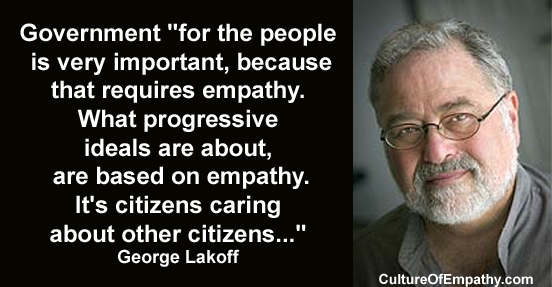
"(Government) for the people
is very important, because that requires empathy. What progressive
ideals are about, are based on empathy. It's citizens caring about other
citizens and others in their country and acting through the government
to provide pubic resources for everyone that allows people to be free.
Whether it's public education, health, justice all sorts of science and
technology development, medical development, etc."
2010-12-10-
Untellable Truths - Huffington Post
How Brains Think
2005-2007
2009
George Lakoff speaking at McNally Robinson Part 4
Recorded December 1, 2011 - George Lakoff, "Retaking Political Discourse"
(we need to create a philosophy, world view, stories, etc. all based on the foundation and premise of fostering more empathy. Creating an empathy based system).
|
||||||||||||||||||||||||||||||||||||||||||||||||||||||||||||||||||||||||||||||||||||||||||||||||||||||||||||||||||||||||||||||||||||||||||||||||||||||||||||||||||||||||||||||||||










|
||||