|
|
Culture of Empathy Builder:
Gary Olson
http://j.mp/V5zAfX
|
|
|
Gary Olson
|
|
 |
 |
'Gary
Olson chairs the Political Science department at Moravian College in
Bethlehem, PA. For the past few years he's been writing on the political
implications of recent neuroscience research findings on empathy'
He is author of
Empathy Imperiled: Capitalism, Culture, and the Brain and many
articles on the role of empathy in society, culture and politics.
|
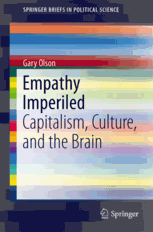
Book: Empathy Imperiled: Capitalism, Culture, and the Brain (Free
Preview)
Empathy is putting oneself in another’s emotional and cognitive shoes
and then acting appropriately. The evolutionary process has given rise
to a hard-wired neural system, described as “the most radical of human
emotions, that equips us to connect with one another. But this critical
connection has been short-circuited by the dynamic convergence of
culture, politics and the brain under the hegemonic influence of
neoliberal capitalism.
The book explores this process through sections on
education, the neoliberal state, neuromarketing, corporations,
militarization, mass culture, film, photo images and media. How does the
system blunt, bracket off and or otherwise channel empathy’s
revolutionary potential? What does this reveal about how the world works
and especially, how it might work better?
Empathy Imperiled offers a provocative, empirically
grounded dissent from capitalism’s narrative about human nature. It
offers a unique perspective on our current political culture and process
and as such it will appeal to students and scholars in political
science, psychology, anthropology, and several related fields.
TABLE OF CONTENTS
-
1. Introduction: Good, Better, and (Dangerously)
-
2. Retrospective: Moral Outrage or Moral Amnesia?
-
The Execution Class
-
Postscript 2012
-
Notes
-
3. Mirror Neurons, Evolution, and Eco-Empathy
-
Empathy Versus Ecocide
-
Notes
-
4. The Body Politic’s Brain on Neoliberal Culture. Any
Questions?
-
Cultures Suppress Some Emotions and Encourage Others
-
The Cultural Regulation of Emotion
-
Neuropolitics and the Encultured Brain
-
Gramsci on Culture
-
Notes
-
5. The Neoliberal State and the State of Empathy
-
6. Corporations: Empathy–Devoid Psychopaths
-
7. Neuromarketing 101: Branding Empathy
-
9. The Empathetic Power of Images
-
10. Cuban Internationalism as Dangerous Empathy
-
11. Conclusion: Making the World Safer for Loving Our
Neighbors
June 15, 2011 - Masculinity, Militarism and Empathy
Knowing something of feminist-human rights
activist and sociologist Kathleen Barry’s ground-breaking work on female
sexual slavery and related topics, I hoped to unconditionally recommend
her latest book Unmaking
War, Remaking Men (Santa
Clara, CA: Rising Phoenix, 2010). And
because I’ve recently been studying the politics of empathy, I was also
favorably predisposed by the book’s intriguing subtitle, “How Empathy
Can Reshape Our Politics, Our Soldiers and Ourselves.” I do intend to
make this book required reading in two of my courses, including a
seminar on the politics of identity which has a gender component. However,
as will become clear below, my only hesitation for not totally embracing
Barry’s thesis derives from questions I have about the political lessons
she draws from her research.
2010-06-26 -
Empathy & Neuropolitics
Mirror neurons, the brain cells believed to be the basis for empathy,
have recently been identified in the human brain. And yet we’re left to
explain the disjuncture between this deep-seated, pre-reflective, moral
intuition and the paucity of actual empathic behavior, especially in
certain cultures. I suggest that answers may be found in the
bidirectional connection between culture and brain development.
2010-02-09 -
Jeremy Rifkin’s The Empathic Civilization and P.W. Singer’s Wired for
War
Two recent books on the future, both seeking to interpret selected
aspects of a rapidly moving, technologically complex world, are each
deeply flawed but well worth examining for what's missing. One author
fears we are heading toward global entropic destruction of the Earth’s
biosphere unless we reinterpret history in light of new scientific
evidence that proves humans are an empathic species. The other, more
narrowly focused, explores the advent of military robotics, the
revolutionary technology that promises to dominate future battlefields.
2009-10-13 -
Frans de Waal's Age of Empathy: A Review and Critique
The next time you find yourself in a contentious conversation with
someone who’s arguing that humans are inherently selfish, embrace
killing and war, and (mis) using terms like “Social Darwinism,” give
them a copy of Frans de Waal’s latest book, The Age of Empathy:
Nature’s Lessons For A Kinder Society (Harmony, 2009).
2009-06-01
-
Empathy Marketing
101
Not infrequently the most convincing testimony to the veracity and
potential power of new scientific discoveries is when they're embraced
-- for profit-driven motives -- by corporate America. Today the
incandecent mantra in business and advertising circles is "empathy
marketing," or more broadly, neuromarketing (NM). Market researchers and
advertising experts are attempting to stand shoulder to shoulder with
"the better angels of our nature" in hopes this will increase sales. In
short, putting oneself in another's shoes is a technique for selling
them another pair.
2009-11-00
-
We Empathize, Therefore We Are: Toward a Moral Neuropolitics
Based on recent findings from neuroscience we can plausibly deduce that
the mirror neurons of the viewer were engaged by these images of others
suffering. The appeal was to the public's awakened sense of compassion
and revulsion toward graphic depictions of the wholesale violence,
barbarity, and torture routinely practiced on these Atlantic voyages.
Rediker notes that the images would instantaneously "make the viewer
identify and sympathize with the 'injured Africans' on the lower deck of
the ship . . ." while also producing a sense of moral outrage
2008-05-20
-
Hard-Wired for Moral Politics: Neuroscience and Empathy
The nonprofit
Edge Foundation recently asked some of the world's most eminent
scientists, "What Are You Optimistic About?
Why?"
In response, the prominent neuroscientist Marco Iacoboni, cites
the proliferating experimental work into the neural mechanisms that
reveal how humans are "wired for empathy."
etc
Extended Contents with
Notes
-
1
Introduction: Good, Better, and (Dangerously)
-
2
Retrospective: Moral Outrage or Moral Amnesia?
-
The Execution Class
-
Postscript 2012
-
Notes
-
3 Mirror Neurons, Evolution, and Eco-Empathy
-
Empathy Versus Ecocide
-
Notes
-
4 The Body
Politic’s Brain on Neoliberal Culture. Any Questions?
-
Cultures Suppress Some Emotions and Encourage Others
-
The Cultural Regulation of Emotion
-
Neuropolitics and the Encultured Brain
-
Gramsci on Culture
-
[talks about intellectuals. Aren't
intellectuals like the detached concern of the doctor. Detaching
from society and looking down on it, instead of feeling into it
and empathizing with it. There's a detachment aspect. Which is not
necessarily empathic. Ties in with the studies on analysis
inhibiting empathy? Talk to Anthony Jack about that. Is the
academic intellectual approach inherently unempathic?]
-
Notes
-
5 The
Neoliberal State and the State of Empathy
-
6
Corporations: Empathy–Devoid Psychopaths
-
7
Neuromarketing 101: Branding Empathy
-
9 The
Empathetic Power of Images
-
10 Cuban
Internationalism as Dangerous Empathy
-
11
Conclusion: Making the World Safer for Loving Our Neighbors
|