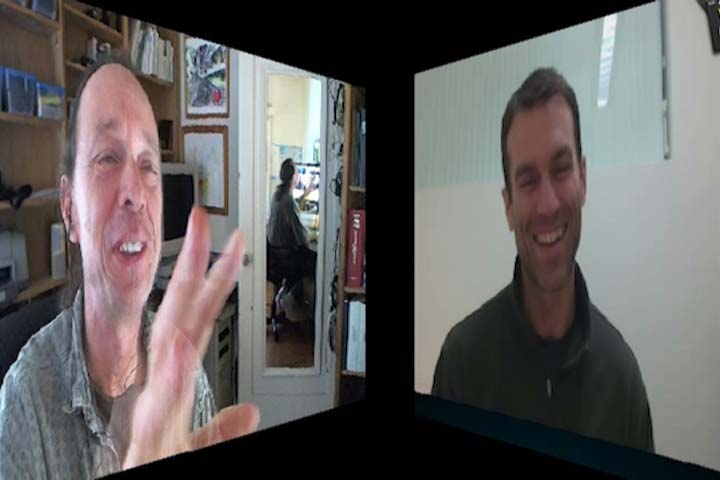
Postdoctoral Fellow, Department of Brain and
Cognitive Sciences, Massachusetts Institute of Technology.
"Research on the psychological biases that exist between members of
conflict groups using behavioral measures and functional magnetic
resonance imaging (fMRI). Massachusetts
Institute of Technology. Research on:
(Video
Transcriptions: If you would like to take empathic action
and create a transcription of this video, check
the volunteers page. The transcriptions will make it easier for
other viewers to quickly see the content of this video.)
Tuesday 8 March 2016, 6-7.30pm
The British Academy, 10-11 Carlton House Terrace, London, SW1Y 5AH
Is empathy an important new approach for achieving conflict resolution?
And is it a viable alternative to military solutions?
This discussion
will showcase the experiences of those working to cultivate empathy in
resolving conflict.
2012-01-23 -
MIT Neuroscientists Study Brain Activity to Learn About Empathy
MIT neuroscientists are studying the patterns of brain
activity that correlate with empathy. They hope to use their findings to
determine how well people respond to reconciliation programs aimed at
boosting empathy between groups in conflict, since compassion for others
suffering often fails between members of opposing conflict groups. MIT
postdoc Emile Bruneau has long been drawn to conflict — not as a
participant, but an observer. In 1994, while doing volunteer work in
South Africa, he witnessed firsthand the turmoil surrounding the fall of
apartheid; during a 2001 trip to visit friends in Sri Lanka, he found
himself in the midst of the violent conflict between the Tamil Tigers
and the Sri Lankan military.
2011-08-25 - Finding Empathy
Kristina Bjoran and Stephanie McPherson follow Emile Bruneau and Rebecca
Saxe as they search for the origins of empathy in the human brain.
2011-08-25 -Experimenting
with Empathy
Emile Bruneau, a postdoc in the Saxelab Social Cognitive Neuroscience
Laboratory, has long been interested in group identity. What informs our
opinion of others?” he asks. “And how does experience change the way
people think about others’ actions and thoughts?” Recently Bruneau’s
research has led him to focus on empathy.
“You could think of empathy as stepping into someone else’s shoes and
seeing through their perspective,” he says, “but an equally valid
definition of empathy might be stepping in their shoes and thinking from
your own perspective.”