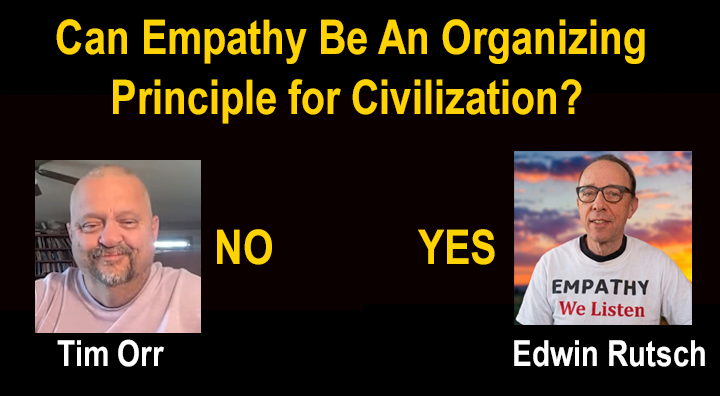
Edwin Rutsch
and Tim
Orr meet to explore whether empathy can function as an organizing
principle for civilization. Edwin argues from a secular perspective that
mutual ("wholistic") empathy and deep listening can serve as the
foundational bedrock for society. Tim contends that while empathy is an
essential moral virtue, civilization also requires objective truth, moral
value judgments, and structural frameworks to function effectively.
Tim
Orr is an ordained Evangelical minister, seasoned academic, and
passionate advocate for interreligious dialogue. He serves as a Research
Fellow with the Institute for the Study of Global Anti-Semitism and Policy, where his scholarship focuses on the intersections of religion,
ideology, contemporary anti-Semitism, and public life.
Next
Steps: They agreed to explore doing a future
4-person "Empathy Circle" together with progressive and Muslim
participants to continue modeling
the dialogue practice.
Title: Can Empathy Be An Organizing
Principle For Civilization? Yes or No
Participants: Edwin Rutsch (Director of The
Empathy Center) & Tim (Academic, Interfaith Advocate, Ordained
Evangelical Minister)
Meeting
Overview
Edwin Rutsch and Tim meet to explore whether empathy can
function as an organizing principle for civilization. Edwin argues from
a secular perspective that mutual ("wholistic") empathy and deep
listening can serve as the foundational bedrock for societal conflict
resolution and governance. Tim contends that while empathy is an
essential moral virtue, civilization also requires objective truth,
moral value judgments, and structural frameworks to function
effectively.
Meeting
Overview Paragraph
In
this recorded dialogue, Edwin Rutsch invites Tim to discuss Tim's
article analyzing the "Red-Green Alliance" and the limits of empathy as
a societal foundation. Edwin presents his model of mutual and wholistic
empathy—practiced through structured "Empathy Circles"—as a scalable
framework capable of bridging intense political, cultural, and religious
divides. In response, Tim grounds his perspective in Christian theology
and academic study of Islam, emphasizing that human dignity originates
from being made in the image of God. Throughout the discussion, both
examine how modern polarized media, ideological doctrines, and power
dynamics impede mutual dialogue, concluding with shared appreciation for
direct engagement across differing worldviews.
Key
Decisions Made
Agreement on the Value of Dialogue: Both
parties agreed that open, mutual dialogue and active listening are
crucial to avoid caricaturing opponents and breaking ideological echo
chambers [14:03].
Potential Future Empathy Circle: Edwin
proposed, and Tim agreed to explore, convening an expanded 4-person
Empathy Circle featuring participants from different theological or
political perspectives (such as Muslim and progressive voices) to
model the dialogue process together [47:06].
Agreeing to Disagree on Civilizational Scope:
Both acknowledged their differing foundational conclusions: Edwin
maintains empathy can be a core organizing principle, while Tim
maintains it is a necessary moral virtue with inherent systemic limits
[57:36].
Core Discussion
Points: Edwin introduces Tim, highlighting his academic
background, work as an ordained Evangelical minister, and his master's
degree in Islamic studies [01:35].
They frame the discussion around Tim's article regarding the Red-Green
Alliance and his thesis that empathy cannot serve as civilization’s
organizing principle [00:56].
Outcome: The
foundation of the discussion was set with both speakers establishing
mutual respect for each other's credentials and differing worldviews.
2.
Dignity, Authority, and the "Red-Green Alliance"
Core Discussion
Points: Tim outlines his perspective that empathy is rooted in
human dignity (being created in the image of God) [03:40].
He clarifies that values like truth and social order are equally
necessary and describes the "Red-Green Alliance" as a tactical
political alignment between progressives and Islamists united around
opposition to Western culture [05:20].
Outcome: Tim
clarified that empathy is not solely a progressive trait and defined
the geopolitical context of his article.
3.
Defining Mutual & Holistic Empathy vs. "Suicidal Empathy"
Core Discussion
Points: Edwin defines empathy as two-way deep listening and shared
humanity rather than a one-directional sentiment [07:37].
Tim introduces the challenge of "suicidal empathy" in geopolitics
(e.g., in Gaza), arguing that pure empathy toward one side can bypass
critical moral judgments regarding terrorism [10:20].
Edwin notes that true empathy requires listening to all sides without
reducing people into rigid oppressor/victim binaries [12:03].
Outcome: Both
recognized that misapplying empathy to strictly one group distorts the
concept into a retributive justice model rather than genuine mutual
understanding.
4.
Personal Practices & The "40% Rule" in Interfaith Dialogue
Core Discussion
Points: Tim describes studying among Shiite scholars in London and
adhering to the "40% Rule" (speaking only 40% of the time to actively
listen and ask questions) while remaining firm in his own convictions
[17:45].
Edwin affirms this mutuality, noting that genuine empathy does not
require abandoning one's core values [19:51].
Outcome: They
identified mutual active listening without ideological compromise as
the most effective path to interfaith relationships.
Core Discussion
Points: Edwin outlines the mechanics of the "Empathy Tent" and
structured "Empathy Circles," sharing real-world examples where
political adversaries reached understanding [21:16].
He argues empathy is the prerequisite for conflict mediation and
collective problem-solving [25:52].
Outcome: Both
agreed that mutual listening de-escalates conflict when willing
parties participate.
6.
Systemic Barriers, Cultural Polarization, and Digital Media
Core Discussion
Points: Tim highlights systemic barriers to empathy, noting that
doctrinal indoctrination and ideological purity tests discourage
people from coming to the table [27:23].
They discuss how social media algorithms reward conflict and outrage,
isolating individuals in ideological silos [34:24].
Outcome: Both
recognized that structural dogmatism and digital media environments
present major obstacles to establishing broad cultural empathy.
7.
Power Dynamics, Authority, and Human-Centered Design
Core Discussion
Points: The conversation shifts to sources of authority in
society—comparing authoritarian "power-over" models with democratic
"power-with" frameworks [42:51].
Edwin introduces the Silicon Valley methodology of Human-Centered
Design as an example of empathy driving iterative problem-solving [51:11].
Outcome:
Edwin framed empathy as an operational methodology for societal
problem-solving, while Tim reiterated the need for objective moral
benchmarks.
Core Discussion
Points: Tim uses marriage counseling to illustrate that empathy
must be paired with objective truth and forgiveness, as subjective
feelings can be distorted [53:45].
Edwin provides a complementary view on how mutual listening prevents
blame-shifting [56:04].
They reflect on the productive nature of their conversation despite
differing ultimate conclusions [57:36].
Outcome: The
meeting wrapped up with an invitation for Tim to participate in a
future multi-participant Empathy Circle with diverse faith and
political representatives [58:05].
By the end of the discussion, both participants
acknowledge that they remain at an impasse on this specific question:
Edwin Rutsch (Pro): Maintained his stance
that mutual, holistic empathy can and should serve as the primary
organizing principle and foundation for civilization, mediation, and
societal problem-solving.
Tim
(Con): Maintained his position that while
empathy is an essential moral virtue, it
cannot serve
as civilization’s overarching organizing principle because systemic
factors, objective truth, legal infrastructure, and moral value
judgments are also required.
Final Outcome & Agreement
While they disagreed on whether empathy can organize
civilization, they reached common ground on process:
Shared Appreciation for Dialogue: Both
agreed that direct, mutual listening is necessary across political and
religious divides to prevent polarization and dehumanization.
Next Steps: They agreed to explore doing a
future 4-person "Empathy Circle" together with progressive and Muslim
participants to continue modeling the dialogue practice.