|



|
|
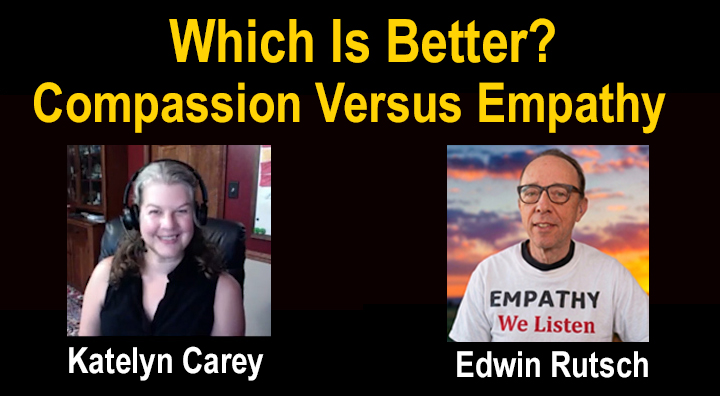
Culture of Empathy Builder: Katelyn Carey
Which is Better? Empathy Versus
Compassion
Edwin Rutsch's Position
Short Meeting Overview This dialogue between Edwin Rutsch and acute care nurse/author Katelyn Carey explores the philosophical and practical differences between empathy and compassion. The speakers analyze how academic terminology diverges from real-world practice, addressing clinician burnout, emotional contagion, and conflict mediation. They find common ground on the core elements of meaningful connection: providing safety, practicing active reflection, and maintaining healthy emotional boundaries.
Paragraph Meeting Overview
The meeting centers on examining the perceived tension
between empathy and compassion, specifically contrasting academic
definitions with practical application in healthcare and community
conflict resolution. Katelyn Carey outlines the clinical risks of
uncontained emotional resonance-such as vicarious trauma and defensive
disconnection among medical staff-advocating for action-oriented,
boundaried compassion.
Step-by-Step Outline of the Discussion
1. Introduction & Framing the Debate
2. Defining Empathy: Perspective-Taking vs. Rogerian Active Listening
3. Clinical Realities, Vicarious Trauma, and "The Dock vs. The Water"
4. Emotional Contagion as a Block to True Empathy
5. Neuroscience, Terminology Proliferation, and Questioning
6. Emergency Support, Acute Care Boundaries, and Reciprocity
7. Institutional Support Deficits and Healthcare Burnout
8. Clinical Agency and Navigating Tragedy
9. Core Pillars of Meaningful Connection & Future Collaboration
Key Decisions Made Agreed Definition of Connection Pillars: Both speakers aligned on three core pillars necessary for constructive human connection across clinical, personal, and political domains:
Shared Stance on Emotional Contagion: Both agreed that
taking on another person's emotional distress to the point of becoming
overwhelmed is harmful, counterproductive, and should not be treated as
the clinical goal. Commitment to Future Dialogue: Katelyn agreed in principle to participate in a collaborative Empathy Circle alongside Edwin Rutsch and empathy/compassion researcher Tania Singer to help bridge the semantic and conceptual divide between the two movements.
TRANSCRIPT
Edwin Rutsch (00:00:01):
Okay, hi everyone. I'm here today with Katelyn Carey-is that the proper pronunciation? Katelyn is an acute nurse, speaker, author, and educator who specializes in crisis communication, trauma-informed care, and the science of compassion. Katelyn has written and talked about the relationship between empathy versus compassion. Some of the articles you've written or talks you've given include "The Problem with Empathy," which was a TED Talk; "Compassion vs. Empathy: The Secret to Meaningful Support," which I think was in an oncology nurse journal; and recently an academic paper in the Patient Experience Journal titled "Supporting the Human Experience: Why Compassion Outperforms Empathy in Care Delivery." Your website is Katelyn.com so if anybody wants to find more, they can have that information right off the bat. You have some criticisms of empathy that actually many people in the compassion movement have-I've seen them quite often, and I totally disagree with them. So this will be a fascinating conversation.
Katelyn Carey (00:01:23): It'll be a good conversation. A real "versus," right? I'm pretty excited to have that.
Edwin Rutsch (00:01:27):
Is there more by way of introduction that you have?
Katelyn Carey (00:01:32):
That'll do.
Edwin Rutsch (00:01:35): Okay, well I'll just introduce myself. I'm Edwin Rutsch, the director of The Empathy Center, and our goal or mission is to make mutual empathy a core cultural value. So yeah, how would you like to get started? What would you like to say about the empathy versus compassion ideas you have?
Katelyn Carey (00:01:56): Well, I suppose I should start off by putting in a mandatory disclaimer, which is that I don't dislike empathy. I am not anti-empathy. But I feel like culturally we have started to use and preach that empathy is a universal tool that can make any situation better, and on that I disagree. I think there are some ground rules for situations where empathy is not the best tool to walk in with-assuming that we're defining empathy in the same way. That's a big part of the problem, because a lot of people aren't.
Edwin Rutsch (00:02:35):
Yeah, that's what I find too: 90% of the disagreements are just definition. We're using different terms for different phenomena. So maybe that's a good place to start: how you're defining it, and then maybe I can share how I define it as well, and we can start from there.
Katelyn Carey (00:02:59):
I pulled my definition out of the Cambridge Dictionary, but I know that it doesn't agree across the board with all other definitions either. When I talk about empathy-oh, let's stop one second. Did I hit record? Oh, I did hit record. Always good to catch oneself before you get too far in.
Going back to the Cambridge definition, that would be basically perspective-taking. Empathy in that scenario is putting yourself into the shoes or trying to take on the perspective of another person, with the goal being building better understanding and prompting kindness, but at the core, empathy is about perspective-taking. How would you define empathy?
Edwin Rutsch (00:03:48):
I've been working on this for about 15 years, so it's quite an extensive definition, and I start with the work of Carl Rogers. If you're familiar with him in the therapeutic world, he is one of the top clinical psychologists and did a lot of work on empathy in the '50s, '60s, and '70s. He would use empathy in his therapeutic practice, and that is sort of the foundation that I base my definition on.
It is listening to someone and listening to the fullness of who they are-the whole person, their feelings, their thoughts, their humanity, their desires-and sensing into who they are. With his process, he developed the active listening process where he would do active listening with his clients. They would speak about something going on for them, and he would reflect back his understanding without trying to direct them, fix them, or judge them. He would just be present with them. He used the term "accompanying someone on their journey" with a sense of presence. That is the core of how I'm defining empathy.
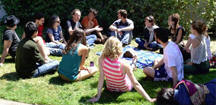
We have something called the Empathy Circle, which is based on mutual active listening. It might be four or five people in a circle. One person is the speaker, and they select who they are going to speak to. I might say, "I'm having a hard time today, I'm struggling with a few things." You would just reflect back your understanding after I pause: "I'm hearing you're struggling and having a hard time today." Then I share some more, you reflect back, and we take five-minute turns. At that point, you as the listener become the speaker, select someone to speak to, and they reflect back what you say. We go around the circle for an hour or two.
That basic listening to the other person is what I consider to be empathy. What you're talking about is sort of the imaginative part, which in the academic world they sometimes call cognitive empathy. I would use the term imaginative empathy: instead of being directly with someone, you're imagining what that person would be like an actor, rather than really just hearing them.
Within the Empathy Circle process, there is also self-empathy (sensing into your own experience) and mutual or holistic empathy (everyone in the group empathizing with everyone else). We even have empathic action. In conflict mediation, when people understand each other through an Empathy Circle, they then start problem-solving together. So it's an extensive framework, but it starts with the work of Carl Rogers.
Katelyn Carey (00:08:24):
Already I can peel this down a little bit further. On the surface of what you described, it's showing up with presence rather than assumptions. Here's another way in which I find empathy and compassion can be different. In my experiences with most definitions of empathy, part of it is emotional resonance and connection.
My background is acute care nursing. I started on the ambulance, spent five years in a pediatric ICU at a children's trauma hospital, and then spent 13 years in the emergency department, typically in Level II trauma centers. We got a lot of very sick people and high-emotion situations. What I noticed over time working with open-hearted, loving people is that nurses burn out. A senior nurse once told a sobbing junior nurse in the break room, "Give it a year or two and you'll burn that part of yourself out, and then you'll be able to do this job well." Or we see physicians in residency programs who become steadily less empathetic over time, moving from patient names to room numbers and diagnoses. There is a steady dehumanization that progresses.
Where I started raising concerns about empathy when meeting patients is when we are emotionally present with people in high-stress, high-emotion situations-not the calmness of a therapy room, but walking into a room and telling someone they have cancer, or telling parents there is nothing more we can do for their child. If we try to be emotionally present and feel what the other person is going through in that moment, we end up with vicarious trauma where their pain becomes our pain. Once our pain is triggered repeatedly, our safety defenses kick in, and we distance ourselves. Physicians lose their empathy because they've never been taught how not to just show up and be emotionally connected when the situation calls for distancing.
Edwin Rutsch (00:12:45):
What you're describing-if you're in high stress, I listen to you, and then I become highly stressed too-is sometimes called emotional contagion. In Paul Bloom's book Against Empathy, that is the phenomenon he describes: you go to a therapist in grief, the therapist falls apart in grief too, and that is emotional distress or contagion.
In an Empathy Circle, if that happens, it is actually seen as a block to empathy. To empathize, you sense what the person is feeling, but you stay present without taking on the feeling as your own. In Rogers' definition, there is the "self-other distinction." If you lose that distinction, you are no longer empathizing; you are getting lost in the emotional resonance. Any good therapist knows you want to stay present with the person and hear them. That is why in an Empathy Circle you also get a turn to speak, which provides a healing aspect for caregivers. When you become overwhelmed and take on trauma, you have lost presence with the other person and become self-focused, which blocks empathy.
Katelyn Carey (00:16:07):
Let me share a story. A woman told me that when she had to put her dog to sleep, the vet met them at the door tearful and upset. The vet was emotionally present with them, but the woman said it was everything she didn't need in that moment. Her emotions were already raw. What she needed was for the vet to stay in a professional context and reassure her: "You're making the right decision, you've done everything appropriate, and this is the right choice." The vet's empathetic presence interfered with what she needed from her caregiver.
When I talk about empathy versus compassion in medicine, I use a metaphor. Empathy is seeing someone drowning from the dock, thinking "what would I want," and jumping into the water. But any lifeguard will tell you that jumping in with someone in acute distress is dangerous because they can pull you under. Compassion is seeing someone drowning, taking a step back, and asking: "Do I understand the situation clearly, and what skills or knowledge do I possess to make this situation better?"
Health care providers have an obligation to hold a container of safety for the other person to feel what they're feeling, while staying on the dock to reach for a life preserver, call for help, and protect their critical thinking. Compassion is focused more on agency, action, and doing for, rather than feeling with. Empathy in high-emotion, high-complexity crises is the wrong tool because connecting to the emotion compromises our ability to hold the container safely.
Edwin Rutsch (00:21:28):
I agree with the phenomenon you're describing, though it is very subtle. We take an Empathy Tent out to political rallies with left and right demonstrators where fights break out. It is super high stress, but we offer listening to both sides and bring them together for dialogue. You have to stay grounded-it's like threading a needle to remain empathically present.
With the veterinarian example, the vet being in distress was personal distress, not empathy. Just because you are in an emotional state does not mean you are empathizing; it can actually block presence. Empathy is feeling into or sensing into the experience of the other while maintaining boundaries. An empathic approach would have been to give space and say, "I hear you're feeling really distressed and struggling with what to do. Would you like to look at the options?" You give space without taking over the emotional spotlight.
Katelyn Carey (00:27:18):
Interestingly, you've described several tools that I categorize as compassion-based: active reflection ("you seem upset, am I reading that right?") and compassionate questioning. When I teach compassion-based care, the single rule is that compassion asks questions so we don't assume or jump into the water. In trauma-informed care, the phrase is "not what's the matter with you, but what matters to you."
In my paper for the Patient Experience Journal, I categorized about 15 academic terms. When you look at fMRI studies, perspective-taking that triggers the same pain centers in our brain leads to distress and defensive disconnection. When you flip that to a compassionate perspective focused on agency, goodwill, and helping, it protects against burnout and fills our sense of efficacy. I label the perspective-taking that causes pain as empathy, and the desire to relieve distress with agency as compassion.
Edwin Rutsch (00:34:12):
They definitely overlap. Carl Rogers was a practitioner who developed his theories from direct clinical experience and active listening. He didn't use terms like affective or cognitive empathy; cognitive scientists later created those terms and split the experience apart. Rogers would just reflect back without giving unsolicited advice or questions, giving the person space to find their own solutions.
Imaginative empathy without direct listening easily turns into projection-like assuming negative things about political opponents. Sitting down with someone and doing active listening gives an accurate picture through direct feedback and error-checking.
Katelyn Carey (00:38:40):
We definitely agree that effective connection involves asking questions, seeking to understand, and leaving biases behind. Whether in healthcare or politics, we villainize others when we fill in blanks imaginatively instead of sitting down to discover that we agree on core values most of the time. Do you ever use the term compassion, or see a difference between Empathy Circles and Compassion Circles?
Edwin Rutsch (00:41:52):
I don't use the term compassion as much because many definitions (like Stanford's Center for Compassion and Altruism Research and Education) define compassion specifically around addressing pain and suffering. For me, empathy is sensing the full person-their joy, desires, thoughts, and suffering.
Katelyn Carey (00:43:16):
In an acute emergency-say an ER nurse with limited time, or a bystander at a car accident where someone is trapped-is building a back-and-forth understanding the right tool, or is a compassionate approach focused on relieving suffering better?
Edwin Rutsch (00:44:48):
An empathic response in that crisis would be presence: sitting with the person, being grounded, and offering what we call "emergency empathy." It is one-directional presence-holding space and letting them know they are heard without requiring anything in return.
Katelyn Carey (00:46:02):
So you're not jumping into the hole with them, but reflecting where they are. How do you keep from sliding into distress in those situations?
Edwin Rutsch (00:46:46):
It relies on the neurological self-other distinction-sensing their experience "as if" it were yours, without losing yourself. The act of verbally reflecting ("I'm hearing you feel distressed") actually reinforces that boundary by confirming it is their distress, which keeps you grounded.
Katelyn Carey (00:48:54):
We agree that meaningful connection requires understanding, curiosity, reflection, and maintaining a self-other boundary. In caregiving, we need to teach that distancing. When you deal with severe trauma, child abuse cases, or domestic violence where you must treat both the victim and the aggressor, emotional distancing is essential. How would you teach people to navigate those intense spaces?
Edwin Rutsch (00:56:11):
Carl Rogers once noted getting so drawn into a client's destructive state that he had to withdraw to regain equilibrium. That is why holistic, mutual empathy is essential. Clinicians dealing with trauma need their own empathic support community-a space to be heard, share distress, and recharge their empathy battery before and after difficult events.
Katelyn Carey (00:59:34):
You just pointed out a huge flaw in modern medicine. In all my years dealing with traumatic deaths and abuse cases, I had exactly one debriefing session. Firefighters on the same calls get mandatory debriefs and counseling check-ins before returning to shift, while nurses go straight back to work. A Duke University study showed that simply sending doctors to dinner once a month to talk with peers was one of the most effective interventions against burnout.
How do you approach empathy when caring for someone who was the aggressor or perpetrator of harm?
Edwin Rutsch (01:05:03):
Empathizing with a perpetrator means seeing their basic humanity and hearing what is going on for them without condoning their actions. Being heard can de-escalate tension and foster personal insight. On a systemic level, developing mutual empathy skills addresses root causes of crime and conflict.
Katelyn Carey (01:13:46):
In healthcare, we also face situations where we cannot cure the patient or fix the tragedy, which breeds helplessness. We need to teach caregivers to value the skills and knowledge they do bring-even if it's just sitting with a family, explaining a process, or relieving guilt.
I remember an ER case where a mother accidentally backed over her three-year-old child, and we could not save him. Because of my pediatric ICU background, I knew to tell her, "This is not your fault; I can see how much you love your child." Instead of leaving all the medical tubes and lines in place for the autopsy investigation as rigid hospital protocol dictated, I removed them so she could bathe him and hold him with love for five hours while waiting for the mortician.
My own child was three at the time, and I went home to curl up with my son, later finding out he received a preschool spot that had opened up from that family. If we do not teach caregivers how to p rovide meaningful, compassionate connection while holding emotional boundaries, we will lose our best people to burnout and PTSD.
Edwin Rutsch (01:25:52):
That shows how vital presence and sensitivity are in moments of profound grief. When my partner's mother was in hospice for ten days, the presence and caring nature of the hospice workers made an enormous difference. Just being present and caring has an inherent healing quality.
Katelyn Carey (01:27:51):
If we synthesize what makes a meaningful connection, I would identify three things:
Providing safety (preventing people from entering a defensive "blowfish" state).
Seeking true understanding through curiosity.
Helping the other person feel seen and cared for.
Edwin Rutsch (01:35:36):
I absolutely agree. That is exactly what the Empathy Circle practice embodies: the structure ensures safety so you don't compete to be heard, active listening confirms mutual understanding, and the speaker feels seen and valued.
We should hold an Empathy Circle together sometime and invite researcher Tania Singer to explore how we can bridge the rhetorical divide between the empathy and compassion fields.
Katelyn Carey (01:37:55):
I would love that. A lot of the work is about cutting through confusing terminology to focus on the practices that re-establish meaningful connection.
Edwin Rutsch (01:41:40):
Thank you so much, Katelyn. I really enjoyed this conversation and appreciate your willingness to dialogue.
Katelyn Carey (01:42:07): Thank you, Edwin. I'm happy to support anyone working to create meaningful connection so we can move toward solutions together.
|
|
||||