The primary purpose of this meeting is an in-depth scholarly dialogue
comparing Fritz Breithaupt's concept of empathy as "co-experience" with
Edwin Rutsch's "Wholistic Empathy" model rooted in Carl Rogers'
person-centered therapy and Empathy Circles. Prompted by Jillian's recent
conference poster on Breithaupt's work, the two participants dissect
specific phenomena associated with empathy's downsides, notably self-loss,
tribal side-taking, and emotional contagion.
Edwin contends that authentic empathy requires maintaining distinct
self-other boundaries
.
Edwin contends that authentic empathy requires maintaining distinct
self-other boundaries and fostering reciprocal, mutual presence, arguing
that academic critics confuse emotional reactions or partisan rescue
dynamics with real empathy. Jillian offers counterpoints rooted in
golden-mean virtue ethics and cognitive science, exploring how intense
empathy can naturally slip into bias or over-identification. Together,
they discuss the sociopolitical context of modern anti-empathy literature,
evaluate the structured Empathy Circle as an anti-authoritarian practice,
and highlight the necessity of dialogic engagement over pure intellectual
abstraction.
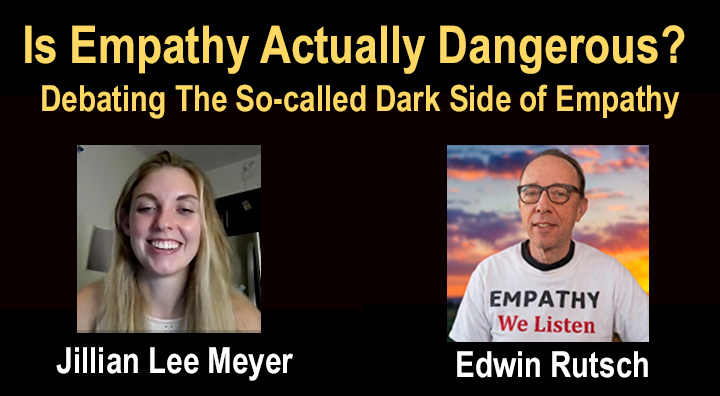
Edwin Rutsch and PhD candidate Jillian Lee Meyer meet to examine and
debate Fritz Breithaupt's book
The Dark Side of
Empathy alongside related critiques of empathy. Edwin argues through
his "Wholistic Empathy" framework that alleged negative outcomes are
failures, blocks, or reactions rather than genuine empathy. In contrast,
Jillian proposes viewing empathy through virtue ethics, suggesting dark
sides may represent the harmful overextension of the trait.
Paragraph Meeting Overview
The primary purpose of this meeting is an in-depth scholarly dialogue
comparing Fritz Breithaupt's concept of empathy as "co-experience" with
Edwin Rutsch's "Wholistic Empathy" model rooted in Carl Rogers'
person-centered therapy and Empathy Circles. Prompted by Jillian's
recent conference poster on Breithaupt's work, the two participants
dissect specific phenomena associated with empathy's downsides, notably
self-loss, tribal side-taking, and emotional contagion.
Edwin contends that authentic empathy requires maintaining distinct
self-other boundaries and fostering reciprocal, mutual presence, arguing
that academic critics confuse emotional reactions or partisan rescue
dynamics with real empathy. Jillian offers counterpoints rooted in
golden-mean virtue ethics and cognitive science, exploring how intense
empathy can naturally slip into bias or over-identification. Together,
they discuss the sociopolitical context of modern anti-empathy
literature, evaluate the structured Empathy Circle as an
anti-authoritarian practice, and highlight the necessity of dialogic
engagement over pure intellectual abstraction.
A Step by Step Outline of the Discussion
1. Introductions, Background, and Establishing the Debate
Edwin introduces himself as director of The Empathy Center, and
Jillian introduces herself as a 4th-year PhD candidate in psychology
and cognitive science at Indiana University Bloomington [00:16].
Edwin explains the discussion was prompted by Jillian's LinkedIn
post regarding her poster presentation on Fritz Breithaupt's
The Dark
Side of Empathy [00:50].
Jillian notes that empathy literature includes dozens of differing
definitions, mentioning Breithaupt's recent collaboration covering
around 20 definitions, and shares that she generally agrees with
four of Breithaupt's dark sides [02:14].
Outcome: Both
participants establish their roles: Edwin will advocate for the
Holistic Empathy and Empathy Circle model, while Jillian will
represent Breithaupt's points and test them against Edwin's model.
2. Defining Empathy: Co-Experience vs. Active Listening
and Self-Other Distinction
Edwin notes Breithaupt operationalizes empathy as "co-experience,"
which opens doors to getting lost or manipulated [04:02].
Edwin contrasts this with Carl Rogers' client-centered framework and
the Empathy Circle format, emphasizing Rogers' "as if"
criterion—sensing another's inner world while strictly maintaining
the self-other boundary [08:11].
Jillian inquires whether falling apart with someone or taking action
(as highlighted in Paul Bloom's critiques) is considered empathy [09:02].
Edwin asserts that becoming overwhelmed, taking on the "helper"
role, offering advice, or sharing one's own story are blocks to
genuine empathic presence [09:08].
Outcome:
Edwin defines true empathy as disciplined, grounded presence without
merging, while Jillian questions whether absorption and emotional
contagion should be categorized as an extreme form or extension of
empathy.
3. Empathy as a Virtue: The Golden Mean vs. Categorical
Boundary
Jillian proposes an Aristotelian virtue ethics framework (the Golden
Mean), likening empathy to courage [17:30].
In this model, courage sits between cowardice (under-exercised) and
recklessness (over-exercised); similarly, empathy could sit between
apathy and excessive self-loss [18:18].
Edwin rejects viewing empathy on a continuum of excess, arguing that
genuine empathy does not become bad when increased; rather,
judgments, advice, and emotional contagion represent completely
different states that replace empathy [20:14].
Edwin connects judgments (both positive and negative) to nonviolent
communication (NVC) and "power-over" dynamics that shut down
empathic connection [20:30].
Outcome: The
disagreement clarifies: Jillian sees the "dark sides" as the extreme
end of the empathy spectrum, while Edwin insists they represent
entirely distinct, non-empathic behavioral reactions.
4. Roleplaying Scenarios: Empathy vs. Co-Identification
and Sympathy
Jillian roleplays a frustrating experience with an older participant
in her water aerobics class [27:32].
Edwin demonstrates reflective listening ("I hear you felt frustrated
when someone wanted to change the music") versus reactionary
agreement/co-identification ("Those old people are terrible") [27:58].
Edwin reads the Empathy Tent card detailing "free empathy" as 10
minutes of deep listening free of judgment, advice, detachment, or
sympathy [30:03].
He distinguishes empathy from sympathy, noting sympathy is
patronizing and self-focused [30:21].
They examine emotional contagion, empathic concern, and academic
terminology, agreeing that academia often mislabels various
emotional reactions as empathy itself [36:52].
Outcome: Both
recognize the semantic ambiguity in modern psychology, with Jillian
acknowledging that current language lacks a distinct term for the
extreme state between helpful empathy and reckless absorption.
5. Breithaupt Pitfall 1: Self-Loss, Groupthink, and Cult
Dynamics
The conversation shifts to Breithaupt's concept of self-loss, where
empathizing pulls someone so far into another's frame that they
surrender their own perspective (e.g., Stockholm syndrome) [43:43].
Edwin explains how the Empathy Circle guards against self-loss:
reflective repetition acts as a cognitive brake, constantly
reminding both parties of who owns the experience [45:11].
They explore cult dynamics and authoritarian manipulation,
contrasting "love bombing" with Empathy Circles [49:52].
Edwin shares an anecdote about an Empathy Circle at a political
rally in Sacramento with Identity Evropa members and a Jewish
participant, illustrating how being forced to accurately reflect
someone else's reality disrupts ideological dogmatism [51:48].
Edwin shares a photo from State Street in Santa Barbara where an
ex-cult member engaged with the Empathy Tent [54:29].
Outcome:
Jillian recognizes that the explicit structure of Empathy Circles
prevents self-loss, while Edwin maintains that self-loss occurs
primarily when people lack practiced boundary-maintenance skills.
6. Breithaupt Pitfall 2: Side-Taking, Polarized Conflict,
and the Drama Triangle
They analyze Breithaupt's assertion that empathy deepens conflict by
compelling people to take sides and demonize the out-group [01:03:52].
Edwin frames this phenomenon using Stephen Karpman's Drama Triangle
(Victim, Rescuer, Persecutor) [01:13:07].
Taking a side and attempting to "rescue" one party inevitably casts
the opposing party as a persecutor, perpetuating the cycle [01:13:37].
Edwin states that authentic empathy is the sole structural exit from
the Drama Triangle because a restorative facilitator listens
unconditionally to all perspectives without validating attacks [01:14:11].
They discuss active listening as an initial "scaffolding" or
training wheel that eventually fades into intuitive mutual presence
during deep sessions [01:20:30].
Outcome: Both
recognize how unguided empathy triggers partisan bias, but Edwin
asserts that multi-partial, reciprocal listening neutralizes tribal
conflict rather than worsening it.
7. Morality, Sociopolitical Anti-Empathy Literature, and
Human-Centered Design
They explore the claim that empathy is not an inherent moral compass
[01:21:55].
Jillian discusses her research on a "moral compass" values tool,
while Edwin emphasizes empathy's somatic and biological benefits
(cortisol reduction, oxytocin release) [01:23:22].
They critique recent anti-empathy publications (Paul Bloom, Allie
Beth Stuckey, Gad Saad, Joe Rigney), evaluating how critics
conflated empathy with progressive or "woke" politics [01:27:00].
Edwin recounts how Allie Beth Stuckey mischaracterized an Empathy
Tent encounter in Berkeley on Fox News, claiming they gave massages
to Antifa when it was actually a fatigued right-wing demonstrator [01:34:53].
Edwin references Silicon Valley's human-centered design loop
(empathy, ideation, prototyping, testing) [01:39:46].
Jillian asks whether empathy can be weaponized for exploitative
products, leading Edwin to distinguish between one-sided empathy
("power-over") and mutual empathy ("power-with") [01:41:08].
Outcome: They
conclude that while empathy can be used tactically in one direction,
sustainable and ethical application requires reciprocity.
Edwin formally introduces his distinction between partial (one-way)
empathy and holistic (mutual) empathy, arguing that Western
psychology errs by treating empathy purely as an individual trait
rather than a relational ecosystem [01:44:46].
Due to time constraints, Edwin briefly lists Breithaupt's remaining
points to cover in a future session: empathic sadism, vampiristic
empathy, and selective/self-serving empathy [01:50:23].
Edwin mentions upcoming events, including an upcoming Empathy Summit
and a citizen assembly grant proposal related to AI governance,
before wrapping up the call [01:53:31].
Outcome: Both
agree to schedule a follow-up conversation to analyze Breithaupt's
remaining concepts and continue refining their definitions.
Key Decisions Made
Schedule a
Follow-Up Meeting: Agreed to hold a second recorded discussion to
cover the remaining three concepts from Fritz Breithaupt's book:
empathic sadism,
vampiristic
empathy, and
selective/self-serving empathy [01:50:23].
Summit Absence
Noted: Jillian confirmed she cannot attend the upcoming Saturday
Empathy Summit due to a speaking commitment on a civic engagement
panel concerning political extremism [01:53:37].
Grant
Collaboration Follow-Up: Edwin agreed to send Jillian information
regarding a potential democratic AI governance grant project focused
on citizen assemblies and empathy circles [01:54:48].