|
|
Culture of Empathy
Builder:
Edwin Rutsch 2
|
|
|
|
|
|
|
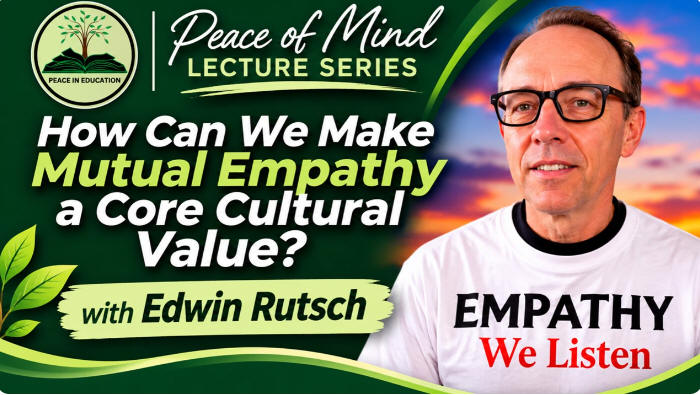
Peace of Mind with Edwin
Rutsch:
How can we Make Mutual Empathy
a Core Cultural Value?
(Nov 22, 2026) |
|
|
|
In
this session of the
Peace of Mind
lecture series hosted by Peace in Education, host Renata Valree interviews
Edwin Rutsch, Founding Director of The Empathy Center, on making mutual
empathy a core personal, social, and cultural value. They examine the
Wholistic Empathy model, barriers to listening across deep ideological
divides, and strategies for scaling Empathy Circles into schools, public
demonstrations, and civic life. The session concludes with a live,
participatory Empathy Circle modeling mutual Active Listening among the
attendees.
"Usually
empathy gets defined in an individualistic term, like 'I'm empathizing
with you.' Mutual empathy is that we're in a relationship and there's a
level of empathy between us
-
it's the fullness of empathy."
"If we want
peace, if we want greater well-being, we need to be nurturing that
mutual empathy at the core of not only our families and our
relationships, but the whole society."
-
Edwin Rutsch
|
2. Paragraph Meeting Overview
Hosted by Renata Valree as part of
Peace in Education’s
Peace of Mind
lecture series, this conversation with Edwin Rutsch explores how structured
mutual active listening can bridge social, familial, and political divides.
Drawing from over 15 years of global interviews and street-level mediation
with the Empathy Tent, Rutsch outlines his Wholistic Empathy
framework—comprising Basic Empathy, Self-Empathy, Imaginative Empathy, and
Mutual Empathy—while responding to contemporary anti-empathy critiques.
Together, Rutsch and Valree address student-submitted questions on overcoming
communication barriers, scaling Empathy Circles into K–12 schools and
universities, and launching "Occupy Empathy" nonviolent direct action
campaigns at state capitols to urge legislators to model empathic dialogue.
After taking audience questions on whether empathic listening yields concrete
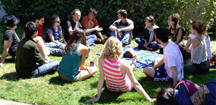
social change, Rutsch facilitates a live, multi-turn Empathy Circle with
participants Renata, James, Susan, and Nikesha, culminating in a group debrief
and plans to collaborate on classroom and university micro-skill curricula.
3. Step-by-Step Outline of the Discussion
Phase 1: Introduction & Origin of The
Empathy Center
-
3.1. Topic Title:
Welcome, Background, and the Birth of the Empathy Tent |
Time code:
[00:04]
– [13:45]
-
3.2. Core Discussion Points:
-
Renata Valree introduces Edwin
Rutsch, highlighting his work building The Empathy Center, interviewing
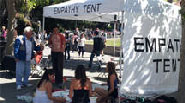
over 400 experts, and creating the Empathy Circle and Empathy Tent,
while sharing how taking his training twice exposed her own listening
filters.
-
Rutsch traces his journey from 10
years of world travel and a career in Silicon Valley to producing
documentaries on human values and launching the Empathy Tent during the
2011 Occupy Wall Street movement to champion "100% empathy."
-
Rutsch connects his work to peace
researcher Johan Galtung’s definition of peace—transforming conflicts
with empathy, creativity, and nonviolence—and explains how Carl Rogers'
Active Listening forms the "minimal viable empathic space" of an Empathy
Circle.
-
He highlights bringing the
Empathy Tent to polarized protests (such as an Impeach Trump rally
featured in the documentary
Trump Phobia),
where five out of six paired groups from opposing political sides ended
their circles with hugs, and reviews web resources across
TheEmpathyCenter.org, EmpathyCircle.com, and CultureOfEmpathy.com.
-
3.3. Outcome:
With the foundational context and web resources established, Valree
transitions to the student-submitted Q&A portion of the session.
Phase 2: Defining Wholistic Empathy &
Building Stronger Communities
-
3.1. Topic Title:
Student Question 1 — Defining Empathy and Strengthening Relationships |
Time code:
[13:45]
– [25:29]
-
3.2. Core Discussion Points:
-
Addressing recent anti-empathy
literature (Against
Empathy,
The Sin of Empathy,
Toxic Empathy,
Suicidal Empathy),
Rutsch argues that pushback stems from narrow, individualistic
definitions of empathy.
-
He presents his Wholistic Empathy
framework:
Basic Empathy
(sensing into the wholeness of another person's words, feelings, and
needs),
Self-Empathy
(sensing into one's own experience when given space to speak),
Imaginative Empathy
(stepping into another's role, such as in family inheritance mediation
roleplays), and
Mutual Empathy
(the shared, holistic level of empathy built between people in
relationship).
-
Rutsch and Valree discuss family
dynamics where one member listens to everyone else without feeling heard
in return; Rutsch shares a story of facilitating an Empathy Circle at an
Oakland church between a mother and her estranged teenage son to restore
open communication.
-
3.3. Outcome:
Valree resolves to try a family Empathy Circle with her middle daughter,
and moves on to the second student question.
Phase 3: Overcoming Barriers Across
Deep Divides
-
3.1. Topic Title:
Student Question 2 — Barriers to Empathizing Across Differences |
Time code:
[25:29]
– [37:10]
-
3.2. Core Discussion Points:
-
Rutsch recounts setting up the
Empathy Tent at a Unite the Right rally at the California State Capitol,
where five members of the white nationalist group Identity Europa spoke
with his Jewish friend, Dave. Initially, the group's leader argued
rather than listened, until another member prompted him to accurately
reflect Dave's family loss in the Holocaust—dissolving an intellectual
wall and shifting the room's energy.
-
Valree emphasizes acknowledging
cultural conditioning, communication styles, and internal biases upfront
with a spirit of forgiveness so unintentional misinterpretations do not
derail connection, candidly sharing her challenge listening to a
chronically pessimistic university colleague.
-
Rutsch notes that structured
turn-taking and longer formats—such as two-hour circles on abortion or
8-hour Empathy Circle marathons—allow participants to move past surface
positions into deeper human stories.
-
3.3. Outcome:
Valree plans to share the online 8-hour marathon recordings with her
university students over the next two weeks as they prepare for community
relationship-building, then introduces the third student question.
Phase 4: Scaling Empathy into Schools,
Movements, and Politics
-
3.1. Topic Title:
Student Question 3 — Making Empathy a Shared Cultural Value |
Time code:
[37:10]
– [48:11]
-
3.2. Core Discussion Points:
-
Rutsch outlines a vision to teach
all 8 billion people how to participate in and facilitate Empathy
Circles, proposing two high-leverage catalysts: getting high-profile
political leaders (e.g., Trump, Schumer, Newsom) to model an Empathy
Circle on camera, and launching an
"Occupy Empathy"
nonviolent direct action encampment at the California State Capitol to
petition legislators to engage in cross-partisan circles.
-
Valree shares her work with Black
Women for Positive Change, which launched an October Peace Circle
toolkit campaign across U.S. school districts in 2023 where students and
teachers co-designed and co-facilitated classroom circles.
-
Rutsch shares how five- and
six-year-old nieces and nephews use Empathy Circles to resolve fights,
and both agree that engaging legislative gatekeepers and staffers is a
practical stepping stone toward getting elected officials into circles.
-
3.3. Outcome:
Valree commits to bringing a joint school-based Empathy Circle toolkit
proposal to her Peace in Education board the following Wednesday, then
opens the floor to audience questions before starting the live practice.
Phase 5: Audience Q&A — Does Empathy
Lead to Tangible Change?
-
3.1. Topic Title:
Audience Dialogue on Outcomes, De-escalation, and Psychological Safety |
Time code:
[48:11]
– [59:16]
-
3.2. Core Discussion Points:
-
Participant Susan asks whether
verbalizing empathy actually shifts policies or personal stances on
fundamental human rights, such as reproductive privacy or transgender
dignity.
-
Rutsch frames Empathy Circles on
an
escalation ladder:
moving adversaries down from dehumanization and violence toward seeing
one another's shared humanity. While agreement on every policy is not
guaranteed, de-escalation creates the necessary common ground for
creative mediation and collaborative next steps.
-
Rutsch also shares a recent
Braver Angels Bridging Divides circle where a Black woman in Southern
California felt safe enough to share her shifting political views
without fear of being ostracized. Valree adds that active listening
builds psychological safety, allowing people to release emotional
defensiveness—a prerequisite in mediation before any resolution can
occur.
-
3.3. Outcome:
With audience questions addressed, Rutsch transitions the group into a
live, experiential Empathy Circle.
Phase 6: Live Experiential Empathy Circle
-
3.1. Topic Title:
Practicing Mutual Active Listening in a Five-Person Circle |
Time code:
[59:16]
– [01:31:22]
-
3.2. Core Discussion Points:
-
Rutsch reviews the roles
(Speaker, Active Listener, Silent Listeners), the 3-minute timed turns,
and the prompt:
What are your feelings of
concern, worry, or fear for the future, or whatever is on your mind?
-
Turn 1 (James to Edwin):
James expresses gratitude and openness rather than worry, wanting to be
present and prepared to meet interesting times.
-
Turn 2 (Edwin to Renata):
Edwin shares his concern and passion around bringing mutual empathy into
mainstream American culture during a pivotal historical moment.
-
Turn 3 (Renata to Susan):
Renata voices concern that society fails to listen to young adults,
restricting their voice, civic engagement, and leadership development.
-
Turn 4 (Susan to Nikesha):
Susan shares deep concern over extreme value polarization that
dehumanizes transgender individuals and deprives them of dignity,
vulnerability, and love.
-
Turn 5 (Nikesha to Edwin):
Nikesha reflects on skepticism toward political systems and whether
recent electoral shifts stem from genuine human connection or short-term
economic self-interest, before sharing her decision to homeschool her
children in California to customize their education despite social
stigma.
-
Turn 6 (Edwin to James):
Edwin deepens his reflection on organizing nonviolent direct empathic
action—camping on the Sacramento State Capitol lawn and later in
Washington, D.C.—to compel politicians to model cross-divide listening
for the media and public.
-
3.3. Outcome:
Every participant completes a turn as both Speaker and Active Listener,
concluding the live demonstration.
Phase 7: Group Debrief & Next Steps for Collaboration
-
3.1. Topic Title:
Participant Reflections and Curriculum Partnership Plans |
Time code:
[01:31:22]
– [01:38:51]
-
3.2. Core Discussion Points:
-
James
appreciates the unique structure and plans to attend the Sunday Bridging
Divides Empathy Circle.
-
Susan
values the reminder of core listening skills and the confidence of
knowing she would be accurately heard.
-
Nikesha
contrasts Active Listening with coaching and formal mediation, noting
that people often derail listening by relating back to their own stories
rather than simply holding space.
-
Renata
highlights the power of language and accurately reframing a speaker's
essence without simply parroting words.
-
Rutsch shares the link to the
bi-monthly Sunday Bridging Divides Empathy Cafe hosted with Braver
Angels, and Valree outlines plans to integrate Empathy Circles into her
university's repetitive micro-skill curriculum (with a follow-up
milestone in April) and discuss a broader partnership at her upcoming
board meeting.
-
3.3. Outcome:
The session concludes with mutual appreciation and concrete commitments to
follow up the next week.
4. Empathy Movement Curriculum Insights
For the
Empathy Movement Curriculum
([https://sites.google.com/view/empathy-movement-curriculum](https://sites.google.com/view/empathy-movement-curriculum)),
this interview yields several high-value pedagogical, structural, and
strategic insights:
-
Anchor Theory in the Wholistic
Empathy Model to Counter Anti-Empathy Critiques:
Curriculum modules should explicitly introduce
Basic Empathy,
Self-Empathy,
Imaginative Empathy,
and
Mutual Empathy
upfront [15:07].
Defining empathy as a relational, mutual practice directly inoculates
learners against popular critiques (e.g.,
Against Empathy,
Toxic Empathy,
Suicidal Empathy)
that attack one-way, individualistic emotional overwhelm.
-
Teach the "Escalation Ladder" and
"Minimal Viable Empathic Space" Frameworks:
Frame the Empathy Circle as a foundational, scalable social technology—a
minimal viable empathic space
[08:03]—and
pair it with the
Escalation Ladder
[53:07].
Clarify for students that the immediate goal of an Empathy Circle is not
forced political agreement, but de-escalation and humanization, which
unlocks the creative space needed for conflict resolution.
-
Incorporate "Listening Filters" and
Upfront Forgiveness into Onboarding:
Renata Valree’s insight on internal filters—how cultural upbringing,
habits,
and assumptions distort how we hear and restate information [09:19],
[31:08]—makes
an ideal pre-circle reflection exercise.
Encouraging participants to acknowledge their filters upfront fosters
psychological safety and reduces defensiveness when an Active Listener
needs a second try to reflect accurately.
-
Use Roleplay Scenarios for
Imaginative Empathy & Conflict Mediation:
Include structured roleplay modules—such as Rutsch’s sibling inheritance
dispute scenario [17:25]—so
students can practice
Imaginative Empathy
(stepping into a conflicted role) while maintaining the guardrails of
Active Listening.
-
Leverage Repetitive "Micro-Skill"
Practice & Student Co-Facilitation:
Adopt Valree’s university micro-skill model (repetitive practice over
weeks until active listening becomes second nature) [01:37:51]
alongside K–12 peer co-design [42:26],
where students are trained not merely as participants, but as co-designers
and facilitators of classroom circles.
-
Integrate Video Case Studies & Live
Debrief Prompts:
Curate short clips from real-world Empathy Tent interventions (e.g.,
the Impeach Trump rally or the State Capitol Identity Europa dialogue) and
8-hour Empathy Circle marathons [36:45]
as curriculum case studies.
Follow experiential circles with the debrief question used at the end of
this session:
"What did you notice about your own
listening filters, and how did being accurately reflected shift your
internal state?"
-
Include a Civic & Direct Action
Module ("Occupy Empathy"):
Expand curriculum pathways beyond interpersonal and workplace settings to
civic engagement—teaching students how to engage institutional
"gatekeepers" (staffers, administrators,
local officials) [47:43]
and organize public Empathy Tent listening actions.
5. Powerful and Insightful Quotes from the
Interview
-
"Occupy Wall Street was about the
99% against the 1%, and I thought what we really need is 100% empathy."
—
Edwin Rutsch
[05:19]
-
"Usually empathy gets defined in
an individualistic term, like 'I'm empathizing with you.' Mutual empathy
is that we're in a relationship and there's a level of empathy between
us—it's the fullness of empathy." —
Edwin Rutsch
[18:25]
-
"If we want peace, if we want
greater well-being, we need to be nurturing that mutual empathy at the
core of not only our families and our relationships, but the whole
society." —
Edwin Rutsch
[21:53]
-
"What I learned about myself the
very first time was that we have filters in how we hear information, how
we translate information... and how that lack of awareness, even though
it may be small, can make a difference in whether or not you connect
with that person." —
Renata Valree
[09:19]
-
"People might not agree with you,
but they're going to see you as more human... We're taking the wall
apart and starting to see each other's humanity." —
Edwin Rutsch
[52:04],
[55:54]
-
"You don't get to the point of
agreement in mediation until people are ready to release the emotions
attached to whatever that conflict is. If we can create spaces where we
demonstrate empathy, we see a shift where people are more inclined to be
open and less judgmental." —
Renata Valree
[58:43]
-
"We have one mouth and two ears,
which means that our listening should be greater than sometimes we
speak... A lot of times we hear people and we try to relate by saying,
'Oh, my situation is like this,' when what that person really needs is
someone to listen to them." —
Nikesha (Participant)
[01:34:45]
6. Short Article About the Interview
From "99% vs. 1%" to "100% Empathy": How Mutual
Active Listening Can Bridge Our Deepest Divides
In an era defined by polarized
headlines, family estrangement, and a growing wave of books warning against
the dangers of empathy, Edwin Rutsch offers a disarmingly simple
counter-proposal: we don't have too much empathy—we have too narrow a
definition of it.
Speaking with host Renata Valree on
Peace in Education’s
Peace of Mind
lecture series, Rutsch, Founding Director of The Empathy Center, laid out a
practical blueprint for transforming mutual empathy from a private personality
trait into a shared cultural value. Drawing on more than 15 years of global
interviews and street-level dialogue through his public
Empathy Tent
initiative, Rutsch argued that much of today's pushback against empathy stems
from treating it as a one-way, individualistic burden rather than a reciprocal
relationship.
To clarify what empathy actually looks
like in action, Rutsch shared his
Wholistic Empathy
framework, anchored in the structured dialogue practice he created: the
Empathy Circle.
Within a circle, participants take timed turns speaking and selecting an
Active Listener, who reflects back what they hear until the speaker feels
understood to their satisfaction. In this space, four dimensions of empathy
emerge:
-
Basic Empathy
(sensing into the wholeness of another person’s thoughts, feelings, and
needs),
-
Self-Empathy
(discovering one's own deeper truth when given uninterrupted space to
speak),
-
Imaginative Empathy
(stepping into another's shoes or role), and
-
Mutual Empathy
(the collective trust and warmth generated when everyone is both hearing and
being heard).
Throughout the conversation, Rutsch
illustrated how this "minimal viable empathic space" works even in high-stakes
conflict. He recalled setting up the Empathy Tent at a volatile protest in Los
Angeles, where five out of six pairs of demonstrators from opposing political
camps ended their dialogues with hugs, as well as a tense encounter at the
California State Capitol where structured reflection helped break through an
ideological wall between a Jewish participant and members of a white
nationalist group.
"People might not agree with you, but
they're going to see you as more human," Rutsch explained, framing the Empathy
Circle as a tool for moving communities down the "escalation ladder" from
hostility toward creative problem-solving. Host Renata Valree echoed this
dynamic from her own experience taking Rutsch's facilitator training twice,
noting that structured active listening forces us to confront the invisible
cultural filters that distort how we hear others—and builds the psychological
safety required before any conflict can be resolved.
Looking ahead, Rutsch and Valree
explored how to scale these skills into everyday institutions—from training
K–12 students and university cohorts in repetitive listening "micro-skills" to
launching
Occupy Empathy,
a nonviolent direct action movement inviting citizens and legislators alike to
sit down at state capitols and model cross-partisan listening.
Rather than leaving the ideas in
theory, the session concluded with a live, five-person Empathy Circle. Over 30
minutes, participants—including educators, mediators, and parents—practiced
reflecting one another's candid concerns about youth voice, transgender
dignity, political trust, and education. By the final debrief, the room had
experienced firsthand what Rutsch has spent over a decade championing: when
people stop waiting to argue and start listening to understand, the walls
between us begin to come down.
Video Reference:
Peace of Mind with Edwin Rutsch: How can we Make
Mutual Empathy a Core Cultural Value?
|