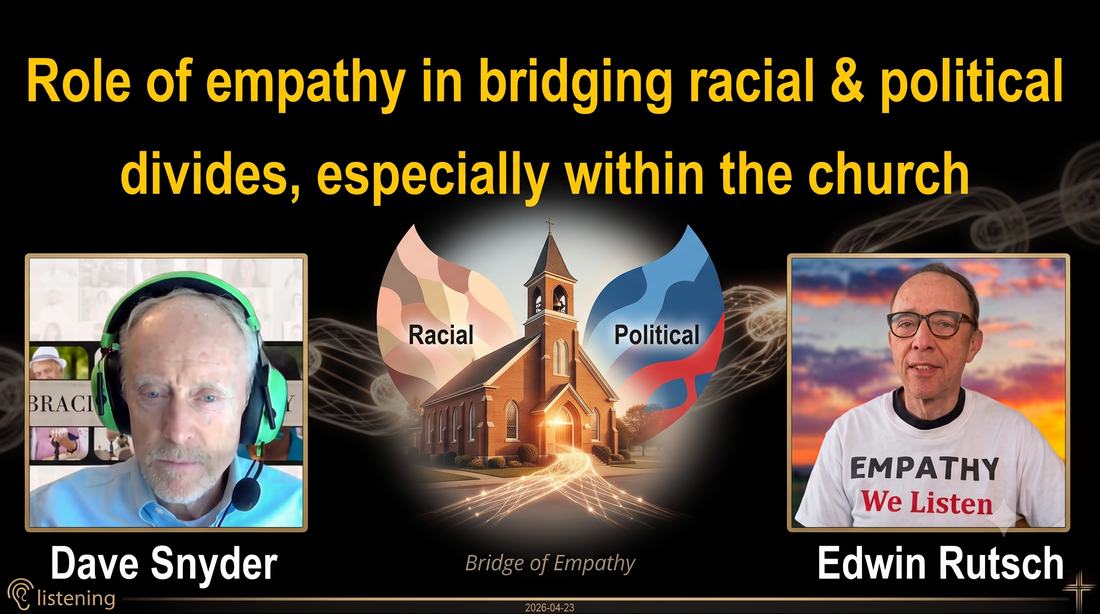
Edwin Rutsch and
Dave Snyder
(EmbracingRacialUnity.org)
discussed the role of empathy in bridging racial and political
divides, especially within the church. Dave is equipping Christians
to talk race, build church unity and put things right in our
communities. Dave shared his journey in a historically white church
that became more diverse, highlighting the challenges and the
importance of
empathy in building unity.
In this YouTube video, Edwin Rutsch
(Director of the Empathy Center) interviews Dave Snyder about the critical
role of empathy in bridging racial and political divides, specifically
focusing on Snyder's experiences within a Christian church in Cincinnati,
Ohio.
The conversation focuses on how deep,
structured listening helps overcome historic segregation, the pushback empathy
faces from some theological circles, and practical formats (like Empathy
Circles and Braver Angels workshops) designed to bring people with opposing
views into productive dialogue.
Executive Summary
Dave Snyder recounts his journey of
trying to foster racial and political unity in a historically white,
170-year-old church located in a community that is now 70% Black. Realizing
that the congregation was ill-equipped to connect across cultural divides,
Snyder initiated small-group dialogue sessions using a structured empathy
framework (represented by the acronym
DI-RP).
Rutsch and Snyder discuss the
definition of empathy, contrasting it with the criticisms of the religious
right (such as books like
The Sin of Empathy and
Toxic Empathy). They agree that
empathy does not equal
agreement. Instead, empathy is about acknowledging another person's
humanity, recognizing their emotions, and deciding they are "worthy of
connection." Through structured practices like "Empathy Circles" and political
bridging workshops, both advocates argue that deep listening is a prerequisite
for the biblical calling of unity and love.
Detailed Interview
Outline
I. Introduction and Dave Snyder’s
Background [00:01]
LinkedIn
Description: Equipping Christians to talk grace,
build church unity, and put things right in their communities [00:18].
The
Church's History: Snyder belongs to a 170-year-old
church in Cincinnati, Ohio, that remained entirely white despite the
surrounding neighborhood transitioning to 70% Black in the 1970s [00:51].
The
Catalyst for Action: Eight years ago, Snyder
invited the church's only five Black elders and deacons for a 3-hour lunch.
He listened to their stories of perceived racism and realized the critical
need for a structured dialogue to bridge the gap [02:36].
II. Defining Empathy and its Biblical Foundations [09:21]
Edwin
Rutsch’s Definition (Holistic Empathy): Grounded
in Carl Rogers’ active listening. It means sensing into another's
experience, being present to hear their thoughts and feelings, and
practicing "mutual empathy" where both sides listen to each other [10:07].
Snyder’s
Biblical Definition: Snyder points to
Romans 12:15
("rejoice with those who rejoice, weep with those who weep") [12:03].
The
Example of Jesus: When Lazarus died, Jesus wept
with Mary and Martha even though he knew he was about to raise Lazarus.
Jesus was not agreeing with their hopelessness; he was feeling their pain [12:32].
Empathy does not imply agreement.
The
Evangelical Pushback: They discuss the rise of
anti-empathy rhetoric within the religious right, specifically citing books
like The Sin of
Empathy (Joe Rigney),
Toxic Empathy
(Alisa Childers/Allie Beth Stuckey), and
Suicidal Empathy
(Gad Saad) [09:21],
[21:12].
Testing
Every Claim: A Christian critic argued that
listening to stories of racism without immediately challenging them violates
biblical instructions to "test everything." Snyder counters that sharing a
personal lived experience is not a formal legal accusation requiring two
witnesses; it's a personal story [14:36].
Selective vs. Universal Empathy: Rutsch addresses
the criticism that progressives only empathize with their own side [50:18].
He argues that true "holistic empathy" requires extending empathy to
everyone in a group—even political opponents.
Snyder explains the exact structured
framework they use in their church’s small groups to teach empathy:
D –
Decide: Decide that the other person is worthy of
connection [40:02].
I –
Inquire: Ask active listening questions to
identify the specific emotion the other person is feeling [40:15].
R –
Recall: Recall a time in your own life when you
felt that same emotion
(even if the underlying situation was totally different) [40:29].
P – Play
it out: Respond to them based on what you needed
when you felt that emotion [41:00].
Meeting
Format: Groups of 10 or fewer, led by one white
facilitator and one facilitator of color. Everyone gets exactly 2 minutes to
share their lived experiences using "I" statements [41:16].
The
Problem in American Churches: Snyder references
researcher Corey Edwards, noting that attending a homogeneous church makes
Christians statistically less motivated to dismantle structural racism. Echo
chambers insulate and reinforce natural racial biases [31:24].
Implementing Structural Diversity: Snyder's church
decided that any church ministry requesting funds must be fully integrated [34:34].
They also put new elders and deacons through the empathy small groups,
preventing defensive "gut reactions" when issues of race arise in leadership
meetings [36:03].
Braver
Angels Workshops: Snyder details his involvement
with Braver Angels in Cincinnati, running "Red/Blue" workshops to
respectfully discuss heavily polarized propositions [21:11],
[37:14].
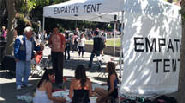
The
Empathy Tent: Rutsch shares his experience taking
a physical "Empathy Tent" to highly volatile political rallies (e.g., in
Berkeley, CA) to facilitate mutual listening between opposing groups (such
as Trump supporters and Antifa counter-protesters), resulting in unexpected
connections [52:19].
VII. Conclusion: Feeling Heard
is Feeling Loved [53:55]
Snyder quotes:
"Feeling heard is so
close to feeling loved that most people cannot tell the difference." [53:55]
They agree to organize a joint,
recorded Empathy Circle online in the future to model bridging social and
political divides [46:42].
Zoom Meeting
summary
Quick recap
Edwin Rutsch
and Dave Snyder discussed the role of empathy in bridging racial and
political divides, especially within the church. Dave shared his journey
in a historically white church that became more diverse, highlighting
the challenges and the importance of empathy in building unity. They
explored definitions of empathy, with Edwin referencing Carl Rogers and
the Empathy Circle practice, and Dave connecting empathy to biblical
teachings. They addressed criticisms of empathy, such as those in "The
Sin of Empathy," and discussed the need for dialogue and mutual
understanding. Dave described the small group experiences his church
uses to foster empathy and racial understanding, while Edwin explained
how structured empathy practices can help in conflict mediation and
bridge-building efforts. Both agreed on the transformative power of
feeling heard and the potential of empathy to heal divisions.
The
transcript appears to contain only brief, fragmented audio captures from
Edwin without any substantive discussion content. No decisions,
alignments, or action items were discussed that could be summarized.
Empathy in
Religious Contexts Discussion
Edwin Rutsch,
Director of the Empathy Center, interviewed Dave Snyder about empathy in
religious contexts. Dave shared his experience with racial integration
at his church in Cincinnati, which had historically been all-white but
began diversifying in the 1970s as the community became 70% black. Eight
years ago, Dave initiated conversations with Black elders and deacons
about their experiences with perceived racism, leading to a small group
experience focused on building relationships across cultures and
learning empathy skills. The discussion highlighted how empathy training
helped bridge divides within the congregation and challenged traditional
Christian approaches to listening and understanding.
Journey of
Discovering Empathy
Dave shared
his journey of discovering empathy through workshops and small group
experiences, which led him to write essays and eventually leave his
corporate job to focus on sharing these insights about race and empathy
with Christian audiences. Edwin defined empathy based on Carl Rogers'
work, explaining both basic empathy (sensing into someone's experience)
and holistic empathy (mutual empathy between people). Dave responded
positively to this definition and explained his own understanding using
biblical examples from Romans 12:15 and Jesus's reaction at Lazarus's
tomb, emphasizing the importance of entering into others' experiences
without necessarily agreeing with their perspectives.
Empathy and
Cultural Understanding Practices
Dave
expressed concern about a ministry leader who criticized empathy and
listening to people of color's experiences without understanding the
concept of empathy as not requiring agreement. Edwin explained the
empathy circle practice as a method to ground and demonstrate empathy
through structured speaking and listening turns, ensuring everyone has
an opportunity to share and be heard. The discussion highlighted the
importance of understanding and practicing empathy, particularly in
intercultural and interfaith contexts.
Holistic
Empathy in Conflict Mediation
Edwin and
Dave discussed the importance of holistic empathy in conflict mediation,
emphasizing the need to fully listen to others and decide that they are
worthy of connection. They compared their approaches to empathy circles,
which welcome everyone and allow free speech. Edwin mentioned critics of
empathy who refuse to engage in dialogue, contrasting this with the
empathy group's willingness to listen. Dave shared his experience with
Braver Angels, highlighting their efforts to address political division
within the church to build racial solidarity.
Empathy and
Social Divide Solutions
Edwin and
Dave discussed the role of empathy in addressing social divides,
highlighting the importance of structured dialogue and the Empathy
Center's collaboration with Braver Angels Network. They addressed
criticisms of empathy, emphasizing that empathizing with harmful
individuals does not mean condoning their actions but can help prevent
future harm and foster healing. Edwin suggested transforming prisons
into empathy training centers, and both agreed on the value of building
connections and understanding across different groups to address
societal issues.
Church Racial
Integration Initiatives
Dave
discussed challenges in building bridges across racial and political
divides in church settings, citing research by Corey Edwards that shows
Christians are twice as likely to believe racist narratives if they
attend homogeneous churches. He explained their church's intentional
efforts to create integrated ministries and inclusive programs,
including requiring funded ministries to be integrated and organizing
ethnic meals and lunches together. Dave reported significant progress
through small group experiences for new elders and deacons, which helped
facilitate more constructive discussions about racial topics in
leadership meetings, though they are still working on addressing
political divides through workshops with Braver Angels.
Empathy
Circle Discussion Planning
Edwin invited
Dave to participate in an Empathy Circle practice and offered to host an
online session with 4-6 participants, including Dave. Dave described his
congregation's approach to empathy through small group experiences using
the D-I-R-P method, where participants share their lived experiences in
groups of 10 or less with facilitators of different races. The
discussion concluded with Edwin suggesting they explore the topic of
empathy within the Christian community, particularly in response to
criticisms raised in "The Sin of Empathy" book, with Dave agreeing to
review the author's arguments the following week.