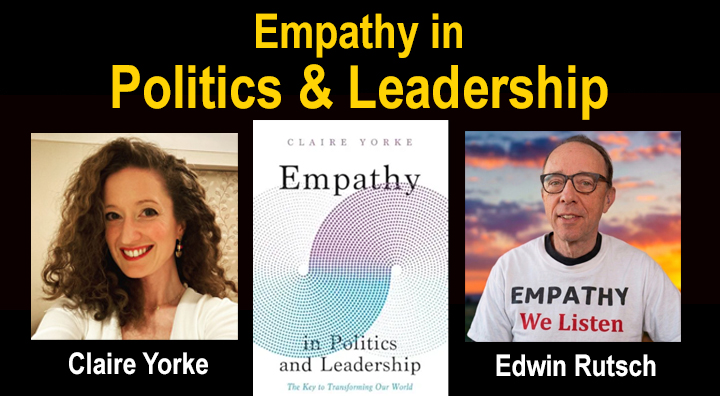
Claire Yorke is an Author, academic and advisor
specializing in the role and limitations of empathy and emotions in
security, international affairs, politics, leadership, and society. Her
doctoral research focused on the role of empathy in diplomacy. How Empathy
- can be a tool for navigating complex international transitions and
building state relations. Claire is author of
Empathy in Politics and Leadership: The Key to Transforming Our World.
Edwin Rutsch and Claire York discuss the importance of empathy in politics
and society. Claire, a senior lecturer at Deakin University, emphasizes
the need for empathy to connect people and understand their intrinsic
dignity. They explore the challenges of empathy, such as dealing with
conflict and dehumanization.
Edwin introduces his wholistic empathy definition model, which includes
basic, self, imaginative, and mutual empathy. They debate the
effectiveness of empathy circles and the importance of active listening.
Claire Yorke
is
a Henry A. Kissinger Postdoctoral Fellow at International Security Studies
and the Jackson Institute for Global Affairs at Yale University. Her
research explores the role and limitations of empathy and emotions in
international affairs and diplomacy. Claire wrote an article/paper
titled,
The Significance and Limitations of Empathy in Strategic Communications.
"This article examines the varied dynamics of empathy
through the lens of American politics at domestic and international
levels. It argues that empathy is a multifaceted and complex concept with
transformative power, but also with practical and political limitations,
which deserves far greater attention from strategic communications
practitioners."
ABSTRACT
Empathy is increasingly seen as integral to effective strategy, offering
solutions to policy failures and new ways to achieve strategic and
operational success. Despite its softer connotations, empathy is hard,
requiring strategists to confront misperceptions and false assumptions,
and overcome individual egos and national hubris. This article reviews
the literature, examining some of the gaps and costs incurred. Whilst
strategic empathy may have transactional and instrumental connotations,
it suggests that the concept holds greater potential to transform
strategy. Used wisely, it offers an ethos and means to put people first,
foster greater security, and offer innovative approaches to contemporary
challenges.
3. Case Study One: Germany, Refugees and the Migration Crisis
4. Case Study Two: Brexit and the UK’s Decision to Leave the European
Union
5. Case Study Three: New Zealand’s Response to Terrorism
6. Conclusion: Empathy as a Variable Asset References
Abstract
Defined as an attempt to understand the experiences, feelings, and
perspectives of another, and emphasizing the benefits of genuine human
connection, the importance of empathy has been extolled by political
leaders including former President Barack Obama, and current Prime
Minister of New Zealand, Jacinda Ardern. Yet it is no panacea, and its
benefits may be subjective, dependent on diverse perspectives of who it
benefits, and at what cost. More work needs to be done to understand its
complexity and how it interacts with the imperatives and challenges of
politics and public discourse.
2026-04-02 -
Otter.ai Summary and Transcipts
Edwin Rutsch and Claire York discuss
the importance of empathy in politics and society. Claire, a senior
lecturer at Deakin University, emphasizes the need for empathy to
connect people and understand their intrinsic dignity. They explore
the challenges of empathy, such as dealing with enmity and
dehumanization.
Edwin introduces his holistic empathy definition model, which includes
basic, self, imaginative, and mutual empathy. They debate the
effectiveness of empathy circles and the importance of active
listening. Claire suggests that empathy should be a collective
practice, involving community engagement and civic education. They
also discuss strategies for promoting empathy, including grassroots
initiatives and participatory democracy.
Edwin Rutsch and Claire Yorke discuss the depth of empathy and its
role in fostering trust and intimacy in groups. They explore
criticisms of empathy, particularly from Fritz Breithaupt, who argues
it can foster in-group favoritism. Yorke emphasizes empathy's
spectrum, from individualistic to mutual, and its role in politics.
They also touch on the importance of self-reflection in strategy and
diplomacy, the impact of British colonialism on Australia, and the
need for empathy in political culture. Yorke highlights the
significance of citizens' assemblies and participatory democracy in
bridging political gaps and fostering empathy.
Action Items
[ ] @Edwin Rutsch - Arrange and
confirm Claire York’s participation in the upcoming eight-hour
online empathy marathon.
Outline
Introduction and Background of Participants
Edwin Rutsch introduces himself as
the director of the Empathy Center and welcomes Claire York, an
author and academic advisor specializing in empathy and emotions in
international affairs.
Edwin provides an overview of
Claire's background, including her doctoral research on empathy and
diplomacy and her book "Empathy and Politics: The Key to
Transforming Our World."
Claire introduces herself, mentioning
her role as a senior lecturer at Deakin University in Canberra,
Australia, and her work at the Australian War College, where she
teaches courses on empathy in the Indo-Pacific region.
Claire explains the Indo-Pacific
region she covers, including countries like Indonesia, India, Japan,
Korea, Fiji, and Solomon Isles.
Defining and Understanding Empathy
Edwin and Claire discuss the
importance of making empathy a core cultural value and the
challenges of defining empathy.
Claire expresses her belief in the
intrinsic value of empathy and its role in connecting people and
understanding their dignity and humanity.
They explore the tensions empathy
encounters in politics and security, particularly the blockages
caused by enemy images and dehumanization.
Edwin suggests starting with a
definition of empathy, mentioning his holistic empathy definition
model and his disagreement with the academic binary between
cognitive and affective empathy.
Wholistic Empathy and Active Listening
Claire shares her agreement with
Edwin's holistic empathy definition and her frustration with the
cognitive-affective binary.
She emphasizes the importance of
understanding emotions in both cognitive and affective forms of
empathy, arguing that emotions shape how we interpret the world and
give it meaning.
Edwin explains his definition of
empathy based on Carl Rogers' active listening process, focusing on
sensing into someone's experience and using the empathy circle as a
model for mutual empathy.
Claire differentiates between
different types of empathy, including basic empathy, self-empathy,
imaginative empathy, and mutual empathy, and discusses the
importance of emotional literacy and intelligence in empathy
practice.
Challenges and Projections in Empathy
Edwin and Claire discuss the
challenges of imaginative empathy and the risk of projection, where
one's imagination can lead to inaccurate understanding of others.
Claire shares an example from her
research on empathy with animals, where imaginative empathy is used
to understand the experiences of urban wildlife.
They explore the importance of
self-reflection in empathy practice, particularly in government and
military contexts, where historical legacies and political dynamics
can complicate empathy.
Edwin shares his experience with
mediation between political left and right, emphasizing the
importance of creating a space for mutual listening and
understanding.
Empathy in Politics and Conflict Resolution
Claire discusses the role of empathy
in politics, particularly in reducing animosity and tension in
political discourse.
She emphasizes the importance of
creating spaces for people to feel heard and understood, and the
need for emotional literacy and intelligence in political
engagements.
Edwin shares his experience running
for Congress as the empathy candidate and his efforts to bring
politicians together for empathy circles.
They discuss the potential for
nonviolent direct action to promote empathy, such as occupying a
space to encourage politicians to engage in empathy circles.
Strategies for Promoting Empathy
Claire outlines strategies for
promoting empathy, including engaging in everyday conversations,
volunteering, and reading diverse perspectives.
She highlights the importance of
civic education and participatory democracy, such as citizens'
assemblies, in fostering empathy and mutual understanding.
Edwin shares his vision for scaling
up empathy efforts, including organizing empathy circles and
occupying public spaces to promote empathy between political groups.
They discuss the need for a training
curriculum to support empathy practice, including the empathy circle
as a foundational practice.
Criticisms and Improvements in Empathy Practice
Claire shares her criticisms of the
empathy circle training, particularly the lack of follow-up
questions and the need for deeper engagement to feel heard and
understood.
Edwin responds by explaining the
truncated nature of the training and the importance of participants
taking responsibility for sharing their deeper feelings.
They discuss the challenges of
dealing with high-conflict topics in empathy circles and the need
for facilitators to manage the process effectively.
Claire emphasizes the importance of
understanding different ways people feel heard and the need for
empathy practice to be tailored to individual needs and contexts.
Conclusion and Future Directions
Edwin and Claire discuss the
importance of continuing to explore and refine empathy practice,
including holding longer empathy circles and incorporating follow-up
questions.
They emphasize the need for empathy
to be a core cultural value and the potential for empathy practice
to transform political and social relationships.
Claire shares her vision for
promoting empathy through grassroots initiatives and community
engagement, highlighting the role of local organizations in
fostering empathy and mutual understanding.
Edwin expresses his commitment to
scaling up empathy efforts and creating a movement to promote
empathy in politics and society.
Building Trust and Intimacy in Empathy Circles
Edwin Rutsch discusses the importance
of sharing understanding rather than parroting others' words to
foster deeper connections.
Trust is crucial in empathy circles;
deeper trust leads to more intimate sharing and understanding.
The process of empathy circles allows
for unlimited time to share, ask questions, and reflect on others'
perspectives.
Edwin emphasizes that it can take
time for people to open up and share deeply, sometimes taking hours.
Criticisms of Empathy and Its Implications
Edwin and Speaker 1 discuss
criticisms of empathy, particularly from Fritz Breithaupt, who
argues empathy can foster in-group favoritism.
Speaker 1 explains that empathy can
be used by populists to build connections, making certain groups
feel valued.
The conversation touches on the idea
that empathy is not limited to those we agree with; it can be used
by both populists and those advocating for a fair society.
Edwin argues that defining empathy as
mutual rather than individualistic is crucial for understanding its
true nature.
Empathy as a Spectrum and Its Political Implications
Speaker 1 explains that empathy
exists on a spectrum, from individualistic to mutual empathy.
Empathy can be used as a means to
build connections within groups, or as an end to create a more
empathetic political culture.
The conversation highlights the
importance of mutual empathy in politics, where differences and
discomfort are encountered and addressed.
Speaker 1 emphasizes the need to be
specific about the type of empathy we want to create and to call out
manipulative empathy.
Challenges of Defining and Practicing Empathy
Edwin and Speaker 1 discuss the
challenges of defining empathy and the potential for
misunderstandings.
Speaker 1 argues that empathy can be
used to create in-group belonging, but this is different from mutual
empathy.
The conversation explores the idea
that fear often creates barriers to empathy, both within and between
groups.
Edwin suggests that the problem is
not with empathy itself but with the fear and blocks that prevent
true empathy from flourishing.
Empathy as an Ecosystem and Its Role in Politics
Speaker 1 introduces the concept of
empathy as an ecosystem, emphasizing the need to embed empathy in
political culture.
The conversation explores the role of
leaders in practicing empathy and the importance of creating a
culture where empathy is valued.
Speaker 1 discusses the need for
citizens to demand better and show up in their communities to create
a more empathetic political environment.
The conversation highlights the
importance of storytelling in transforming the present moment and
amplifying hopeful narratives.
Structural Approaches to Empathy and Political Engagement
Edwin and Speaker 1 discuss
structural approaches to empathy, such as citizens' assemblies and
participatory democracy.
Speaker 1 explains that citizens'
assemblies help bridge the gap between politicians and the public,
fostering political literacy and awareness.
The conversation touches on the need
for leaders to model constructive dialog and empathy through actions
like empathy circles.
Edwin shares his experience of
reaching out to political leaders to participate in empathy circles
and the challenges faced.
Self-Reflection and Strategic Empathy
Speaker 1 emphasizes the importance
of self-reflection in strategic empathy, encouraging leaders to
question their assumptions and biases.
The conversation explores the role of
reflective practices in university education to foster empathy and
critical thinking.
Speaker 1 discusses the need for
humility and avoiding hubris in strategic decision-making to create
more effective and equitable outcomes.
The conversation highlights the
importance of understanding institutional assumptions and biases in
strategic contexts.
Cultural and Historical Context of Empathy
Speaker 1 shares personal reflections
on carrying a British-centric view of the world and the importance
of interrogating these assumptions.
The conversation explores the impact
of British colonialism on Australia and the need to engage with
Indigenous history and perspectives.
Speaker 1 discusses the importance of
self-reflection in understanding the legacies of colonialism and
their long-lasting implications.
The conversation touches on the
broader implications of empathy, including care for animals and the
environment, and its connection to climate change.
Empathy and Animal Rights
Speaker 1 discusses the importance of
extending empathy to animals and the impact of animal rights
advocacy on personal perspectives.
The conversation explores the
connection between animal rights and environmental concerns,
emphasizing the need for a broader consciousness.
Speaker 1 shares personal experiences
of learning about animal rights and how it has informed dietary
choices and political care.
The conversation highlights the
importance of self-reflection in understanding and addressing the
impact of human actions on the environment.
Conclusion and Future Explorations
Edwin and Speaker 1 discuss the
potential for future conversations and explorations of empathy and
its role in politics and society.
The conversation touches on the
importance of continuing to model and practice empathy in everyday
life and leadership.
Speaker 1 expresses interest in
exploring further the concept of empathy as an ecosystem and its
implications for political culture.
The conversation concludes with a
mutual appreciation for the depth of the discussion and the
potential for future collaboration.
Transcript
Preview
Edwin Rutsch 0:01
Hi everyone. It's Edwin Rutsch, director of the empathy center, and
we're here today to talk about, how do we build a culture of empathy,
make empathy a core cultural value. And I'm really pleased to be here
with Claire York, thanks for joining me for this discussion.
Unknown Speaker 0:19
It's so lovely to join you again. Thank you for
Edwin Rutsch 0:21
having me. Yeah, and let me give a little overview of you. You're an
author, academic advisor specializing in the role and limitations of
empathy and emotions and security, international affairs, politics,
leadership and society. And you also did your doctorial research on the
role of empathy and diplomacy. And it's like how empathy can be a tool
for navigating complex international transitions and building state
relations. And that's what I've gotten from your My digging in report on
your background from your website, and then you're the author of empathy
and politics and leadership, the key to transforming our world. And
yeah, I was gonna have a hard copy of it. I listened to it on, on
Audible. You know, it was 12 hours. It's a long it's a lot of work you
put into that. That's a really hefty work. And your website is Claire
york.me, the links will be in the in the video notes below. And is there
anything else by way of introduction? You know that you'd like to how
you'd like to introduce yourself?
Speaker 1 1:35
I guess I should say that. I'm based in Canberra, Australia, and I work
for Deakin University. I'm a senior lecturer at Deakin University, and I
teach at the Australian War College, where I actually teach courses on
the Indo Pacific region through the lens of empathy, so looking at the
role of empathy and informing strategy, informing policy, and helping
senior leaders make decisions about how we engage with allies and
partners in the region, okay? And that's
Edwin Rutsch 2:05
indo, Pacific region. So in that area that include
Speaker 1 2:08
Indonesia, yes, it does. So it's Australia's neighborhood. So all the
way up, Pakistan, India, Japan, Korea, Fiji, Solomon, Isles. So the
whole kind of region we looked at that.
Edwin Rutsch 2:21
Yeah, I had first study. Started studying Indonesian language and
culture, so that was my first area that I studied. I eventually kind of
dropped that after a couple of years and got into economics.
Unknown Speaker 2:32
So, yeah, I'm still to go. I've heard it's amazing country, yeah.
Edwin Rutsch 2:36
Oh, great. So I would say that we both agree that, you know, it's
important to make mutual empathy a core cultural value. Is that sort of,
would you say that we have that in it, as in a core agreement? Yes, yes,
I would, yeah. So you're like, like, how do we use empathy to get for
for in politics and cultural relations, or kind of political relations
is kind of your interest area?
Speaker 1 3:05
Yeah, I'm interested. So I believe in the real intrinsic value of
empathy as a way of connecting us to one another, of seeing each other's
intrinsic dignity and worth and humanity. But I'm then interested in
what does that mean when we incorporate it into these more collective
spaces like politics, like security, and I'm also interested in the
tensions that empathy encounters, where you're trying to bring in ideas
of understanding others while also having to deal with a sense of
enmity, maybe that's involved in security or In threat or risk and
power, and how does it interact with those kind of elements within our
politics and security landscape?
Edwin Rutsch 3:47
Would you be it would be fair to say those are the risk, the blocks to
empathy. It's like you're those things you're talking about are like
things that would be blocking empathy. How do we address those? I think
there's
Speaker 1 3:59
ways that they can coexist, and that's what I'm interested in really
exploring. But certainly the enemy images, the dehumanizations that can
accompany these spaces can be a blocks to empathy. They make it very
hard.
Edwin Rutsch 4:13
Okay, well, let's maybe we should start with the definition of empathy.
I find that, you know, there's a lot of books coming out about that are
negative, critical of empathy. And for the most part, I think it's just
the definitional problem. We're talking about different phenomenon. And
so I think it's really helpful to spend some time kind of exploring
that. And I sent you sort of my definition, or if you had a chance to
look at that, I call it the holistic empathy definition model, and I did
see on your definition, you did talk about affective and cognitive
empathy. Is that? How do you feel about that, that definition, or sort
of like a academic definition, which I kind of disagree with, yeah,
yeah. Is affective and cognitive. Anthony, I just feel that the
cognitive scientists have done a real disservice to empathy. So anyway,
just where do you kind of what? What's your definition? Let's kind of go
from there.
Speaker 1 5:09
Yeah, so I listened to your definition on holistic empathy. I think
there's a lot that we share in how we define empathy, and I share as
well, your frustration with the binary between cognitive and affective.
So in my work, I often engage with those as being the way that
literature currently captures empathy, this idea of cognitive and
affective. But for me, I argue that if you want to do really good
empathy, even if it's the more say cognitive form, which is the more
deliberative that it's talked about as being the more deliberative,
conscious process of understanding others, and especially in a strategic
space where maybe you don't have that emotional connection with the
people that you are empathizing with, I argue you still need to
understand emotions. And this division between reason and emotion, to
me, is a false dichotomy. It doesn't work, because if you are going to
do reason properly, you need to understand the ways in which emotions
shape, how we interpret the world, how we give it meaning, how people
respond to it, and what it is that is informing their judgment. So for
me, in both of them, you need to have a bit of both, and so I try and
find a bit of a middle ground there.
Edwin Rutsch 6:23
Yeah, you know, the model that I've been doing, how I've been defining
empathy, is I've been trying to make it more concrete, because it tends
to get very abstract, you know, especially among academics, because the
work, you know, the definition I'm using is based on the work of Carl
Rogers, who I kind of really admire his empathy work. And he developed
the whole active listening process. So he was a clinician, so he was
actually very involved in the experience as well as the scientific so
explaining how things worked in science, in scientific works, you know,
with studies and his process was, you know, the act of listening is the
empathy is kind of sensing into someone's experience. So now I'm you're
listening to me. You're shaking your head like, you know you you're
hearing me. I feel like you're kind of getting what I'm saying. So
you're sort of sensing into and empathizing with me. I'm kind of doing
an interview with you, and I'm trying to sense into what your experience
is, and that sensing into is what I would just call basic empathy, that
I'm trying to understand who you are, but it's hard to differentiate
between your your thoughts and and your feelings. So yeah, so that
that's kind of how and not also doing it within the context of the
empathy circle. The Empathy circle for anyone listening is, you know, we
have a group of four people. I listen, one person speaks, and the other
listens the and then they reflect back their understanding and make sure
that they understand what the speaker is saying when we're have time
turns, and maybe five minute turns, when the time is up to listener
becomes a speaker, and they speak to someone else, and we go around in
that process and and that's sort of what I consider, yeah, what I
consider empathy is that sensing into and you're aware of both the
feelings and any sort of thoughts, and they're almost indistinguishable.
You know, it's like hard to really distinguish. And I Yeah, so I just
wonder how you sort of, how that kind of lands with you, and where you
are with that.
Speaker 1 8:37
Yeah, that lands with me and and I think, I think what's interesting is
I also differentiate between different types of empathy, because it can
often become this word that captures so many different forms of that
understanding and that process of listening and seeking to gain a deeper
appreciation of different people's internal worlds or their reality. And
I talk about empathy as being a lens to emotionality, and I use empathy
in all environments. I mean intentionally, because I I think we can use
concepts like perspective taking, but to me, they sound too abstract. I
want us to get better as individuals or as professionals, at seeing how,
as human beings, we are very naturally emotional. And that's not not
something we should shy away from. That's something that we should
actually get more curious about and more literate about. And I think the
work of people like Susan David on emotional agility, that we should
learn how our emotions shape, how we respond to others, but also get
better at reading them in others, so that we can say, if someone sat in
front of us, you know, what is it you're actually feeling beyond what
you're telling me? Because I feel like there's something there, you
know? So that then helps aid that connection, but we can only do that
when we understand emotions more fully and. We're also not connected too
deeply to our ego or our sense of that vulnerability that can come with
sharing emotions. Yeah, the
Edwin Rutsch 10:10
sorry, it's more No, no, okay, yeah, so that's where you're saying that
that differentiation between feeling and reason or thought that that
sort of a it's, I don't find it's very helpful, because even reason,
when people reason that there's a felt experience associated with the
feeling, and I've done, I did an empathy circle once on the question of,
What does reason feel like? So there is a visceral, felt experience when
people are thinking and reasoning. Sometimes it's kind of constricted a
focus, feeling of focus and so, yeah, it just that whole differentiation
between the two. And Carl Rogers never differentiated between feeling
and reason when he was listening to people. So I think that that, and
also that term cognitive empathy and affective empathy is so academic
sounding that it has a it kind of, I think for lay people, it just
confuses the situation.
Speaker 1 11:17
I do think that the cognitive this idea of cognitive empathy becomes
more pertinent to those who are maybe in the Ministry of Foreign
Affairs, or they're in a government bureaucratic building where they do
not have maybe that felt sense of what everybody they're designing
policy for feels, and they could, therefore it's more of a cognitive
process. What might people be feeling right now? And because there's so
many people that they're designing policy for, and they're having to
think about very diverse communities and disparate people, then
actually, that cognitive process becomes a more comfortable space to
engage in the practice of empathy, because we can't expect people to
hold all those emotions. I don't think we can have access to that in any
accurate form. And so the cognitive is about saying, Okay, well, how do
you then go through a process of thinking about what this might mean for
different people, about how they might see the world, and how the ideas
that you're developing might land with them. What is your history with
them? What kind of levels of trust are they having government? What kind
of experience do they have of being disappointed by policy directed
towards them? How have they been let down? And so that cognitive is also
I also find that a lot of it is about how do we get more people to
understand the value of empathy? And we're still dealing with a
resistance to the importance of emotions, and it's seen as something
that's weak, and it's often gendered, this idea that emotions are
something that women do and not men, which I think is ridiculous. It's
not, you know, it's not irrational women that are the problem right now.
And, you know, how do we, how do we then encourage people to start to
see it? And I think that often takes steps. I think it takes people to
go, oh, that's where emotions play a part. That's how they create
meaning in people's lives. And doing it through that more cognitive
process can can be a bit of an entryway to that. And sometimes you can't
carry the emotions of people you disagree with. And some of the work I
do on empathy is about, how do you empathize with adversaries. You know,
maybe that's the Taliban. Maybe it's a terror you know, other terrorist
organizations or people who've committed serious crimes, it's often hard
to get a sense of how you feel, because you don't feel naturally caring
or kind or understanding towards them. So it then becomes more of a
cognitive process, what are they thinking? What are they doing? What
choices do they have? What motivations are they being guided by? So
that's where I think that cognitive element has a beneficial function.
Edwin Rutsch 13:53
So one area that I see is becomes confusing, is there's the empathy of
sensing into someone's situation, sort of more of a direct like we are
now. We're kind of facing each other. We're sensing into each other's
experience. I'm, you know, sort of reading your emotions or sensing your
enthusiasm or curiosity, etc. And then there's what I would call
imaginative empathy. I think those two get conflated, and sometimes
cognitive empathy is another word for imaginative empathy in the sense
that I can sort of imagine what your situation is. I can kind of put
myself in your situation, or I can put myself in my situation, in myself
and being in is a Taliban. I can imagine being a Taliban, and what this,
you know, how I would feel, let's say in that situation, or I can
imagine what it's like to be a Taliban in their situation. So that's so
that's like an imaginative and there is a problem with that in this, and
it's a good it's a way of knowing. And I think, right. Obama, that's
kind of how he was defining empathy. Quite often, it's a way of knowing.
But the problem with imaginative empathy is you can be right or you can
be wrong, and sometimes it turns into projection, where you imagine the
Taliban being a certain way, and you project it onto them, and it's not
accurate. Whereas the basic empathy of sitting down with the Taliban,
hearing what they have to say, and sensing into you know what they're
saying, that that's more like a direct, more accurate way of knowing,
because especially using active listening, where you have to reflect
back your understanding to get confirmation that you do understand that
person,
Speaker 1 15:42
yeah, and I can understand that. And I guess there's a couple of points
I'd say in response to that. One is I, I love the idea of imaginative
empathy that you outlined, and for me, it really spoke to like one of
the examples you gave in the video. And hope you link the in the notes
to the other video, so people can follow up, is, you know, you can
empathize with animals. And when I was doing research for the book, I
discovered that actually, that's something that's really going on in
Denmark. There's a organization in Aarhus, and it's one of their
projects there, which is, it's the organization is designed to build
community and to help citizens reclaim a bit of their agency in their
local area and shape their city. Aarhus is in the north of Denmark, and
one of the projects there is encouraging people in the city to imagine
what life is like for the urban wildlife. So what is it like when you
put spikes on the top of buildings. For pigeons, where are they nesting?
So I think for me, imaginative empathy is a little bit more for how I
interpret it creative, you know, where you're people, where you can't
maybe have those conversations. You know, for for animals, where we can
maybe take a guess, but we we really can't determine from them what it
is that they feel like. But you're right that the danger with some of
the more cognitive forms is that we're still projecting. And that's why,
for me, self reflection is an integral part of defining empathy, that if
we are going to empathize with other people, we also have to be able to
reflect on ourselves. What am I bringing to this encounter? What is it
that maybe in the past, I have done that means my words and my actions
have shaped how I'm going to be received by this person? And again, this
is maybe where my work with government organizations and public servants
and the military shapes my my my understanding of it. But there, you're
not just dealing with a person engaging with another person. You're
dealing with the politics of someone who represents an organization in
their engagements with someone so it's not just like I as an individual
could sit down with a Taliban. If I were a member of government sitting
with them, there's so much politics around them, and they would then
represent everything that they are, for everything they're representing,
in terms of the ministry or the organization and the history, and
especially for countries like Britain, where you can tell I'm from, or
Australia, there's often kind of colonial legacies or historical
legacies in those engagements that as individuals, we Just need to be
conscious of. So it's never just in that moment, there's a element of
understanding what we bring each time we show up.
Edwin Rutsch 18:28
Okay, well, that's a good example. Then we have the Taliban. You're
talking with the Taliban as a as an example, and what I'm hearing you
say is that you're bringing a lot of past history, a lot of, maybe
judgments, or, yeah, just all kinds of other stuff that you're bringing
to to the relationship and that you're it sounds like you're thinking
wanting to do sort of a self analysis, or self analysis of what you're
thinking and bringing to the table.
Speaker 1 18:59
Yeah, it's part of my belief that we need to get better emotional
literacy and more emotional intelligence in ourselves. So what is it
that I expect to find? What are my assumptions? What are they rooted in?
And I think it's impossible to go into such encounters with no
preconceptions or ideas or stereotypes, but at least if we're aware of
them, we can more critically interrogate whether or not we were right in
that, whether or not that aligned with what we found. But the danger is,
if we take a projection and a stereotype and we just perform empathy,
and I talk in the book about that idea of, you know, just the sincere
empathy and performative empathy, then you're not actually going to get
to know the different people on their own terms. That doesn't in any way
mean you agree with them. It doesn't mean you sanction their actions. It
doesn't mean that you think what they're doing is right. And I think
there's a whole other topic to discuss around the boundaries of empathy,
but I think just being aware that we get that more accurate
understanding what. Is it that they're dealing with beyond the
projections that we put on different people.
Edwin Rutsch 20:04
So it would be a projection you would have like, what would be? How do
you think if you're sitting down with the Taliban to negotiate some kind
of an agreement, what would maybe? What would be an example? Can you
think of one? Might be one of your many?
Speaker 1 20:21
Yeah, that'd be many. I mean, I think what you know, one very obvious
one that I would have to that I would struggle with, and empathy is
uncomfortable, and that's something that people who say it's a weakness
miss. You know, it's very hard to sit with people so you actively find
conflict with your worldview, the way they live, the way they think, the
way the actions, you know, and as a woman, I'd struggle with the
treatment of women, and I think trying to understand, why is it that you
think hiding women away and restricting their access to education and
the arts and music is okay in order to just gain an understanding that
was kind of, I mean, it's never going To be objective, but a little bit
more objective, I would struggle with that, and I'd have to be very
conscious of the fact that I would take that bias in with me to any
conversation, because it disagree. It disagrees and does not align with
my view of the world. But I you know, if you want to understand why is
it you do that like let me actually understand what's going on. I have
to be conscious of that bias and that tension, and it might even help to
articulate that. I might even say this is a point of resistance I have
with you. Were I ever to get that origin to be in that position?
Edwin Rutsch 21:38
Yeah, so you in that situation. You probably be against, I guess the CHA
do, or is that the full Cloaking is you, I imagine you'd be against
that. And women being, you know, kind of pushed, treated, and, yeah,
can't go out in public on their own. And so you would be against that,
but you'd be willing to sit down with with someone from the Taliban and
listen to their point of view and try to understand, understand where
they're coming from, not that you agree with it, but that you would try
to understand,
Speaker 1 22:10
I think, as well. How do you design policies that make things better if
we don't understand the nature of the problem and what we're dealing
with? And I probably am not the right person for that job, in all
honesty, but you know, I think that's something that we do have to bear
in mind in even the less extreme instances. How do we make sure that
when we're trying to use empathy in context to make people's lives
better, that we're not showing up and interpreting someone else's
experience through our own lens in a way that's not self reflective? If
you go into certain neighborhoods in America, you might have certain
preconceived ideas because of what the media says. And I imagine, once
you get into certain neighborhoods, whether they're the poorer
neighborhoods, whether they're, you know, some of the more run down
neighborhoods where the cities left them behind, you'd probably find
people just like you, who care about the world, just like you, and if
you go in with preconceived ideas, you might be shut down to that,
because you're looking for certain things and not looking for what
people are actually like.
Edwin Rutsch 23:10
Well, we've been doing mediation between the political left and right.
You know, we take our empathy tent out to public spaces where there'd
be, you know, right wing and left wing, and they're, you know, having
knock down, drag out battles with each other. And we asked, we say, Oh,
we're willing to listen to both sides and then try to bring the sides
together to have empathic dialog with each other using the the empathy
circle practice. And, you know, I've had people say, Well, you have to
really study both sides, like where they're coming from. But I find it's
actually, I don't want to know much. I don't want to do a big study
about their background. I want to focus on the space that we have, a
space where people listen to each other. So that's what I'm interested
in, holding, that creating an empathic space, and that people will slow
down and, you know, listen to each other, and it's through the and if I
bring a lot of analysis and preconceptions and so forth to the to the
situation, you know, it's not it's not going to Help. Doesn't help that
it's creating the space for mutual listening and that both sides feel
heard. So with the Taliban, I would be, you know, if we were doing an
empathy circle with the Taliban, you know, I'd be hearing, you know, why
do you think women you know, should you know, be under the chador or
whatever you know, or treated that way? And then I would say, Well, it's
my turn to speak. Now, I totally disagree with that. I believe in mutual
empathy, and I don't see that that's creating empathy. You're kind of
suppressing their voice, and you're not giving them space to be be
empathic. So I would be advocating for empathy itself in the
relationship. With, with that Taliban person, yeah. How do you
Speaker 1 25:04
find the city dialogs go? Do you find that people show up with certain
ideas and then leave with different
Edwin Rutsch 25:12
Yeah, I would say, you know, we did. We went to some demonstrations, and
during the day, we had a whole film crew, you know, filming it. So it's
in this documentary called Trump phobia, what both sides fear. And this
filmmaker had gone to all these demonstrations and and had videotaped
just all these street fights the first time Trump was elected. And then
she she came to Berkeley, where we were at and we were there listening
to both sides and said, Oh, you're the first people I've seen who are
doing anything like this. So she had us come down to Los Angeles, and
there was a demonstration there against Trump, and there was a pro Trump
demonstration. And we set up and had six pairs of people from one from
each side, you know, six times or for about 45 minutes or an hour each.
And then I would use empathic listening, like in the empathy circle, I
would listen to one side, then listen to the other. And then also had
time turns. So you have, like five minutes was the maximum time, so you
put a limit, otherwise, you know, people will talk forever. And then
after I modeled the listening to both sides. I had them start listening
to each other and reflecting back. And then they would do do that for a
while. And then at the end of that, we had the, you know, I would give
each one a hug. And then they actually five times, five of the pairs
hugged each other too afterwards and on the other side of the street,
there they were. The police were keeping them apart. They were screaming
and yelling at each other. Police were in our in the empathy tent. They
were kind of giving each other hugs after listening. So the you know,
the what changed was the animosity, you know, the animosity went down,
and they started feeling like, Oh, the other person's willing to listen
to me. We might disagree, but it's not, it doesn't have that level of
conflict, because at least I know the other side is listening, and he
actually is kind of a nice guy, you know, or woman, or so it was the
empathy itself is sort of like a healing quality that you might not
convince the Taliban, but you still might take that the conflict down
several notches, and this is only like after an hour, right? So you
know, if you go for a couple days or an ongoing dialogs like this that I
think that over time, people start understanding, and we've done it with
pro life and pro choice too, where, you know, we didn't at the end, they
were still pro life and pro choice, we could just see the whole
narrative of why people had their their positions And and it just
created greater understanding. And I think in the long term, people
could maybe find policies or steps, the next steps forward, that they
could agree to. I think that, yeah, an agreement, and that's what I call
empathic action. So it's the action that comes out of that mutual
empathy and that mutual understanding to where you see each other's
deeper needs of what you're trying to create, and then you can you find
that connection, then you create some policies that address those needs
for each of you.
Speaker 1 28:32
Yeah, I think that's one of the critical roles that empathy can play
right now in our politics, is create a space where we can lower the
animosity and reduce some of that tension, because it's incredibly hard
to get to what is actually the problem? What is it that we are arguing
about when we're so wrapped up in villainizing each other or seeing
these divisions as being just so all encompassing, and so I think by
creating the space to say, Okay, what's actually going on here? What,
what is the issue that you're concerned about? What is your fear? What
is your anxiety and and what are also your aspirations and your hopes?
And I think that's actually where we'll find people are more aligned
than we realize. Is actually most people want safe and secure societies.
They want to be able to guarantee that they know that they're going to
have some money left over at the end of the paycheck, that they're not
going to be stuck if they need medical care, or that their children
can't go to school, you know? So there's, there's certain things that we
can tap into, but we have to create that space, and that's where I think
empathy really does play a
Edwin Rutsch 29:38
vital role, yeah, and that's what we're trying to create. Is that space
like, how do we make mutual empathy a core value so people can have
their different opinions or desires or needs or what have you, but that
the empathy is a space to work through those those issues, and I think
that one of the healing aspects of it is. Just knowing that the other
side will listen to you, you know, say, Okay, we might disagree, but I
know that you will listen to me and that we can and dialog, it dialog,
and you're not going to try to dominate or ignore or, you know, talk
over, over me. So yeah,
Speaker 1 30:17
that speaks to something that for me is so important for empathy is that
it makes people feel like they're seen and they're heard and they're
mattered and that they matter. And so how do we do that? And where is
that we've been failing that in our politics? Where have we been
overlooking people or marginalizing people, or making them feel like
they're not hurt? And that's a real corrective that I think empathy can
address.
Edwin Rutsch 30:39
Yeah, I'm just finding, I'm wondering, how did you get interested in
this? Like, how did I mean that, that that state, you know, wanting to
create that environment, like, what led you to even want to study this
and work on this?
Speaker 1 30:52
Oh, I always, I've always loved people since I was very little. And I
studied languages. I love that. Every time I studied a new language, you
open up this whole new world of history and culture and meaning. And
then I actually, after my master's, I did my Master's in Middle East
politics. And then I actually went into parliament in the UK, and I
worked in the House of Commons for three years for a really brilliant
politician. And there I had friends across all the different parties,
and you see that everyone's in it for what they consider to be the right
reasons. And you disagree on the maybe the policy measures, but people
all are in it because they want to make a change in society. I mean,
this was back in the early 2000s so I think politics has maybe changed a
little bit. Now it's become more tense. It wasn't so tense back then I
joined Parliament when Tony Blair was prime minister and and then I
worked at Chatham House, which is a think tank for international affairs
in London. And there that one of its big strengths as a think tank is
and a research institute is that it has convening power. Everyone will
know the Chatham House rule, and it brings people together from
different perspectives to learn and to share and to gain greater
understanding about the world. So I saw it there, and I found that there
was a lot of different knowledge and perspectives, and it wasn't always
translating into policy choices and decisions. And this would have been
at the time of the Iraq War, the Afghanistan war, and I just, I was left
with a lot of questions around what, why are we not better at
understanding each other and holding space for each other? And that then
led to my PhD at King's College in London, and it just really evolved
from there. And I think my background in politics means that I watch
what's going on with a real kind of dismay. We've got to this point. We
we want vibrant, demo democratic societies. We believe surely in the
power of pluralism, and now that's being challenged. Why is it? How can
we do more and and also, how do we as citizens do more? Because I think
it's very easy to look at politics and blame the political class and say
all our politicians are corrupt. That's not my experience. I think a lot
of politicians are very hard working. There will always be the bad eggs,
but you're going to get them in every walk of life. How do we as
citizens start to be more active so that we elect the right people, so
that we understand our democratic rights but also our responsibilities
that we also find politics in the local area. Because for me, politics
is also what your local council does, what your local school board does.
You know, the decision to ban books is a political action. That's
something a local school board does. So how do we understand how to
reclaim that politics in our everyday right? Because I got frustrated
with the apathy as well that people were feeling this disconnect from
really critical choices about their well being, their society, their
communities. So, yeah, I guess that's how
Edwin Rutsch 33:51
I got in and about the word empathy, even the concept, I mean, you kind
of described your interest, but worded, sort of the word or concept of
empathy, you know, kind of enter that
Speaker 1 34:02
when I first started. I mean, I think I've always found that idea
interesting, but it was actually when I started the PhD that I kept
coming across this idea of empathy in the literature, and I found it
didn't always align with my experience in practice. So I was really
interested in, okay, people are talking about it this way, but it's
quite abstract. What does it mean when you start putting it into
practice, when you actually start incorporating it into diplomacy or
politics? How does it become influenced by those environments? How does
it encounter obstacles? How can it maybe be improved and enhance some of
those environments a bit more? So yeah, I just was interested in that
tension between what I was reading, which is quite a neat, clean idea of
empathy, and then the reality of it's, it's hard. Our systems aren't
always wired
Edwin Rutsch 34:51
for it. Yeah, the that's I've been trying to do with the the holistic
empathy definition to ground it in the empathy circle. So, you know,
take. An empathy circle of, you know, maybe four or five people in a
circle using that mutual active listening in order to talk with each
other and then naming the phenomenon that happens within that so, so it
doesn't get so abstracted, because a lot of times it's like, oh,
empathy. It's like being nice, you know, or whatever. And it gets very
abstract, and so I kind of try to bring the the experience into the
empathy circle, so I can name what's happening, so that you know the
basic empathy is listening to you, sensing into your experience. And
then the self empathy is what I find is even listening. When someone
listens to me, I'm able to sense more into my own experience. And so
that sensing into my experience is self empathy, the imagine, you know,
that imaginative empathy, which is more the imagination you know, like,
like taking on a role in imagining someone else's, is a separate
phenomenon. And then I've been looking at what I call mutual empathy. So
in a group, you know, a lot of for me, the academic empathy is very
individualistic. As you as an individual, empathize with someone else,
and that's kind of where it's left, but it's really a relationship, or
in a relationship. So I kind of see the empathy circle as a model of
mutually empathic relationship. You know, because everybody's listening
to everyone else, there's a degree the empathy level goes up. And we
just did a marathon empathy circle marathon for eight hours. We should
take part in one just you can, I think you want to ask about your
criticisms of the empathy circle, but, and then there's empathic action.
So when I do conflict mediation, you know, people are in conflict.
There's all those walls that you were talking about. You get people
listening to each other, they start understanding each other. And then
the question at the end becomes, well, what do we do now? And then you
come up with steps going forward in conflict, like, how, what are we
going to do? And that's sort of an empathic action that comes out of
that mutual understanding. Instead of, like, sympathy, I'm going to do
something for you and and, you know, I don't know, really, it's more
like, you know, addressing your own problem pain, than really having a
dialog and coming up with a shared solution. So that's sort of the
framework that I'm kind of using for. I'm just wondering about what you
think of that whole that model. Yeah, I
Speaker 1 37:38
mean, that makes sense. And I think that idea of mutual empathy, I think
I call it collective empathy, but I suspect, how do we create those
spaces where it's more normal that we feel this it's more and I talk
about empathy as like an ethos and a mindset and a skill and a practice,
but an ecosystem. It's not something that just an individual does. We
have to start thinking about, how does it exist in different spaces, and
help us connect with others in a more everyday way so it just becomes a
normal way of being. And I think you know this difference between the
basic empathy that you've outlined makes a lot of sense, and I think
that's the one that most of us are familiar with, just our everyday
interactions and relationships with friends and family and strangers. I
think that individual empathy, I think that's a really vital part, that
self understanding, self understanding, where one is feeling things in
response to what they're learning, how one is also thinking about what
they think. And I do think that should be an iterative that's part of
relationality that we question ourselves and that we're able to reflect
on that. And I think that imaginative then allows that more creative
element, that we go beyond those relationships into the more expensive.
What does it mean when we apply it to animals or to fruit? I think was
the other example in your video, you know, where we start to think about
how the world is experienced by other beings, and then that mutual. I
think there's some real space there to expand on that as well, because I
think that's what's missing. Like, how do we start to create that as
just a way of communities engaging with one another, and so modeling
that, letting people discover its value. And I think one of the things
to emphasize is that it's not an immediate win, and it's going to take
time for the for that kind of mutual empathy, or the individual empathy,
the interpersonal to grow, because it's not always instinctive.
Sometimes it will be something where those people that you've done
empathy circles with will go away. They might have found things a bit
confronting, they might have found some of it a bit uncomfortable, and
then they'll reflect on it, and something will happen. And I've had
students come to me and go, I wasn't sure about this empathy thing, and
then I had this issue, you know, at work or. Or in a personal
environment, and I could totally see now why it would be helpful. And I
think it doesn't always happen immediately, but we need to stop kind of
cultivating the practice, and the more we do so the easier it gets, the
more natural it gets, the more widespread it becomes.
Edwin Rutsch 40:17
So what would be your strategy for bringing it into the social,
political environment, like, what's sort of some actual strategies you
would have for that?
Speaker 1 40:28
Yeah, so I've got a few in the book just to do a mini plug. There's a
kind of some ideas at the end. I think there's multiple different
levels, and part of it is, maybe akin to your model, is that it's it's
about how we engage in those spaces, so that we start practicing it in
our everyday and we start listening to people with different views. We
start not shutting people down because we disagree with them. We
actually get a bit curious, and we lean in and we ask, Well, why is
that? And we try and find some form of common ground, and we make people
feel heard, not with an intention to respond and put them right, but
just to hear them out, get a sense of what what they really think and
why it is that they think that. How have they been let down by politics
or government or the local community? I think we need to get get better
at engaging at a local level. In our communities, I think there has been
a disconnect from civic life, and there's a lot of really great work
going on right now that's really energizing civic life and community.
That's where I found a lot of hope, that empathy is growing, that there
are organizations that are building connections between people. I think
we need to get involved. Volunteer, help out, be a part of your local
community. Figure out what it is you care passionately about. Lean in a
little bit more. I think we need to read news or get outside the
algorithm so we escape the bubble of just what we always read. You know,
try and understand how the world looks to different people, because that
really shapes how they then approach topics. And if you don't understand
their major environment, you suddenly just think, where are they getting
this from? So just be aware of those different stories that are being
told about the very same thing. I think we need to have higher standards
and hold people in power to higher levels, we need to have more
expectations of that and hold people to account, because I think, you
know, we are seeing certain people in positions of power who I think
aren't demonstrating that kind of basic form of empathy. And we have to
ask ourselves, why, what is it that they bring? Why is it that we see
that growing and and I think as well, you know, part of it is about
getting better at the dialogs that we have with others and and
encouraging that civic education. One of the things I found really
encouraging when I was writing the book was countries like Finland have
a huge amount on just a huge amount of time in their curriculum to teach
young students about what it means to do democracy. And that's where you
learn that differences in innate part of democracy, that disagreement,
is something that can be healthy, if it helps you work together. I'm a
big fan of citizens assemblies and participatory democracy. I think
that's a really good way that you get a bit more of that mutual empathy
that you spoke about, because people then have time to go deep on an
issue, to hear the different facts, to hear the different perspectives,
and then to collectively come together and talk about what they might do
differently. So just a few ideas have more. But yeah, yeah.
Edwin Rutsch 43:41
Glad to hear all of them. So is it, are you seeing that as sort of an
individual, we as individuals, kind of do this? Or how do you see that
it being part of a collective or or a government policy that supports
empathy? I'm seeing a
Speaker 1 43:59
lot of grassroots up initiatives that even if they don't center empathy
as their reason to enter, even if it's not a core part of what they're
doing that is effectively what they're doing, they're saying, there are
gaps in what we're seeing from government. There are spaces in society
where we would benefit from more community, whether that's through
community centers or after schools club or sports clubs for senior
people, or bringing together generations. You know, where you've got
young people and old people spending far more time together, learning
from each other, finding that they aren't as different as they may be
previously thought. And I'm seeing a lot of grassroots initiatives
around the world that are really championing this, and I think that's a
good way of people getting familiar with the concept at a more local
level. And it's also something where you are often connected by mutual
interests or mutual concerns about your community, or about what you'd
like to see, or what what you're motivated by. And that helps us see
those people. We maybe think differently or live differently as more
like us, and that's what we need. We need more of these spaces, and you
had in the US the former Surgeon General talk about this loneliness
epidemic, and I think that's another way of also helping cultivate that
belonging. And belonging is a key way to build resilience within
society. It's a key way to help people feel less alone, to feel like
they are part of something bigger, to feel like there is purpose in
politics. And so any kind of initiative that helps do that, I think,
starts to contribute to that sense of mutual empathy and connection, and
to me, that they're really connected those two concepts. Well, you
Edwin Rutsch 45:40
know, we're talking about politics. I actually ran for Congress here in
the in my district in this year, near Berkeley, California. Yeah, four
years ago, three or four years ago, and I ran as the empathy candidate.
And the first thing I did is I invited the other candidates to take part
in an empathy circle. And our topic was, how might we bridge the
political divides in the countries? And I only got 3% of the vote, so
still pretty good. Yeah, it was another candidate who's sort of the
establishment candidate, been in politics long time. He won the it, but
the election, but, and then we held an empathy circle with candidates
for the state assembly here in California. And we always like 11
candidates, and they actually, I think 10 of them, took part in an
empathy circle. So it was actually at UC, Berkeley. We had one of the
halls there, and then we mediated or facilitated an empathy circle with
them. So, and then we've done the empathy tent, you know, being out in
public. And that's really where we've gotten the most publicity, you
know, for, you know, on TV, newspapers. Oh, we actually, just recently
at the Democratic Convention in in San Francisco, the state convention.
And we, you know, a group of us, we set up at a table. We offered
empathy to, you know, listening to, you know, people walking by. And I
did, you know, meet Adam shift, who's a Senator for California, you
know, federal Kent senator. So that's what we've been trying to do, you
know, in terms of, you know, the politics and, you know, doing this
empathy tent. I do want to kind of scale up on that. And one thing I'm
thinking we can, just like your thoughts on this is, is, I think that
the empathy movement, and we're, you know, the empathy Center, which I'm
director of, has the mission of making a movement to make empathy a core
cultural value. And I'm thinking, what we need to do is, with our
empathy tent, do something like Occupy Wall Street, where we actually
occupy a space, you know, in a park, maybe the state capitol here in
California, and we say we're not leaving until the Republicans Democrats
have empathy circles with each other, because this polarization is very
destructive. And so sort of an activist, you know, using nonviolent,
say, direct action for empathy building, you know, for calling for it.
And then we have the empathy circle is sort of a first step. You know,
if we get politicians taking part in an empathy circle, they they model
it for the public, right? How the public can see it? So, just wondering,
What you thinking about, sort of a non violent direct action empathy
sort of a movement?
Speaker 1 48:43
Yeah, I'd love to see, I would love to see more politicians, Republicans
and Democrats, sit down together and talk about what it is they're
dealing with and what the challenges are. I mean, do you think you
would? It sounds like you've got a big community there as well. It
sounds like you'd actually get enough people that it would. It would be
like an occupation, occupation, you know, like an Occupy Wall Street,
where you'd have a presence, you'd have people talking about what it
means and why it matters and and I think really it's it, it's important
for people across the political divides in America right now to see that
they're really there's core issues that they should be working together
on, and so getting them to kind of find, where is it that you can start
making small steps to at least address some of the challenges and
bipartisanship in America seems to have declined significantly. We're
not really sealing seeing much of that. So I think it would be great to
see it around an issue where you think there could be quick wins in
terms of bipartisanship, so not the big, toxic, hard issues, but just
easing in. Where is it that we can agree we need to do something, and
what is it that we can agree on?
Edwin Rutsch 49:57
Yeah, in terms of like, there'd be a there's. Small Group. I don't know
how many are willing to do an Occupy, I mean, like, stay overnight, but
it's kind of like you have to do it and see who comes sometimes, you
know, you just, what I think is, is like, who is willing to, you know,
put themselves on the line to to get out in public and, you know, stay
overnight somewhere and where, and maybe even get arrested for for that,
even though occupy, they didn't really do much resting of people. And
then the idea would be to do around the clock empathy circle. So my
marathon was sort of a test of how that worked. So it would be because
the occup Occupy Wall Street is where I started with the empathy tent
the first time. So it was like I saw that they said, Oh, it's the 99
against the 1% and I thought, I'm for 100% empathy. You know, as soon as
you go into the us and them, there's even if it's the 1% you know, you
chop off their head, then there's another 1% you chop off their head. So
if an us versus them, I think, is not empathic, and it's also, you know,
not, it's not going to be transformative, because it's always going to
create conflict. So I went with a canopy, set up a tent, and I called it
the 100% empathy tent. So we just offered listening. And I didn't have
the empathy circle sort of a practice at that point, but it was a very
dysfunctional space, you know, it was like, you know, drug addiction and
homelessness. So just it was in groups against each other. So it's very
dysfunctional. And to keep that from happening, it would be, everybody
would be doing empathy circles from the beginning, right? It's like
you're in a continuous empathy circle with with a group. You go from one
group to the other, so you kind of create and maintain and everybody's
welcome, conservatives, liberals, left, right, Republican, Democrat,
Nazis, anti Nazis. Everybody is welcome if you take part in an empathy
in an empathy circle, you know is, is a core sort of a practice. So, and
then I'm looking at, we need a training curriculum, and I'm wondering
what you have any thoughts on a curriculum? So that would be, empathy
circle is the foundation, and then other practices. And you know,
people's assemblies would be one of the practices. And I think empathy
circles are a good found foundation for people's actually doing having
trainings in that public space that are empathy building. So, yeah,
Speaker 1 52:39
yeah, I think encouraging people to get more comfortable with being
uncomfortable is a good way of kind of leaning into some of that and and
encouraging people to kind of ask the right questions, to follow up, to
really get the heart of what people are talking about, and to be able to
dig deeper into what lies beneath. Because often, I imagine people only
have so long and so they talk at surface level. So how are you then,
asking, what goes beyond that? Yeah, I guess as well, it'd be
interesting to see what literature you might suggest to accompany it.
What would be the kind of readings that would make people think about
the other side differently. I think fiction is such a great tool for
some of that. Or movies, you know, are there good movies that you could
just encourage people to think about? And listening is a practice,
something that we we can get better at, but it's also something that I
think we often think we're really good at, but active listening is so
much harder because you've got to be so present, and you've got to be
able to really lean in to what different people are saying.
Edwin Rutsch 53:46
Yeah. So what are your thoughts about the empathy, sir, I think you said
there was something about it that you didn't like and that you felt you
weren't heard, or something like that. So I'm wondering what your your
criticisms or were, yeah,
Speaker 1 53:59
and I guess maybe it's also understanding different people have
different ways of feeling seen and heard. And I think for me, I really
like the idea of coming together with different people. And I really
like that people have a set amount of time to talk about something that
moves them. What I struggled with, for me was because we did the the
trainings, I think during the pandemic, there are some online trainings.
What I struggled with was there were no follow up questions, and so if
someone reflects back to me what I've said, I actually just feel like
they're parroting. I don't feel like they've actually listened, because
if they had listened, they would ask a question, to go deeper, not to
tell me what it was they thought about what I said, but to go, why is it
that you feel that way? What is it that happened that shaped your
perspective? And I found that by be by people just reflecting back me to
me, it it left me just feeling really unheard, because it's very. Easy
to take someone's words and reformulate them, and I think there's a
benefit to reflecting back to people. But then I wanted it to go a bit
further. I wanted to go, Okay, what I'm hearing you say is this, but
could you tell me a bit more about this? Or what was it that motivated
that for you, and I think it's something that a lot of us do very
instinctively in conversations with others, but I just felt like five
minutes, if you're given that space to open up, you've actually touched
on quite a bit in that time, but then you don't get to go any deeper,
really, because then you just move on to another topic, and it may be
because, actually, the training was very short, and that if you're
actually sat for a long period of time with people, there's far more
time to go into that. But I, I wanted follow up questions for me to feel
heard and seen. I need to feel like someone is curious and that they're
picking up on subtle cues of things that maybe I've said or alluded to
that I haven't maybe gone deeper onto, because either I was conscious
that time was a little bit short, or because I was just trying to warm
up and make sure that I was in a trusted space. I'm not someone that
will maybe go very vulnerable very quickly. I need that time to open up
and I need to feel like someone is interested in me.
Edwin Rutsch 56:20
Can I sign you up for the eight hour empathy circles?
Speaker 1 56:27
Yes, yeah. If it's online during my daytime that's fine, because I
can't. I would love to know how the empathy marathon goes when you're at
like, 3am in the morning, because I think my empathy would be so low
when I was like, I want bed or I want tea, like, we have to
Edwin Rutsch 56:44
find a time like now, which works for Australia and California. Yeah.
So, yeah. The thing is, is with you were doing the training, so I don't
think you had the full experience of the empathy circle, because it's
very truncated. You got three minute turns. So it's very much a training
experience. And it's, it's very short, you know, relatively short,
speaking turns. And so it's, it's very different in your if you're
actually in a two hour circle, so you'd have kind of more the the
experience of it. The other part is, is, as a speaker, you're you're
it's up to you to be heard to your satisfaction. So if you're not heard
to your satisfaction, it's because you didn't say that you weren't heard
to your satisfaction. You I'm saying is you can say I don't feel really
heard in this situation. I feel like you're, you're you're not able to
ask me questions. I feel something is missing, and so you could have,
like, shared deeper about your dissatisfaction, and have been heard
about that.
Speaker 1 58:02
I do, I do, and I guess as well, the training would have constrained
that a little bit, because we didn't, you couldn't keep saying, I don't
feel heard. But for me, a part of relationality is I want someone to ask
a question about it, because I'm not just going to keep volunteering my
perspective. I mean, I can talk for a long time about opinions. I have a
lot of opinions, but with empathy circles being a bit more about that
vulnerability or about how you feel or what is moving you, I my idea of
relationality is that it's a dialog between people, and so I don't just
want someone to reflect back what I've said. I want them to kind of
probe a little bit deeper about certain things where they feel like,
Hold on. What is it you're saying that I can feel there's more to it,
and that might be something I wouldn't volunteer naturally if I was
given more time, right? And so for me, that's about reading the other
person. And I think another concern was that, and this would be
something that I'd want to see by being in a longest empathy circle, is
really, how do you deal when you're dealing with the very tense topics,
with the heated emotions, especially when you're bringing people
together who may have denied the rights to exist of others, or may have
undermined their fundamental sense of self. And I think there I would
want, I would want to make sure that there was enough safety in place,
psychological safety in place for different people to say, you know, if
they're Nazi, why it is they think that, but to not offend people who
have been very much harmed by the ideology. And I think either you need
to then make sure that you've got people in the circle who are robust
enough that they know the terms of engagement, or you need to make sure
that you can steer it and the fact that there was no questions, or there
is you're not meant to set any boundaries. For me. I was like, I don't
know how that would work when you're dealing with very fragile, very
tense topics with people who are emotionally in the thick of it, like
it's not like me now talking about something that's abstract and far
away, if you're talking about a conflict in my homeland, and something
that I may have been very directly affected by I may have lost family, I
may have encountered hardships because of that. I'm not sure I would
find it easy to show up as my most empathetic self in the first
instance. And so I'm curious about how you curate that when you're
dealing with those very hard topics, like what parameters you set. And I
guess in the training, we didn't get time to see that in action, because
you do need to see that in action over several hours.
Edwin Rutsch 1:00:47
Yeah, that was, you know, I mentioned the mediation, and there's a
video, you know, of that video clip, part of the movie, because those
people were in conflict. You know that we're mediating the political
left and right, because on the other side of the street, they were
screaming and yelling at each other. And the in the in the in the
empathy tent with and in the empathy circle, people felt like, Oh, the
other person's listening to me. So there was that, that that is that
that helps, you know, some of the most intense empathy circles are
actually with family members who've been in real conflict, you know,
deep conflict. And I've had done empathy circles with family members who
they're so triggered, they're so so in pain. You know about the family
relationship that they they just stop being willing to do the active
listening, the empathic listening. And then I would say, Well, if you're
not going to follow this process, which I think creates a sense of
fairness and actually safety in the process, then I'm not willing to be
here, you know, and because this is the structure that, you know, I feel
is an empathic structure. And then I've had them say, Okay, I'll stick
with the structure, because I threatened to leave, right? And they know
it's at the end of the relationship if they if I leave. And so there is,
you know the circles that we do, you know 95% are not high conflict
circles or people, but the higher the conflict, the more skill you have.
You need to have to hold the practice so someone in the circle might
stop doing the active listening, and then you as a facilitator, have to
be able to maybe step in and reflect back like somebody's talking. And
then, you know, saying something that triggers the other person. The
other person says, I didn't say that. And then, you know, as a
facilitator, I step and say, Well, I hear you didn't say that. And we
would do want to hear your point, but we've all agreed to stay within
the time limits and and the speaking terms, and so we just, we just
continue and stay in the process. So and that takes some grounding as a
facilitator to be able to, you know, reflect back what the person says,
so that they feel quickly heard, but then bring them back, back into the
process. So there is more in terms of the level of conflict that that's
sort of needed. But the other part, too, I think you need to look at,
too, is with the questioning. That questioning is like, can be a form of
control, like I was a big question. When I did a lot of travel, I would
ask questions all the time, but the questioning is a way of, sort of
steering the conversation the way you want it to be, versus right when,
when you ask questions to someone, you're sort of steering them in a
direction, versus them following their own what's arising in themselves.
And I do hear that when somebody asks you a question, you feel like they
care about you. They're curious, and it's giving you a lot of signals.
It makes it easier for you to share so you're sort of you sort of
appreciate that. So I think there's, there is problems with questioning
too, in the sense that it kind of controls the direction of the dialog,
versus giving the person who's speaking a chance to let their own
internal you know what's coming up for them, kind of direct them, and
you just following them. But then when it is your turn to speak, to
speak, you can ask all the questions you want. They won't be answered
right away, but they'll get reflected, right so that, yeah, so I don't
those are just some some thoughts. I mean, I really appreciate your, you
know, exploration of the topic,
Speaker 1 1:04:52
yeah, and I guess it just speaks to the fact that we're all so different
in what makes us feel seen and so understanding. Thing that that has
different implications for how we engage. There is no one size fits all
to empathy. You know, we might think we're being really empathetic, and
someone might not see it that way, if that doesn't translate for how
they've been brought up, either culturally or, you know, maybe there's
certain things where they do find questions more intrusive, whereas
others might find them a necessary route to that kind of connection. So
I guess it's just reinforces the idea that there is no one size fits
all, and encourages, therefore, to get curious about, well, what does it
mean for you to feel like you matter or that you're heard? And I think
that's an also important question that could be asked. You know, in this
empathy circle, what would it mean for you to feel heard? What would it
mean for you to feel seen in politics? What would it mean for you to
feel you matter in your community? And then people can, you know, expand
on the various different ways in which it is. And I imagine if you did
that, you'd find very different responses from people that some people
might just want services to work really well. They don't actually need
the personal connection. They just want to feel like society functions.
There might be others who want to have really long doorstop chats with
their neighbors and invite them in for tea, or make, you know, lend bags
of sugar or make cakes for their neighbor who's going through a
difficult time. And there might be others who want to know there's a
local football team that they can join. And so I think those kind of
questions actually then get to, what is it that we all need in different
ways? Because society is not one thing. The policies, the responses we
devise, are not singular. We need to be speaking to the different needs
and interests and wants of various different people. And I think by
asking those kind of questions, that's how we get closer to it.
Edwin Rutsch 1:06:40
Yeah, well, how do you think if, if you're in your what happens in a
normal conversations often somebody dominates, right? And what if the
person says, I need to dominate this conversation, and then other people
say, Well, I don't want you to dominate the conversation. And then
you're you're there. You have no, you know, mechanism for working that
out, where, if you bring it into an empathy circle, you can, you can,
you know, you got a structure to hold it because it becomes unsafe for
those people who are in that situation where there's no rules and
somebody's dominating. So, I mean, I'm just, yeah, there's, what you're
sort of saying is why everybody's kind of different. We can do, you
know, kind of do things. Everybody does it differently. But I'm sort of
questioning that that sort of approach to an empathic process. It's sort
of like, you know, if a politician wants to be authoritarian, so this is
a system that I want they have. I'm saying, Well, I hear that's the
system you want. It's not the system I want. And I'm going to try to
bring you into the system the mindset that I would like, which is a
mutually empathic one. And the way I would try to bring them into is by
the means of empathy, by offering them empathic listening to draw them
into in it.
Speaker 1 1:08:02
Yeah. So, I mean, I think if someone was dominating a conversation, and
I have done this before, I would probably point it out to someone, and
I've probably done the same myself. You know, we all have pet projects
or days where we just need to speak more than we listen, and I'd
probably call them out. But I think we're talking about different
things, because I'm talking about how we empathize. What makes people
feel like you have empathized with them will be different. So for
empathy, and it's my, my partner's grandfather, and is a big advocate of
empathy, and his his partner as well, and they, they talk about empathy
has to involve the other person feeling like you have listened and heard
like it is that mutuality, that it involves people feeling like you've
empathized with them. And I think assuming that empathy is only one way,
that listening in one way or providing a space in one way will work is
to me, also doesn't allow for that variety of people feeling heard. So
for me, when I translate that to a policy space, I have very upset ideas
of what I think would work, but I have to be open to saying, Well, what
is it that in your community matters for you? What is it that would make
you feel heard by politicians? And I think that's different. That isn't
about saying someone has a right to dominate and occupy a space where
they get to do what they like and ride roughshod over everyone else.
That's against the whole idea of empathy, but we have to be open to the
fact that what makes people feel like they are seeing, heard and matter
is very different, and so that affects how we then relate and engage
them, that we understand. What is it that will make you feel cared for
right now, and the way I will probably respond to that might be very
different from the way you respond to that? And our job as people who
want to do empathy well is to try and understand what that looks like.
And it might be we can't provide it. It might be that, you know, I want
to sit here and talk for an hour about what matters to me, and you don't
have the time. You can say, well, I can't do that. That's where
boundaries come in. You know, that isn't a space that will work, but at
least we gain a deeper understanding and appreciation for what it means
to be empathized with. If that makes sense.
Edwin Rutsch 1:10:27
Yeah, I'm trying to, trying to grasp, I kind of come from the seeing
that there's, you know, like the empathy circle is this core sort of a
practice that most people you know, that they find that they're they're
heard and understood within, within the process, and you were, yeah, I'm
trying to understand that. And there what, you know, what is the
structure? I'm trying to understand the structure that you're talking
about, or the the approach, or the the the the attitude that you're
talking about that, yeah, I'm not quite, I don't think, yeah, I'm not
quite getting, you know, kind of the approach that you're talking
talking about, I
Speaker 1 1:11:13
guess, based on my limited experience of the circles, because it was in
a truncated environment where it was shorter, I didn't feel heard and I
didn't feel seen, because I felt that just mirroring back to me what was
what I'd said was not actually understanding what I'd said. That's just
mirroring, you know that something that a flat plane of glass can do? I
for me to feel heard and understood. I want people to show a little bit
more curiosity about what lies beyond what I've said, or about where
that idea or perspective has come from. So my suggestion was, I would be
curious to know, if you did an empathy circle and you posed the question
to people, what does it mean for you to feel seen or heard or like you
mattered in society? What that raised because I imagine that different
people have different ways of feeling seen and heard and like they
matter.
Edwin Rutsch 1:12:06
Okay. Well, yeah, maybe we could do that. Maybe we could hold an empathy
circle and have that topic and kind of explore it for several hours. I
think would be kind of a way to kind of move forward on that. The other
part that I'm looking at is that when, and I've heard other people say
that they weren't, didn't feel heard, but they don't say that they
there's, there's a sense of responsibility for a person to speak, and if
they don't share what's going on for them, then they have to take
responsibility for not being heard, because the space says you will be
heard to your satisfaction, right? That's what we're saying. And if you
don't share what's going on for you, you hide it, and then you say,
Well, I didn't feel heard, but you have to take responsibility for not
having shared what it was that you were feeling. If you're feeling
unheard, you know, saying that there, there's a you're sort of like the
teacher. You're the person in charge of being heard to your
satisfaction. And so it's sort of like your responsibility to take that
step.
Speaker 1 1:13:13
I'm trying to think how to visual in my head. I can see it as a visual.
So I'm trying to think how to articulate it out loud. So if I'm given
three or five minutes to speak, and then you reflect that back to me,
and then I have another three or five minutes to speak. I'm going to
kind of add to that, because I don't always find it very comfortable to
talk about myself in a more vulnerable space, in a group with people who
maybe think very differently to me, I'm very happy to share my opinions,
but if you're actually intending it as a way to get people to be a bit
more vulnerable. That's something that maybe, as a Brit is not something
that comes as naturally. So I'd say I'd be given more time, and then
that would be parroted back again to me, and then I'd be given more
time, and I still wouldn't feel heard, because there's a lot I can talk
about, but it would only get to a certain level, and the more time I
had, the more I would just add more, but it would be on that level. But
for me to feel heard, I want someone to kind of go, Okay, well, take us
to that deeper level. Take us to what's underneath that, or tell us a
bit more about where that comes from, and then that builds a different
opening. And then for me, you know, if that's parroted back, if I don't
feel it, I'll just keep adding to that. But I guess it's that kind of,
it's the depth that would come in you're
Edwin Rutsch 1:14:29
kind of wanting something that kind of goes deeper, like, what is it
that supports you? And going deeper in sharing what's sort of alive and
what's going on on for you.
Speaker 1 1:14:39
And I think with politics right now, I think if I sat down with people
in the UK or America or Australia and asked about politics, you'd get
people talking about what they're frustrated with, politicians, society
failing taxation, people who are billionaires getting away with not
paying any tax. You know, destruction of the environment. You'd get that
i. I could, I could reflect that back to them, and that may be a very
accurate reflection. But what I want to know in order to truly empathize
is, why is it that? What is it about that that most concerns you? What
is it that you most fear? What are you most anxious about with that?
What is it that you hope to get from change? What would a different
system look like to you? And yes, that is leading, but I also think it
helps kind of alchemize a little bit some of what they've said, because
there's so much going on right now that I would if I was asked that
question, I'd just give you like a litany of all the things that I think
are wrong and you'd never actually get to well, what lies beneath all
that. What is it that you wish politics did for you better? What is it
that you wish society provided for you? What would a good community, a
healthy community, look like for you? And then get people to talk for
five minutes about what that would be, and then parrot that back, and
then you might ask a question about, what would you do to make that
change? And so for me, that is what a more empathetic engagement would
look like. For me,
Edwin Rutsch 1:16:06
okay, so you're really, you're looking for depth, and how do we get kind
of more that people be able to share more, more deeply? A couple of
things that come to mind is, when you do the reflection, or it's, it's
not like a parodying. It should be sharing your understanding of what
the other person says. It's like saying this is what I understand that
you say it's not like, just like saying the exact words back. So at the
core, you kind of demonstrate that you understand what the other the
ideas, the feelings behind it. So that's kind of one part, the other
part in terms of how do we get that depth? It's one I find that, if you
know that the other people in the circle will listen to you, that it
creates trust, and as the trust gets deeper, that people share more
about what's you know kind of going on in their lives, and they share it
becomes more intimate. So I think that, for me, the process creates that
that level of trust, and they can ask questions when it's their turn or
your turn, you're welcome to say whatever you could have your whole you
know, five minutes or 10 minutes, and sometimes we just make it no
limit. You know that you can ask all the questions you want. The person
who's who you're, who's, your listener is not going to be sharing what
they think they're going to are share back what they understand your
your questions are, and then when it's their turn, they can select to
answer or not. So those are some sort of added dynamics, but I think
it's a good question like, how do we get you know, how do we get more
intimate, more deep. And sometimes it takes time. You know, it takes,
can take a couple hours for people to share. Yeah, I found that to open,
to open up more, yeah. So maybe we'll do that circle. We can kind of try
it out. And yeah, kind of model that. So maybe we'll move on for that.
Thanks for going deep into this. I think, I do think it's important,
because it gets into the nuances of what, you know, an empathic
relationship is all about. You know, what is, what are the real dynamics
of it? So I did, you did mention in the book, some of the sort of the
criticisms of empathy. So I don't know if you what you're I think you
mentioned, you know, Fritz, Breithaupt, some of his, I don't know if
those were criticisms that you agreed with. I don't remember. But were
there any sort of criticisms, things that you thought were kind of
problems with empathy, because I disagree with Fritz, and I've had
conversations with him, so,
Speaker 1 1:19:08
yeah, I mean, I think, I think one of the challenges with empathy is
that sometimes empathy can exist when we don't like what it looks like.
It's not just something that's done by people we agree with. And so, and
this is in some of the work that is critical, that of empathy is that it
can be used to foster in groups at the expense of out groups, and it can
be used by populists as much as those who want to see, you know, free,
fair society for all as a way of building that sense of I'm listening to
you, I see you, I hear you. You matter. And I do think we see that from
some of the populist leaders. I think it's a good way of building that
sense of connection, because we I'm curious to understand why some
people are so popular, and I do think it's because they make certain
parts of society feel. Like they matter, like their concerns are taken
seriously, and that can be a challenge for people who see empathy is
associated, maybe with kindness, or associated with a certain form of
politics. So that's something that I think Fritz touches on. It's
something Paul Bloom touches on. And I don't fully agree with all of
their analysis, but I think they're right to point to the ways in which
it can have different implications that may be perceived as negative,
because it's a human response. It's a human it's part of how we relate
to people. And it's not only people we like who do it well,
Edwin Rutsch 1:20:37
well that's that's where I think the definition comes in that so we know
we're if we're talking about the same phenomenon. And like with Fritz
saying that, well, empathy is directed towards your in group, and that's
a problem with empathy. Whereas I see it that the problem there is that
if you define empathy as sort of the mutuality, again, using the model
of the empathy circle that we've got, let's say, four people in a
circle, and everyone is listening to everyone else. You know,
everybody's getting a turn to speak. And there's a shared that empathy
is actually defined as the mute as a mutual relationship, and he's
defining it as an individualistic again, that individualism, that, Oh,
you're listening to just your in group. And that's for me, it would be
like, well, that's a limit, limited empathy. It's not, you know, the
true it's it's a fractional empathy, it's a part empathy. It's not a
full empathy, so that a full it's actually a block. What he's talking
about is actually something, something is blocking this empathic space
between all the participants in the circle, for example. So I see that,
and you know what? You know, I have trouble seeing the world that it's
like, I can't believe that he can't see that, you know, it's like, you
know. So I don't know, where were you thinking about that?
Speaker 1 1:22:12
Yeah. I mean, I think it exists on a spectrum. And I think, I think that
idea of the individualistic empathy can exist as well as the mutual
empathy. And I talk in the book about this idea of empathy as a means
and empathy as an end. And I think there's that way of actually some
people use it as a means to build connection in those more bracketed,
fragmented ways, where it's directed to certain communities and certain
people. And that's where empathy shows up as demonstrating care,
demonstrating understanding, trying to get a greater sense of connection
with certain groups, and feel like you're all moving in the same
direction. But then I talk about empathy as an ends, and to me, that
idea of empathy as an ends is much more aligned with that mutual empathy
of this should be what just exists. This should be the nature of our
politics, where we are able to encounter difference and discomfort in
our everyday of politics. And so I think they both can exist. That's
what I've observed, at least. And I think it's, it doesn't have to be
one or the other, you know? And we see this with other concepts. So
power, power can be just between two individuals, or can be exerted in a
small group, or it can be used as a more collective way of creating
change in the ways that people like Hannah Arendt spoke about, or, you
know, the idea of power with, I think it's Mary Parker, Follett. I
always forget the name when I'm talking about things, so I think empathy
can have different meanings at the same time. What we have to be more
specific on is, what is it that we're trying to create with empathy? And
actually it's the breaking down of those fragmentations. It's actually
creating spaces where everybody feels seen and heard and can share. But
that also involves a certain process of creating collective ways of
engaging with each other, that it means strengthening democracy, which
is founded on the idea of difference and coexistence, even with people
that we don't agree with. So I do think there's something to what they
write about. And I do think empathy can have a darker side, but I think
let's call it manipulative empathy. Call it, you know, make it clear
that that is what it is, and then be very specific about the type that
we're trying to create.
Edwin Rutsch 1:24:31
Well, yeah, with with that, that criticism of Fritz and others, too, for
me, that would be limited empathy. And the problem is not with empathy
itself. It's sort of like, it's sort of, to me, it's sort of like
saying, you know, you drink water and it's really good, it's really
healthy, it helps your well being. But if you don't have water, you're
thirsty. Let's call that and then so it's a problem with water. Is that
you get thirsty. So, so empathy. So it's like empathy is sort of like
the water that if you don't have it, because you can sometimes not have
it.
The problem is
with empathy itself, and it like, logically, doesn't make sense, sense
to me, that that you can be, you know, saying that because you don't
have something, it's a problem with with that, with that thing, and the
same way, you know, you're having, you're having limited empathy for
maybe you're in group, and it's even a question if it's really empathy
or just identification the end. So yeah, so I see that is like an
invalid, and if you kind of say that, well, you can define it anyway.
There's all kinds of definitions. Yeah, that's kind of a question. It's
sort of like, if you're in the medical field and and a scalpel is
defined any sort of a way you're going to have trouble with with the
operation. So you got to get a bit, you know, clear on what we're
talking about.
Speaker 1 1:26:01
But I think there's also a danger that if we see people who are using
that limited empathy, let's say, you know, to create the in group. From
what I've observed, they still use the language of care. They still use
the language of caring about people. You know, the people who want
mutual empathy are not the only ones who have a monopoly on the idea
that they care most for people so much of the politics right now, as
much as some of us, and I should probably identify so it helps like, I'm
far more center left. I'm, you know, I don't like the politics of
fascism or racism or homophobia or xenophobia.
I don't like
this kind of rampant nationalism that's going on that is not something
that sits comfortably with me. And I know there will be people that I
encounter that think differently and that that's something I would want
to understand. But I don't believe that in their discourse, they don't,
in some ways, use the language of care that they care for certain
people, and we see it that the language of the family values, that is
often tradition of the very conservative right is rooted as well in a
sense of care. I may not agree with that sense of care, because I don't
necessarily think that is helpful, but it doesn't mean it's not a sense
of caring.
It speaks that
subjectivity of our experience and so that empathy, then is it reflects
all the ways that we talk about empathy in a general sense. I don't
think empathy is a monopoly of the left, and I think when we claim it as
something that only a left, do we risk further perpetuating that
dehumanization or that vilification of those on the right we disagree
with, because then there's an assumption written into it that you don't
care like I do. You don't think about the world like I do.
You are based
only on exclusion and racism, whereas actually what we should be getting
on to, underneath to is, what do you care about? Where does our care
coexist? It's probably about creating safe spaces for children, about
looking after families and making sure that kids have good education.
Surely there's spaces that we can disagree on, but there should also be
a lot that we can agree on in that. And so I just I struggle with the
idea that I assume that the people I disagree with politically don't
care, what we need to understand is what that care means to them and
have empathy for that.
And we can still
call out the behavior that is bigoted and that is racist and that is,
you know, offensive and violent, and we should be calling that out. But
I think there's a danger that we take away people's dignity and their
belief in their care. You know, most people I know who did vote for
Trump, which is not something that I would do, do it because they think
they're really caring. And I can't deny them that, because they are, in
their everyday life, very caring. They are people who show up for other
people. They are people who care deeply about their families. So that's
why I think that idea of empathy is something that can have different
meanings, is important.
Edwin Rutsch 1:29:07
I think that's a little bit different in the sense I agree with with
that. And you know, when we do our empathy tent and we listen to all
sides, and I have good relations with the people on the right or the
left, so, you know, it's that that's not the issue that that I'm saying
that, you know, Republicans are, well, one side or the other doesn't
have empathy or care. That's not what I'm kind of addressing is Fritz's
criticism of empathy, that empathy leads to sort of in group. It leads
to in that it itself, the empathy itself leads to in group, sort of
closing yourself off to other groups.
And I think
that's a misunderstanding of empathy. Because for me, true empathy is
empathizing. Listening to all groups, all sides. Some people might limit
their empathy, but that's the nature the holistic or mutual empathy is
an empathizing with all sides doesn't mean I agree with with all sides.
So it's more that, that it's a different it's a different criticism he's
making than what you're saying, because I thoroughly agree that you know
Republicans or conservatives, you know might care about each other, or
might care deeply, or empathize deeply.
This video features a deep-dive dialogue between Edwin
Rutsch, Director of the Center for Building a Culture of Empathy, and
Claire Yorke, a postdoctoral fellow at Yale University. The conversation
explores the critical role, strategic importance, and inherent
limitations of empathy within the realms of international relations,
diplomacy, and domestic politics.
Video Summary
Claire Yorke discusses her research on how empathy can be
a powerful tool for strategic communication and leadership, countering
the common perception that empathy is a political weakness. She argues
that true empathy involves understanding multiple, often conflicting,
audiences simultaneously—adversaries, constituents, and party members
alike.
The duo analyzes successful and failed applications of
political empathy, citing Jacinda Ardern’s leadership after the
Christchurch attacks as a model of empathy-as-strength, and Barack
Obama’s "empathy deficit" rhetoric as a case study in the challenges of
bridging partisan divides. They conclude that building a "Culture of
Empathy" requires moving beyond symbolic gestures toward structured
practices like empathy circles and active listening to foster genuine
trust and long-term societal stability.
Detailed Outline
I. Introduction and Professional Background
Context of the Dialogue: The conversation takes place
during the early stages of the COVID-19 pandemic [00:33].
Claire Yorke’s Expertise: Introduction to her work at
Yale on emotions in foreign policy and her article for the NATO
Strategic Communications Centre of Excellence [01:02].
II. Empathy in Strategic Communications
Multiple Audiences: The challenge of showing
understanding to diverse groups (adversaries, domestic public, party
members) without alienating others [03:34].
Defining Political Empathy: How leaders use empathy to
connect with audiences and demonstrate they are listening [04:58].
III. The Perception of Empathy: Strength vs. Weakness
The "Weakness" Trap: Why empathy is often viewed as
conceding ground or being soft [10:45].
Case Study - Jacinda Ardern: How the New Zealand Prime
Minister combined deep empathy with firm policy action (e.g., gun
control) to model strength [11:06].
Boundaries and Empathy: The necessity of having firm
boundaries for empathy to be effective [12:11].
IV. The "Empathy Deficit" and Partisanship
Barack Obama’s Legacy: Discussing Obama’s focus on the
"empathy deficit" and his admitted struggle to bridge the partisan
divide [14:35].
The Discomfort of Empathy: Why true empathy is painful,
as it requires confronting worldviews that challenge one's own values
[19:26].
V. Structural Barriers to Empathy
The Justice System: Critique of the adversarial nature
of the legal and political systems as "low empathy frameworks" [23:51].
Polarization as Capital: How politicians currently gain
"political capital" from dehumanizing the opposition rather than
seeking common ground [25:11].
VI. Values of an Empathic Culture
Core Principles: Discussion of openness, transparency,
mutuality, and self-reflection [32:09].
Managing Ego: The role of an "ego check" in the process
of empathizing with others [33:44].
Self-Empathy: The importance of being aware of one's
own emotional state before engaging with others [34:52].
VII. Practical Application: Empathy Circles
Active Listening: The foundational practice of
reflecting back what another person has said until they feel
understood [37:33].
Scaling the Model: Edwin Rutsch’s vision for bringing
"empathy tents" and structured circles to high-level political
negotiations [39:06].
Action Component: Addressing the need for empathy to
lead to concrete policy outputs (e.g., healthcare, prison reform) [41:42].
VIII. Trust and Authenticity in Leadership
Building Community Trust: Moving from "dehumanization"
to trusting that an opponent means no harm [01:17:31].
Performative Empathy: Exploring whether empathy in
politics needs to be sincere or if "performative" empathy still holds
value for the public [01:18:37].
IX. Personal Narratives and Success Stories
Mediation Case Study: Edwin shares a personal story of
using empathy to resolve a deep-seated family conflict on Christmas [01:24:26].
The "Onion" Effect: How structured listening peels away
surface anger to reveal core human needs and identity [01:27:51].
X. Future Vision and Movement Building
Global Movement: The goal of making empathy circles a
standard practice globally to reduce polarization [01:32:27].
Human-Centric Policy: The ultimate aim of putting
people and their vulnerabilities at the heart of decision-making [01:34:22].
Detailed Chronological Summary
[00:00:00] Introduction and Context
Edwin Rutsch introduces the dialogue, noting the backdrop of the
COVID-19 pandemic. Claire Yorke introduces herself as a postdoctoral
fellow at Yale, focusing on the role of empathy and emotions in
international relations and diplomacy.
[00:01:39] Strategic Communications and Empathy
The discussion turns to Yorke's article on empathy in strategic
communications for NATO. She explains that empathy is often
under-conceptualized in politics but is vital for connecting with
diverse audiences, including adversaries and domestic constituents.
[00:04:58] Empathy as a Political Act
Yorke describes how politicians often intuitively use empathy to balance
competing interests. She argues that empathy in politics is about "who"
you are empathizing with and notes that expressing empathy for one group
can sometimes be perceived as neglecting another.
[00:11:06] Case Study: Jacinda Ardern
The speakers analyze New Zealand Prime Minister Jacinda Ardern’s
leadership following the Christchurch attacks. Yorke highlights her as a
model for combining empathy with decisive policy (like gun control),
proving that empathy and strength can coexist.
[00:14:35] The "Empathy Deficit" and Barack Obama
The conversation shifts to Barack Obama's rhetoric regarding the
"empathy deficit." Rutsch suggests that while Obama spoke eloquently
about empathy, he struggled to bridge the partisan divide, which Rutsch
characterizes as a failure to implement a grassroots "empathy movement."
[00:19:26] The Discomfort of Genuine Empathy
Yorke emphasizes that empathy is uncomfortable because it requires
sitting with people who hold fundamentally different values. They
discuss the "pain barrier" of truly understanding an opponent's
worldview.
[00:23:51] Competitive vs. Empathic Systems
Rutsch critiques the adversarial nature of the justice
and political systems, describing them as "low-empathy frameworks." He
contrasts this with "restorative justice" and "empathy circles," which
prioritize mutual understanding over winning a battle.
[00:32:09] Core Principles: Openness and Self-Reflection
They discuss the values necessary for an empathic culture, such as
transparency, mutuality, and "self-empathy"—the ability to recognize
one's own emotional state and exhaustion before engaging with others.
[00:37:33] The Practice of Active Listening
Rutsch explains the mechanics of his "empathy circles," which use
structured active listening where one person reflects back what they
heard until the speaker feels understood. He shares experiences of
setting up "empathy tents" during polarized political rallies in
Berkeley.
[00:46:02] Trust and Long-Term Reconciliation
Yorke discusses the erosion of public trust in politicians. She argues
that for empathy to be effective, it must be part of a long-term process
of building trust rather than a quick political fix.
[01:03:03] Defining Empathy and Role-Playing
The duo explores different definitions of empathy. Yorke describes
"imaginative empathy" used in her classroom, where students role-play as
foreign diplomats (e.g., Iranian decision-makers) to understand
perspectives outside their own cultural context.
[01:10:49] The "Dark Side" and Manipulation
They debate whether empathy has a "dark side." While Yorke mentions its
use in manipulation or "power over" others, Rutsch argues these are
actually blocks to empathy rather than empathy itself.
[01:18:37] Performative vs. Sincere Empathy
The discussion touches on whether political empathy must be sincere to
be effective. Yorke suggests that "performative empathy" might still
hold value for the public if it makes them feel heard, even if the
politician's private views differ.
[01:24:26] Personal Application: A Family Conflict
Rutsch shares a personal story of mediating a heated family conflict
during Christmas using structured empathic listening, illustrating how
the process can de-escalate high-stakes emotions and uncover deeper
human needs.
[01:34:04] Conclusion and Next Steps
Yorke mentions the "Compassion in Politics" movement in the UK. The
speakers conclude by discussing the need for a global movement to train
people and politicians in empathic dialogue to overcome societal
polarization.